
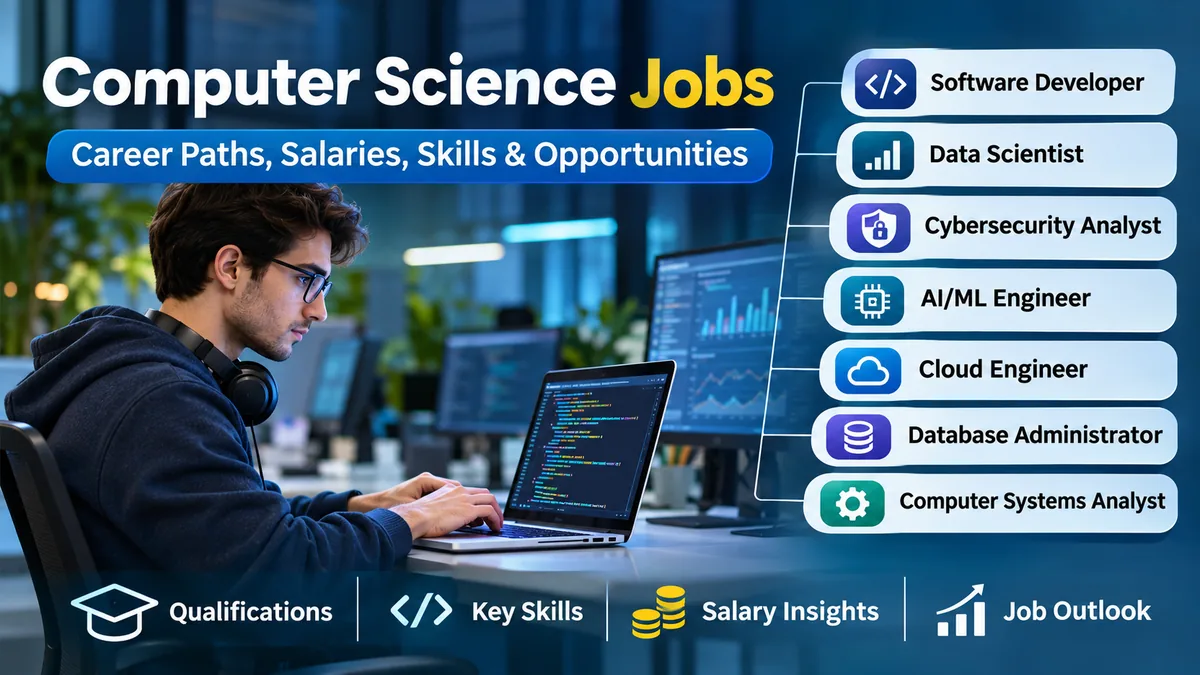

A computer science degree can lead to far more careers than software development. From protecting sensitive information against cyberattacks to building artificial intelligence systems, computer science professionals work across nearly every major industry.
But which careers offer strong salaries, long-term growth, and realistic entry opportunities?
Computer science jobs include software developer, data scientist, cybersecurity analyst, computer systems analyst, database administrator, cloud engineer, and artificial intelligence engineer. These professionals design applications, analyze data, protect networks, and maintain digital infrastructure. Career requirements vary: some positions accept demonstrable technical skills, while others require a bachelor’s degree, specialized certification, or advanced education.
Understanding the differences between these roles can help students, recent graduates, and career changers make informed decisions.
What Are Computer Science Jobs?
Computer science jobs are professional roles that involve computing systems, software, algorithms, data, networks, or digital technologies.
Computer science itself is the study of computation, including how information is represented, processed, stored, and transmitted. Its practical applications range from smartphone apps and business databases to robotics and machine learning.
A computer science professional might spend the day writing Python code, investigating a network vulnerability, optimizing database queries, or designing an algorithm that improves search results.
The field overlaps with information technology (IT), software engineering, mathematics, and electrical engineering, but these disciplines are not identical.
Computer science generally emphasizes computational principles and software systems, while IT often focuses on deploying, operating, and supporting technology within organizations.
Where Do Computer Science Professionals Work?
Technology companies are major employers, but opportunities extend into healthcare, finance, education, manufacturing, government, entertainment, and transportation.
For example, a hospital may employ software engineers to maintain patient-management systems, cybersecurity analysts to protect medical records, and data scientists to analyze healthcare outcomes.
Banks need database specialists, fraud-detection engineers, and security professionals. Manufacturing companies rely on embedded systems developers, robotics engineers, and industrial automation specialists.
This broad industry reach gives computer science graduates flexibility when choosing an employer or specialization.
Best computer science jobs and Career Options
The best career depends on technical interests, qualifications, location, salary expectations, and preferred working environment.
The following roles represent some of the most established and emerging computer science career paths.
1. Software Developer
Software developers design, build, test, and maintain applications and computer systems.
Their work includes creating mobile apps, enterprise software, web platforms, and backend services.
Common responsibilities include:
- Writing and reviewing application code
- Debugging software errors
- Designing software architecture
- Collaborating with product managers and designers
- Maintaining and improving existing systems
Popular programming languages include Python, Java, JavaScript, C#, and C++.
Software developers often use Git for version control, GitHub for collaboration, and frameworks such as React, Django, or Spring Boot.
A bachelor’s degree in computer science or a related field is a common qualification, although some employers consider candidates with substantial portfolios and practical experience.
2. Data Scientist
Data scientists use statistics, programming, and machine learning to identify patterns in complex datasets.
They help organizations answer questions such as why customers leave a service, how demand might change, or which transactions could indicate fraud.
Typical tools include Python, R, SQL, pandas, scikit-learn, and Jupyter Notebook.
Data scientists also need strong statistical reasoning, data visualization, and communication skills.
Although entry-level data roles may be accessible with a bachelor’s degree, some research-intensive positions prefer a master’s degree or PhD.
3. Cybersecurity Analyst
Cybersecurity analysts protect computer networks, systems, and information from unauthorized access and malicious activity.
Their responsibilities may involve monitoring security alerts, investigating incidents, identifying vulnerabilities, and implementing security controls.
Common areas of expertise include:
- Network security
- Identity and access management
- Threat detection
- Incident response
- Vulnerability assessment
- Security information and event management (SIEM)
Professionals may work with tools such as Wireshark, Splunk, and Microsoft Sentinel.
Certifications such as CompTIA Security+, Certified Information Systems Security Professional (CISSP), and vendor-specific cloud security credentials can support career development.
CISSP generally targets experienced professionals rather than beginners.
4. Artificial Intelligence and Machine Learning Engineer
Machine learning engineers develop systems that learn patterns from data and produce predictions or other outputs.
Applications include recommendation engines, speech recognition, image classification, natural language processing, and generative AI.
Their work commonly involves Python, PyTorch, TensorFlow, model evaluation, and data pipelines.
Some engineers build applications using existing models, while others train, fine-tune, or deploy specialized models.
A strong foundation in linear algebra, probability, statistics, algorithms, and software engineering is valuable.
Research-oriented AI positions may require graduate education, while applied engineering roles often prioritize production software skills.
5. Web Developer
Web developers create and maintain websites and browser-based applications.
Frontend developers focus on interfaces and user interactions, using HTML, CSS, JavaScript, and frameworks such as React or Vue.
Backend developers work with servers, databases, APIs, and application logic.
Full-stack developers work across both areas.
Web development can be an accessible entry point for self-taught programmers because candidates can demonstrate their abilities through functioning projects.
However, professional work still requires knowledge of accessibility, responsive design, security, testing, and performance optimization.
6. Database Administrator and Database Architect
Database administrators manage systems that store and organize information.
Their responsibilities include access control, backups, performance monitoring, database recovery, and availability.
Database architects focus more heavily on designing data structures and database systems.
Common technologies include PostgreSQL, MySQL, Microsoft SQL Server, Oracle Database, and MongoDB.
SQL proficiency is especially valuable, although responsibilities vary between relational and NoSQL environments.
These careers suit people who enjoy structured problem-solving, data integrity, and reliable infrastructure.
7. Computer Systems Analyst
Computer systems analysts examine an organization’s existing technology and recommend improvements.
They bridge business requirements and technical implementation.
For example, a systems analyst might evaluate whether a retailer should modernize its inventory-management platform or integrate a new payment system.
The role combines technical understanding, requirements analysis, documentation, project coordination, and communication.
Some positions favor candidates with business or industry-specific knowledge alongside computer science qualifications.
8. Cloud Engineer
Cloud engineers build and maintain computing infrastructure using cloud platforms.
Major platforms include Amazon Web Services (AWS), Microsoft Azure, and Google Cloud.
Cloud engineering responsibilities can involve virtual machines, networking, containers, storage, infrastructure automation, and identity management.
Technologies such as Docker, Kubernetes, Terraform, and Linux are common in cloud-focused environments.
Cloud engineers need to understand security, reliability, monitoring, and cost management.
Related roles include cloud architect, site reliability engineer (SRE), and DevOps engineer.
9. Network and Computer Systems Administrator
Network and systems administrators maintain the infrastructure organizations use to communicate and operate.
They configure servers, manage user accounts, troubleshoot connectivity, install updates, and monitor system performance.
Knowledge of TCP/IP, DNS, routing, firewalls, Windows Server, and Linux is useful.
These positions overlap with IT operations and can provide a foundation for cybersecurity, cloud infrastructure, and network engineering.
10. Computer and Information Research Scientist
Computer and information research scientists investigate new computing methods and technologies.
Their work can include algorithm design, computational theory, artificial intelligence, robotics, and advanced computer architectures.
They may work in universities, government laboratories, or corporate research divisions.
Many positions require at least a master’s degree, and some prefer doctoral qualifications.
This path is particularly suitable for people interested in mathematical reasoning, experimentation, and developing new computing techniques rather than primarily maintaining existing software.
computer science jobs Salary Comparison
Salary is an important consideration when comparing technology careers, but compensation varies considerably by experience, location, employer, and specialization.
The following figures are U.S. median annual wages from May 2025, reported by the U.S. Bureau of Labor Statistics (BLS). They represent workers across experience levels, not starting salaries.
| Computer Science Career | Median Annual Salary |
|---|---|
| Computer and information research scientist | $140,300 |
| Database architect | $139,500 |
| Software developer | $135,980 |
| Information security analyst | $129,180 |
| Data scientist | $120,230 |
| Computer systems analyst | $105,850 |
| Database administrator | $104,620 |
| Software QA analyst or tester | $104,300 |
Sources: U.S. Bureau of Labor Statistics, Occupational Outlook Handbook, 2026 updates. Bureau of Labor Statistics+4
Selected U.S. computer science salaries
$0$40K$80K$120K$160KResearch scientistDatabase architectSoftware developerSecurity analystData scientistSystems analystDatabase administra…
Median annual wages, May 2025. Source: U.S. Bureau of Labor Statistics.
Which Computer Science Job Pays the Most?
Among established computer science occupations, research scientists, database architects, and experienced software engineers offer strong earning potential.
Computer and information systems managers can earn even more. According to the BLS, their median annual wage was $175,140 in May 2025, although these roles typically require substantial professional experience and management responsibilities. Bureau of Labor Statistics+1
Specialized positions at major technology companies may also include bonuses and equity compensation.
However, salary alone does not determine whether a career is suitable. High-paying positions can require advanced qualifications, demanding responsibilities, or extensive experience.
How Much Do Entry-Level Computer Science Jobs Pay?
Entry-level salaries are generally below occupational medians.
A new graduate’s earnings depend on factors such as internship experience, technical specialization, geographic market, and employer size.
For example, a junior developer at a small local company may earn considerably less than a graduate joining a major technology company in a high-cost metropolitan area.
When comparing job offers, consider the complete compensation package, including health benefits, retirement contributions, training opportunities, bonuses, and working arrangements.
Entry-Level computer science jobs for Beginners
Finding a first technology position can be challenging, particularly when job advertisements request professional experience.
Fortunately, several career paths allow candidates to demonstrate practical abilities through coursework, internships, certifications, and personal projects.
Junior Software Developer
Junior developers work on application features, bug fixes, automated tests, and code maintenance under the guidance of experienced engineers.
A strong candidate should understand at least one programming language, basic data structures, Git, debugging, and software testing.
A portfolio containing two or three complete applications can provide evidence of practical ability.
Quality Assurance Tester
Software quality assurance professionals identify defects and verify that applications meet requirements.
Manual testing positions may provide an entry point for candidates with limited programming experience.
Automation testing requires additional skills, often involving Python, Java, JavaScript, Selenium, Playwright, or other testing frameworks.
The distinction matters because automated testing is itself a technical engineering discipline.
IT Support Specialist
IT support professionals troubleshoot hardware, software, accounts, and connectivity problems.
Although IT support is not always classified as a core computer science occupation, it can be a starting point for careers in systems administration, networking, and cybersecurity.
Candidates benefit from knowledge of operating systems, troubleshooting procedures, networking fundamentals, and customer communication.
Junior Data Analyst
Data analysts collect, clean, organize, and interpret information to support business decisions.
Common tools include Excel, SQL, Python, Power BI, and Tableau.
Unlike some data scientist positions, junior analyst roles may focus more on reporting, dashboards, and descriptive statistics than advanced machine learning.
A portfolio featuring SQL queries and clear data visualizations can demonstrate relevant skills.
Technical Support or Application Support Engineer
Application support engineers investigate problems affecting business software.
They may examine logs, reproduce errors, query databases, and coordinate fixes with development teams.
These positions can develop practical knowledge of production systems and provide pathways into software engineering, cloud operations, and site reliability engineering.
Quick takeaway: For beginners, junior development, QA testing, data analysis, IT support, and application support are worth exploring. However, no role guarantees easy entry, and hiring standards vary substantially.
Essential Skills Required for Computer Science Careers
Technical expertise is fundamental, but employers also value analytical thinking, collaboration, and the ability to learn unfamiliar systems.
Programming Languages
Different programming languages support different career paths.
| Language | Common Applications |
|---|---|
| Python | Data science, AI, automation, backend development |
| JavaScript | Interactive websites, frontend and backend applications |
| Java | Enterprise applications, backend systems |
| C++ | Systems programming, gaming, performance-sensitive software |
| C# | Enterprise software, .NET applications, game development |
| SQL | Database queries, reporting, data analysis |
| Go | Cloud services, networking tools, backend systems |
| Rust | Systems software, performance and memory-safe applications |
Beginners do not need to learn every language.
Learning one language thoroughly, then applying it to practical projects, is usually more productive than memorizing syntax across several languages.
Data Structures and Algorithms
Data structures organize information so programs can access and manipulate it efficiently.
Important examples include arrays, linked lists, stacks, queues, hash tables, trees, and graphs.
Algorithms describe procedures for solving computational problems.
Understanding searching, sorting, recursion, graph traversal, and computational complexity helps developers choose efficient solutions.
Big O notation is commonly used to describe how algorithmic resource requirements grow as input sizes increase.
These concepts are especially relevant to software engineering interviews and performance-sensitive applications.
Databases and Operating Systems
Computer science professionals frequently interact with databases, operating systems, and networks.
Useful foundational topics include relational database design, SQL queries, transactions, Linux commands, memory management, processes, and networking protocols.
Even developers who specialize in frontend applications benefit from understanding how browsers communicate with servers through HTTP and HTTPS.
Software Engineering Tools
Modern development depends on collaboration and automation.
Git helps teams track changes, while platforms such as GitHub and GitLab support code reviews and shared repositories.
Continuous integration and continuous delivery (CI/CD) systems automate software testing and deployment.
Docker helps package applications into containers, and Kubernetes coordinates containerized workloads at scale.
Not every beginner needs Kubernetes expertise, but understanding version control and automated testing is valuable across many development roles.
Communication and Problem-Solving
Technical ability alone is rarely sufficient for long-term career growth.
Developers explain design decisions, security analysts document incidents, and data scientists communicate findings to nontechnical colleagues.
Employers value professionals who can investigate unfamiliar problems, document solutions, ask precise questions, and work effectively with multidisciplinary teams.
Education and Qualifications for Computer Science Jobs
A bachelor’s degree in computer science remains a common qualification for many technical careers.
However, the most appropriate educational route depends on the position.
Computer Science Degree
A typical Bachelor of Science in Computer Science covers programming, algorithms, discrete mathematics, databases, computer architecture, operating systems, and software engineering.
Some programs also include artificial intelligence, cybersecurity, distributed systems, and human-computer interaction.
In the United States, bachelor’s degrees commonly take four years of full-time study, although duration varies by country and institution.
When evaluating programs, accreditation can be useful. In the United States, ABET accredits qualifying computing programs, but accreditation is not a universal requirement for employment.
Associate Degrees and Diplomas
Associate degrees and technical diplomas can prepare students for selected IT, support, development, and technical operations positions.
They may also provide a pathway into bachelor’s degree programs.
Students should verify transfer-credit arrangements before choosing a program if they intend to continue their education.
Coding Bootcamps
Coding bootcamps provide concentrated training in specific skills, often web development, software engineering, or data analytics.
They can be useful for career changers who already possess strong independent learning habits.
However, bootcamps vary significantly in curriculum quality, employer recognition, cost, and career support.
Completing a bootcamp does not automatically make a candidate competitive for every software engineering position.
Professional Certifications
Certifications can demonstrate knowledge of specific platforms or technical disciplines.
Examples include:
- CompTIA A+, Network+, and Security+
- AWS Certified Cloud Practitioner and AWS Solutions Architect
- Microsoft Azure certifications
- Google Cloud certifications
- Cisco Certified Network Associate (CCNA)
Certifications are especially relevant to infrastructure, networking, cloud, and security roles.
For software development, a strong portfolio and demonstrable coding ability may be more useful than collecting unrelated certificates.
Can You Get a Computer Science Job Without a Degree?
Yes, some employers hire candidates without computer science degrees, particularly for web development, software development, IT support, and certain operations roles.
However, degree requirements remain common, and applicants without formal qualifications may need stronger evidence of technical competence.
A credible portfolio, professional experience, open-source contributions, and relevant certifications can help.
Research-intensive positions and certain regulated or specialized environments may require advanced academic qualifications.
How to Get a Computer Science Job With No Experience
The most effective approach is to build evidence that you can perform the work associated with your target role.
A practical sequence looks like this:
- Choose one career direction. Focus on software development, cybersecurity, data analysis, cloud engineering, or another defined specialty.
- Learn foundational concepts. Develop proficiency in programming, problem-solving, and the core technologies used in that field.
- Build practical projects. Create applications or technical demonstrations that solve recognizable problems.
- Document your work. Use GitHub repositories, readable documentation, screenshots, and project explanations.
- Gain collaborative experience. Participate in internships, student projects, open-source communities, or supervised technical work.
- Prepare for interviews. Practice explaining technical decisions, debugging problems, and discussing project trade-offs.
- Apply to relevant positions. Target roles aligned with your actual skills rather than applying indiscriminately.
What Should a Computer Science Portfolio Include?
A portfolio should demonstrate problem-solving, not simply display a collection of tutorial exercises.
For a software developer, useful examples might include a task-management application with authentication, a REST API connected to a database, and a tested application deployed to a cloud platform.
A cybersecurity candidate could document an authorized home-lab security assessment, including the environment, identified risks, and recommended mitigations.
A data analyst might create a dashboard using a publicly available dataset, explain the data-cleaning process, and describe the conclusions.
Each project should explain the problem, technology choices, implementation, limitations, and potential improvements.
Are Internships Important?
Internships can help students gain exposure to production systems, teamwork, code reviews, deadlines, and professional workflows.
They also provide opportunities to develop references and understand workplace expectations.
However, internships are not the only route. Relevant employment, research assistantships, apprenticeships, and substantial independent projects can also demonstrate experience.
Job Outlook and Future Demand for Computer Science Professionals
Computer science offers opportunities across growing fields, but employment projections differ by occupation.
The U.S. Bureau of Labor Statistics projects approximately 10% employment growth for software developers, quality assurance analysts, and testers collectively from 2025 to 2035.
Computer and information research scientist employment is projected to grow approximately 22% during the same period. Bureau of Labor Statistics+1
These figures indicate growth in particular occupations, not a guarantee that every graduate will secure employment.
Artificial Intelligence and Automation
Artificial intelligence is changing how software is developed, tested, and maintained.
AI-assisted coding tools can generate code suggestions, explain unfamiliar functions, and support debugging.
However, developers still need to understand requirements, evaluate generated code, identify security problems, and verify correctness.
The increasing use of AI may change the mix of tasks within software engineering rather than eliminate the need for technical judgment.
Professionals who combine programming fundamentals with AI literacy may be better prepared to adapt.
Cybersecurity Demand
Organizations continue to face risks involving ransomware, credential theft, cloud misconfiguration, and data breaches.
Cybersecurity professionals help assess these risks, implement safeguards, and respond to incidents.
Security expertise is relevant across industries because organizations increasingly depend on connected systems and digital information.
Cloud Computing and Distributed Systems
Cloud infrastructure supports applications that must serve users across different locations and handle changing workloads.
Organizations need professionals who understand deployment, monitoring, resilience, security, and cost optimization.
Cloud engineering therefore combines traditional systems knowledge with automation and software development.
Roles Facing Different Employment Trends
Not every computing occupation is projected to expand.
BLS projections for 2025–2035 indicate declining employment for computer programmers as a separately classified occupation and network and computer systems administrators.
Meanwhile, software developer employment is projected to grow. Bureau of Labor Statistics+1
This distinction highlights the importance of examining actual job responsibilities rather than relying solely on broad technology-industry headlines.
Choosing the Right Computer Science Career
The right specialization should match both your interests and the type of work you enjoy doing.
| Your Main Interest | Career Paths to Explore |
|---|---|
| Building applications | Software developer, web developer |
| Mathematics and statistical analysis | Data scientist, machine learning engineer |
| Protecting digital systems | Cybersecurity analyst, security engineer |
| Servers and infrastructure | Cloud engineer, systems administrator |
| Organizing and securing data | Database administrator, database architect |
| Understanding business processes | Computer systems analyst |
| Exploring new computing methods | Computer and information research scientist |
| Testing and improving software | QA engineer, test automation engineer |
Which Computer Science Job Is Best for Beginners?
Web development, junior software development, QA testing, and data analysis can offer understandable starting points because candidates can create practical projects using accessible tools.
However, beginners should consider local employer requirements and the availability of entry-level positions.
A role that appears accessible in one region may be highly competitive elsewhere.
Which Jobs Require the Least Coding?
Computer systems analysts, IT support specialists, certain cybersecurity governance roles, and technical project coordinators may involve less daily programming than software engineering positions.
That does not mean these careers require little technical knowledge.
Systems analysts must understand how applications and business processes interact, while security professionals need knowledge of threats, controls, and infrastructure.
Which Jobs Are Best for People Who Enjoy Mathematics?
Data science, machine learning, computer graphics, cryptography, algorithm research, and computational science can involve substantial mathematical reasoning.
Relevant subjects include linear algebra, calculus, probability, statistics, discrete mathematics, and optimization.
The amount of mathematics required varies by employer and specialization.
Remote Computer Science Jobs and Global Opportunities
Many computing tasks can be performed using online collaboration platforms, remote development environments, and cloud infrastructure.
Software development, data analytics, cybersecurity, and cloud operations may offer remote or hybrid arrangements.
However, remote eligibility depends on employer policies, time-zone requirements, data security restrictions, and applicable employment laws.
Can Computer Science Professionals Work From Anywhere?
Not necessarily.
A company advertising a remote position may restrict applicants to a specific country or region because of payroll, taxation, employment regulations, or security requirements.
Some organizations require employees to attend meetings during particular working hours or occasionally visit an office.
Candidates should distinguish fully remote positions from hybrid roles and location-restricted remote employment.
Freelancing and Contract Work
Freelance opportunities exist in website development, application maintenance, database work, automation, and technical consulting.
Contractors may work on individual projects or longer-term assignments.
Freelancing requires more than technical skills. Professionals must estimate project scope, communicate requirements, manage deadlines, and handle contracts and payment arrangements.
Income can be inconsistent, particularly for beginners without established client relationships.
Challenges of Working in Computer Science
Computer science careers offer intellectual variety and earning potential, but they also present difficulties.
Continuous Learning
Programming languages, development frameworks, security threats, and cloud services change regularly.
Professionals must maintain foundational knowledge while learning new technologies when required.
The most sustainable approach is to understand concepts deeply rather than constantly switching tools to follow trends.
Competitive Entry-Level Hiring
Some junior positions attract large applicant pools.
Candidates with internships, relevant projects, and strong interview skills may have an advantage over applicants who possess only classroom knowledge.
A degree is valuable, but it is not a substitute for demonstrating practical competence.
Complex Problem-Solving
Software defects can be difficult to reproduce, security incidents can be time-sensitive, and infrastructure failures may affect large numbers of users.
Some positions involve on-call responsibilities or urgent troubleshooting.
Workload and stress vary significantly between organizations and teams.
Specialization Trade-Offs
Deep specialization can create valuable expertise but may narrow the range of suitable roles.
Broad technical knowledge provides flexibility, although employers may still expect substantial competence in a specific area.
Developing strong fundamentals before specializing helps balance these competing demands.
Final Thoughts on computer science jobs
Computer science jobs span software engineering, data science, cybersecurity, cloud computing, database management, and advanced research.
The strongest career choice is not necessarily the one with the highest advertised salary. It is the role that aligns with your technical interests, educational background, abilities, and long-term goals.
For students and beginners, the most useful next step is to select a specific career path, learn its core technologies, and build projects that demonstrate practical skills.
For experienced professionals, developing expertise in areas such as secure software systems, artificial intelligence, distributed computing, or data engineering can create opportunities for further specialization.
Computer science continues to offer diverse career possibilities, but lasting success depends on solid technical foundations, adaptability, and the ability to solve meaningful problems.
