
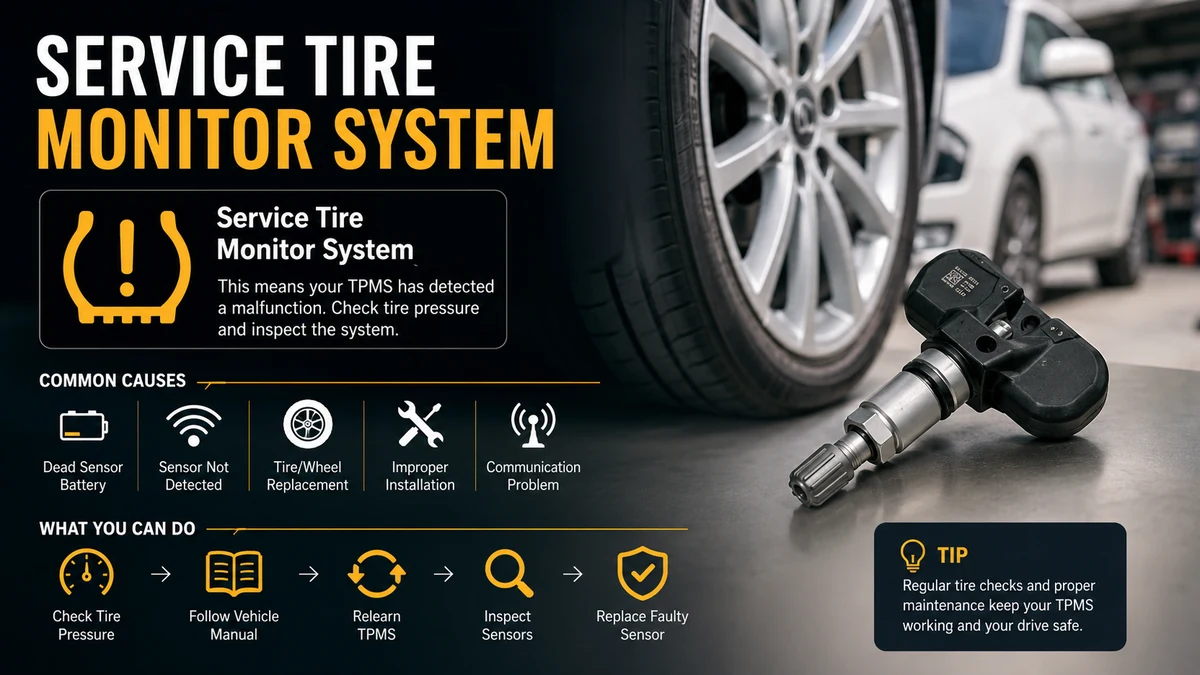

Seeing a service tire monitor system message appear on your dashboard can be confusing, especially when all four tires look perfectly normal. The warning usually does not mean that a tire itself has suddenly failed. Instead, it often indicates that your vehicle’s Tire Pressure Monitoring System, or TPMS, cannot correctly monitor one or more tires.
That distinction matters because a regular low-pressure warning and a TPMS malfunction warning require different responses.
The service tire monitor system message generally means the Tire Pressure Monitoring System has detected a malfunction, such as a failed pressure sensor, dead sensor battery, communication problem, or sensor that needs relearning. Check the actual tire pressures first, then diagnose the monitoring system if the warning remains. General Motors specifically describes the message as an indication that part of the TPMS is not working properly.
What Does service tire monitor system Mean?
A Tire Pressure Monitoring System is an electronic safety system that monitors tire inflation and alerts the driver when pressure becomes significantly low. Depending on the vehicle, the system may display individual pressure readings or simply illuminate a warning symbol shaped like a tire with an exclamation mark.
The service tire monitor system warning is different from a normal low-tire-pressure message.
A steady TPMS warning light generally indicates that at least one tire may be significantly underinflated. A TPMS warning lamp that flashes for roughly 60 to 90 seconds and then stays illuminated indicates a system malfunction on vehicles designed to meet current federal requirements.
GM’s own customer information gives a similar explanation: when the system is not working correctly, the yellow TPMS light may blink for about one minute and then remain illuminated, sometimes accompanied by the Service Tire Monitor System message.
Low Tire Pressure vs. TPMS System Failure
These two warnings are easy to confuse.
| Dashboard behavior | Likely meaning | First action |
|---|---|---|
| TPMS light stays steadily illuminated | One or more tires may be underinflated | Check all tire pressures |
| Light flashes, then stays on | TPMS malfunction | Check pressure, then diagnose TPMS |
| Individual tire displays no PSI reading | Sensor may not be communicating | Inspect or scan that sensor |
| Warning appears after tire/wheel work | Sensors may need relearning | Perform vehicle-specific relearn |
| Warning appears in cold weather | Pressure may have dropped temporarily | Check cold tire pressure |
NHTSA explains that a TPMS malfunction can be indicated by flashing followed by continuous illumination, while a standard illuminated TPMS symbol indicates significant underinflation.
Quick Takeaway: If you see Service Tire Monitor System rather than simply Low Tire Pressure, think of it primarily as a monitoring-system problem—but manually verify tire pressure before assuming the tires themselves are fine.
How the Tire Pressure Monitoring System Works
Understanding the warning becomes easier when you know what TPMS is actually monitoring.
There are two main designs: direct TPMS and indirect TPMS. NHTSA recognizes systems that monitor pressure using tire-mounted sensors as well as systems that infer pressure using wheel-speed and other vehicle sensors.
Direct TPMS
Direct TPMS uses individual electronic sensors, usually installed inside each wheel near the valve stem.
A typical sensor can measure tire pressure and transmit information wirelessly to a control module. Some systems can also monitor temperature. Each sensor normally has its own identification code so the vehicle can distinguish one wheel from another.
A direct TPMS typically involves:
- Tire pressure sensors
- Internal sensor batteries
- Valve stems or sensor mounting hardware
- Radio-frequency communication
- A TPMS receiver or control module
- Vehicle computer software
- Dashboard warning indicators
Because the sensors communicate wirelessly, a malfunction does not necessarily mean tire pressure itself is wrong. The computer may simply have stopped receiving valid information from one wheel.
Indirect TPMS
Indirect TPMS usually does not measure air pressure directly.
Instead, it uses wheel-speed information from systems such as the Anti-lock Braking System (ABS). An underinflated tire changes effective rolling characteristics, allowing the vehicle computer to identify unusual wheel-speed differences.
Indirect systems therefore have different failure and calibration considerations. Tire replacement, tire rotation, uneven wear, or incorrect initialization can affect their operation.
Common Causes of a service tire monitor system Warning
Several problems can trigger the warning, but failed or unrecognized sensors are among the most common explanations.
1. Dead TPMS Sensor Battery
Direct TPMS sensors contain small batteries that power their electronics and radio transmitters.
Unlike a normal replaceable household battery, the sensor battery is commonly sealed inside the sensor. Once it reaches the end of its usable life, the complete sensor usually has to be replaced.
Bridgestone notes that batteries in direct TPMS sensors commonly last around a decade, while automotive service sources often describe a practical lifespan of roughly 5–10 years depending on the sensor and operating conditions.
Sensor age becomes an especially strong suspect when an older vehicle suddenly loses a pressure reading from one wheel.
2. Damaged Tire Pressure Sensor
A sensor can also fail physically.
Because direct sensors are mounted inside or near the tire and valve stem, they can potentially be damaged during tire mounting or removal. Corrosion, road impacts, damaged valve hardware, and other physical problems can also interfere with sensor operation.
A warning that begins immediately after new tires were fitted deserves particular attention.
3. Sensor Was Not Relearned After Tire Service
Many vehicles need to know which sensor belongs to each wheel position.
After a tire rotation, wheel swap, sensor replacement, or seasonal wheel change, the vehicle may need a TPMS relearn or synchronization procedure.
The exact procedure varies considerably between manufacturers and models. Some vehicles learn sensor positions automatically while driving; others require a specific sequence, diagnostic scanner, or TPMS activation tool.
For that reason, generic internet reset instructions should never automatically be assumed to apply to your vehicle.
4. Replacement Sensor Is Not Programmed Correctly
Replacement TPMS sensors must be compatible with the vehicle’s monitoring system.
Direct systems use sensor identification information and manufacturer-specific technology. Bridgestone notes that direct TPMS sensors have unique serial numbers and that manufacturers may use proprietary systems.
Installing a sensor physically inside the wheel is therefore only part of the job. Some replacement sensors must first be programmed and then registered or relearned by the vehicle.
5. Tire or Wheel Replacement
Switching wheels can create a Service Tire Monitor System warning when the new wheel does not contain a compatible sensor or when the vehicle has not learned its sensor ID.
This issue often appears after:
- Installing aftermarket wheels
- Changing winter and summer wheel sets
- Replacing a damaged wheel
- Rotating tires
- Installing a full-size spare
- Replacing one TPMS sensor
Some spare tires contain monitoring sensors, while others do not. Direct TPMS configurations differ by manufacturer.
6. Radio-Frequency Communication Problem
Direct TPMS sensors communicate wirelessly with the vehicle.
Interference, a failed transmitter, damaged receiver hardware, or another electronic communication problem can prevent the control module from recognizing a sensor. Chevrolet service information also identifies radio-frequency communication issues among possible causes of a Service Tire Monitor System message.
These faults are harder to confirm without TPMS diagnostic equipment.
7. Cold Weather and Actual Pressure Changes
Cold weather itself does not necessarily mean the TPMS is broken.
Air pressure can fall as ambient temperature drops, which may cause a marginally inflated tire to cross the warning threshold overnight. NHTSA notes that a TPMS warning can appear on cold mornings and disappear after the tires warm during driving.
That normally produces a low-pressure warning, however, rather than proving the monitoring system itself has failed.
If you see Service Tire Monitor System, verify tire pressure first and then investigate the TPMS fault if pressures are correct.
How to Diagnose a service tire monitor system Warning
Troubleshooting should begin with the tires themselves before moving into electronic diagnosis.
Step 1: Inspect All Tires
Walk around the vehicle and look for:
- A visibly low or flat tire
- Sidewall damage
- Cuts or punctures
- Bulges
- Damaged valve stems
- Objects embedded in the tread
Do not rely only on appearance. NHTSA warns that underinflation can be difficult to detect visually.
Step 2: Check Tire Pressure Manually
Use an accurate tire-pressure gauge when the tires are cold.
Compare each measurement with the manufacturer’s recommended pressure listed on the Tire and Loading Information label, commonly located in the driver’s door opening, rather than using the maximum PSI molded into the tire sidewall.
GM specifically instructs drivers to use the recommended pressure shown on the Tire & Loading Information label when responding to a low-pressure warning.
Correct any underinflated or overinflated tire before diagnosing further.
Step 3: Look at the Dashboard Pressure Readings
Vehicles that show individual pressures can provide an important clue.
For example:
| Display result | What it may suggest |
| All four pressures visible | Sensors are currently communicating |
| One tire shows “–” | That sensor may not be transmitting |
| Several readings missing | Relearn, receiver, or communication issue possible |
| Position is incorrect | Sensor locations may need relearning |
| Reading differs greatly from gauge | Sensor or calibration should be checked |
These observations do not constitute a complete diagnosis, but they can narrow the search.
Step 4: Consider Recent Work
Ask what changed immediately before the warning began.
Did you recently:
- Replace tires?
- Rotate the tires?
- Install different wheels?
- Repair a puncture?
- Replace a valve stem?
- Install a new TPMS sensor?
- Start using a spare wheel?
A warning that appears immediately after wheel or tire service often points toward a damaged, missing, incompatible, or unrelearned sensor.
Step 5: Scan the TPMS Sensors
A professional TPMS tool can communicate with individual wheel sensors and determine whether each one is transmitting.
Depending on the equipment and vehicle, a technician may be able to identify:
- Sensor ID
- Sensor communication status
- Tire pressure
- Sensor battery condition
- Sensor frequency
- Stored TPMS diagnostic trouble codes
This is much more reliable than replacing sensors by guesswork.
How to Fix service tire monitor system Problems
The correct fix depends on what caused the warning.
Correct the Tire Pressure First
If one or more tires are simply low, inflate them to the cold-pressure specification on the vehicle placard.
GM states that a standard low-pressure warning should clear after proper inflation and driving when the TPMS itself is functioning normally.
If the Service Tire Monitor System message remains, however, the system may still have an electronic fault.
Perform the Correct TPMS Relearn
A relearn tells the vehicle which sensor is installed at each wheel position.
Depending on the model, this may involve:
- Entering a TPMS learning mode.
- Activating each sensor in a specified order.
- Waiting for an audible or visual confirmation.
- Completing all wheel positions.
- Restarting or driving the vehicle.
Do not assume that one manufacturer’s reset sequence works for another. Even two vehicles from the same brand can have different procedures.
Your owner’s manual should be the primary reference.
Replace a Failed Sensor
If a diagnostic scan confirms that one sensor is dead, physically damaged, or no longer transmitting, replacement may be necessary.
After installation, the new sensor may require programming and relearning before the dashboard recognizes it.
When an older vehicle still has all of its original sensors, technicians may also discuss the age of the remaining units. That does not automatically mean all four must be replaced, but sensors of similar age may reach the end of their battery lives around the same period.
Repair Valve-Stem or Hardware Damage
Some TPMS faults involve serviceable components rather than the electronic sensor itself.
Depending on the design, technicians may replace items such as valve cores, seals, retaining nuts, or valve stems. Corrosion and improper installation can cause leaks or damage around the sensor assembly.
Diagnose the Receiver or Vehicle Electronics
If multiple known-good sensors fail to communicate, the problem may extend beyond the wheels.
Possible areas for further diagnosis include:
- TPMS receiver
- Control module
- Wiring
- Antenna or radio-frequency communication
- Stored diagnostic trouble codes
- Vehicle software configuration
These faults generally require vehicle-specific diagnostic equipment.
Quick Takeaway: Inflation fixes low pressure. Relearning fixes lost sensor registration. Programming prepares some replacement sensors. Physical sensor failure usually requires replacement. These procedures solve different problems and should not be treated as interchangeable “TPMS resets.”
Can You Reset the service tire monitor system Yourself?
Sometimes, but only when the underlying problem can actually be corrected by a relearn or recalibration.
A reset cannot revive a dead sensor battery.
It cannot repair a cracked sensor.
It cannot make an incompatible sensor compatible.
And clearing a warning without fixing its cause does not restore the system’s ability to monitor tire pressure.
Some online guides recommend driving at a particular speed, disconnecting the vehicle battery, or holding a universal TPMS reset button. Those procedures are not universal. Manufacturer-specific instructions should take priority because TPMS architecture varies by model.
If your vehicle has a documented relearn procedure in its owner’s manual, following that procedure after confirming correct tire pressure is reasonable. If the warning immediately returns, further diagnosis is usually necessary.
Why Is the TPMS Light On When the Tires Are Fine?
This is one of the most common questions surrounding the warning.
Your tire pressures can be completely correct while the TPMS warning remains active because the system monitors more than just the physical amount of air in each tire. It must also receive and interpret sensor data successfully.
Possible explanations include:
- Dead sensor battery
- Damaged sensor
- Unprogrammed replacement sensor
- Missing sensor
- Incorrect sensor ID
- Failed relearn
- Radio-frequency communication issue
- TPMS control-system fault
NHTSA distinguishes this type of malfunction from ordinary underinflation by the flashing-then-steady warning sequence used on compliant systems.
Can You Drive With a service tire monitor system Warning?
The warning does not automatically mean that a tire is about to fail, but you should not assume the tires are safe simply because the vehicle drives normally.
First, manually check all tire pressures and visually inspect the tires.
If the pressures are correct and there is no visible tire damage, the immediate issue may be limited to the monitoring system. The important limitation is that you may no longer receive a reliable warning if a tire subsequently begins losing pressure.
NHTSA emphasizes that TPMS is not a substitute for manual tire inspection and recommends regular checks with an accurate pressure gauge.
Stop driving and inspect the tire promptly if you notice:
- Rapid pressure loss
- Vehicle pulling
- Strong vibration
- Unusual tire noise
- Visible sidewall damage
- A nearly flat tire
- Handling that suddenly feels unstable
A TPMS electronics issue and an unsafe tire can exist at the same time.
Why TPMS Matters for Tire Safety
TPMS became widely standardized in the United States as a response to concerns about tire underinflation and vehicle safety.
NHTSA states that passenger cars, light trucks, and vans from model year 2008 onward are required to be equipped with TPMS, with some 2006 and 2007 vehicles also having the technology.
Bridgestone connects widespread TPMS adoption to the Transportation Recall Enhancement, Accountability, and Documentation Act, commonly called the TREAD Act.
The underlying federal requirement is associated with Federal Motor Vehicle Safety Standard No. 138, which addresses tire pressure monitoring systems. GM’s TPMS customer documentation also identifies FMVSS 138 and the National Highway Traffic Safety Administration in explaining the system’s regulatory background.
TPMS matters because correct tire inflation influences:
- Vehicle handling
- Tire wear
- Rolling resistance
- Fuel efficiency
- Heat buildup
- Tire durability
But the system is an aid, not a replacement for routine maintenance.
How to Prevent Future Tire Monitor Problems
Not every sensor failure can be prevented because sensor batteries eventually age, but good service practices can reduce avoidable TPMS problems.
Check tire pressure about once a month with a reliable gauge rather than waiting for the dashboard light. NHTSA recommends regular manual tire-pressure inspection because significant underinflation may not be visually obvious.
When having tires serviced, tell the technician that the wheels contain TPMS sensors. This helps reduce accidental damage during mounting and dismounting.
After tire rotation or wheel replacement, verify that individual dashboard readings correspond with the correct wheel positions.
When replacing sensors, use parts compatible with the vehicle’s TPMS frequency, protocol, and programming requirements.
Finally, keep the recommended cold tire pressure—not an arbitrary PSI—as your reference. Vehicle engineers determine the correct pressure for the specific vehicle and tire configuration.
What to Do When service tire monitor system Appears
The service tire monitor system message is best treated as a warning that your vehicle may no longer be able to monitor tire pressure reliably.
Start with the basics: inspect every tire and measure the pressure manually. If the pressures match the vehicle manufacturer’s specifications but the warning remains, check for a failed TPMS sensor, aging sensor battery, lost sensor registration, recent wheel or tire changes, or a communication problem.
A proper diagnosis is more useful than repeatedly clearing the warning. When the TPMS is restored to normal operation, it can once again perform the job it was designed to do: alert you when tire pressure falls to an unsafe level.
