
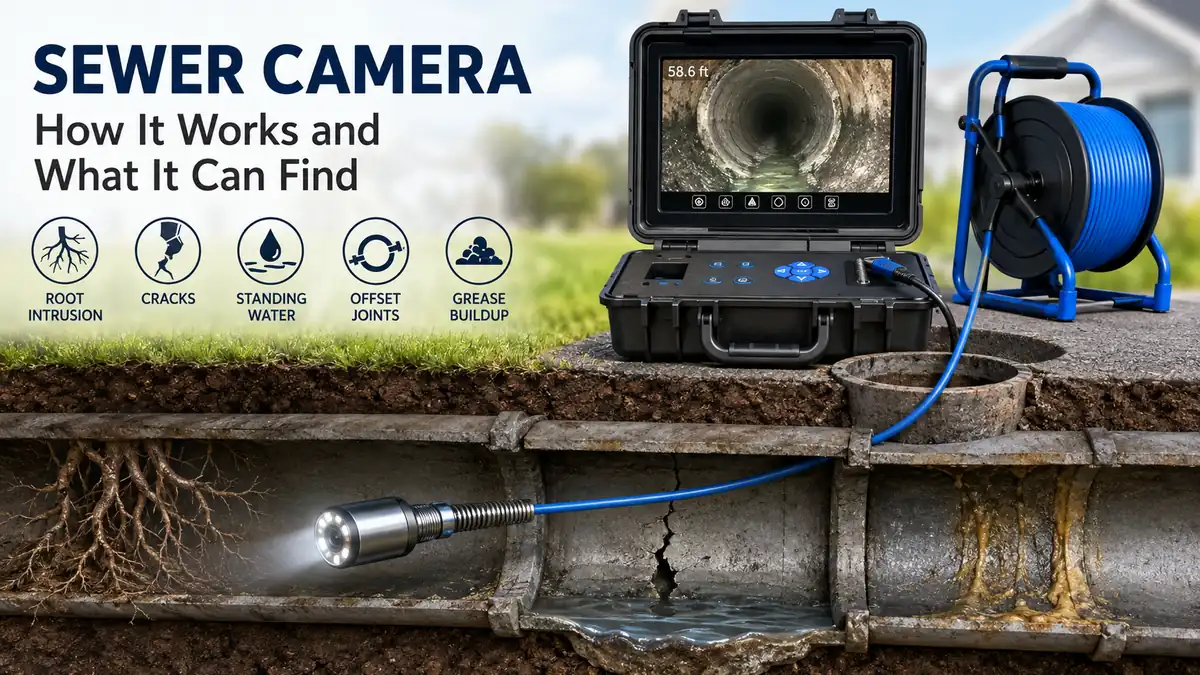

A sewer problem can stay hidden underground until slow drains become recurring clogs or sewage starts backing up. Digging just to discover what is wrong makes little sense when the inside of the pipe can be inspected first.
A sewer camera is a waterproof video camera attached to a flexible or semi-rigid cable that travels through a drain or sewer line. It sends live footage to a monitor, allowing an operator to identify visible blockages, roots, cracks, corrosion, displaced joints, standing water, pipe materials, and structural damage without exploratory excavation.
What Is a Sewer Camera?
A sewer camera is specialized closed-circuit television, or CCTV, equipment designed to inspect the interior of drainage and wastewater pipes.
Residential systems typically use a compact camera head attached to a push rod stored on a reel. The rod carries the camera through the pipe while transmitting its image to a monitor. Professional systems may also record video, display the distance traveled, keep the image upright with a self-leveling head, and incorporate a transmitter known as a sonde.
Larger municipal sewer mains may require self-propelled crawler cameras rather than manually pushed equipment. CCTV is widely used for assessing the structural, maintenance, and physical condition of sewer infrastructure. NASSCO identifies detailed internal television inspection as an important pipeline-condition assessment method.
A sewer camera may also be described as a:
- sewer inspection camera
- sewer scope
- drain camera
- pipe inspection camera
- sewer line camera
- CCTV pipe inspection system
- plumbing inspection camera
Although the terminology varies, the basic purpose is the same: visually examine sections of pipe that cannot otherwise be seen without opening walls, floors, or ground.
How Does a Sewer Camera Work?
The basic process is straightforward, but obtaining useful diagnostic footage requires more than simply pushing a camera into a drain.
1. An Access Point Is Located
The operator first needs an opening into the sewer lateral. An exterior or interior cleanout is generally the most convenient access point.
Depending on the plumbing system, access may sometimes be obtained through another suitable opening. Industry inspection standards recognize access through cleanouts and, in some circumstances, other plumbing openings.
The main goal is to enter the line without damaging the plumbing while giving the camera enough room to move toward the municipal sewer connection or septic system.
2. The Camera Head Enters the Pipe
A waterproof camera head is inserted into the line. LEDs around or near the lens illuminate the otherwise completely dark pipe.
The camera is connected to a push cable that must strike a practical balance: it needs enough stiffness to travel long distances yet enough flexibility to negotiate fittings and bends.
This is why a camera advertised with 100 or 200 feet of cable may not actually reach that distance inside every plumbing system. Multiple bends, offsets, obstructions, small pipe diameters, and changes in direction can shorten its usable reach.
3. Live Video Appears on the Monitor
As the camera advances, video is transmitted to an above-ground monitor.
The operator watches the pipe walls, joints and flow conditions carefully rather than simply pushing the camera as far as possible. Professional inspection practices emphasize sufficient image quality, lighting, pipe visibility and controlled camera movement so defects can be properly evaluated.
Modern equipment may record the complete inspection so the footage can be reviewed later.
4. Distance Is Tracked
Many professional systems display a footage counter showing how much cable has entered the line.
This measurement is useful for documenting where a defect appeared, but it should not be confused with the exact surface location.
If the monitor says a break is 42 feet from the cleanout, that means approximately 42 feet along the pipe. A sewer lateral may curve underneath the property, so the camera may not be 42 straight-line feet away from the access point.
5. A Sonde Can Locate the Camera Underground
Professional sewer camera heads often contain a small radio transmitter called a sonde.
When the operator stops the camera next to a defect, a compatible surface receiver can detect the transmitter. This helps identify the camera’s approximate position and depth underground.
The distinction matters:
The camera identifies what is wrong. The locator helps determine where it is.
A footage counter by itself does not provide the same surface location information.
What Can a Sewer Camera Find?
A good sewer camera inspection can reveal surprisingly detailed information about the accessible interior of a pipe.
Tree Root Intrusion
Roots are especially important in sewer systems containing joints, cracks or deteriorated connections.
Small roots may enter through an opening and continue growing inside the pipe. Over time they can catch toilet paper and other solids, restrict flow, and contribute to repeated backups.
Camera footage can show the location and visible extent of root intrusion.
Finding roots does not automatically mean the entire sewer line must be replaced. The condition of the surrounding pipe and the reason the roots entered are more important than the simple presence of roots.
Cracks, Fractures and Broken Pipe
Open cracks, fractures, holes and visibly broken sections may appear clearly on camera when the surface is clean and visible.
The significance varies considerably.
A small visible defect and a severely fractured pipe are not equivalent, so inspection footage should be interpreted in context rather than treating every imperfection as a catastrophic failure.
Offset or Separated Joints
Individual sewer pipe sections should connect smoothly.
Ground movement, settlement, installation defects or deterioration can leave adjoining sections misaligned. A camera may show an offset joint, separation, gap or abrupt change in the interior profile.
Severe displacement can catch waste, restrict camera travel and interfere with normal gravity flow.
Pipe Bellies and Standing Water
A sewer lateral normally depends on gravity to move wastewater toward its destination.
When part of the line settles lower than surrounding sections, water can remain in the depression. This condition is commonly called a belly or sag.
On camera, the lens may enter standing water and eventually rise above it again farther downstream. Persistent pooled water can also obstruct the view, so the footage needs careful interpretation.
Standing water suggests a low area or flow restriction, but video alone does not provide a complete engineering survey of pipe grade.
Grease, Scale and Other Buildup
The camera may reveal material attached to the interior wall, including grease, mineral deposits and heavy scaling.
Cast-iron drain lines in particular can develop internal corrosion and rough scaling that reduce the effective diameter of the pipe and create surfaces where solids collect.
Foreign Objects and Obstructions
Inspection footage can identify many objects or materials interfering with the line, including accumulated debris and items that should not have entered the drainage system.
However, a completely blocked pipe presents an obvious limitation: the camera may only show the obstruction it reaches rather than whatever lies beyond it.
Collapsed Pipe
A severe structural failure may leave part of the pipe crushed or completely inaccessible.
The camera can document the collapse from the accessible side, but it cannot travel through a closed passage. The uninspected portion beyond the failure should therefore not be assumed to be in good condition.
Changes in Pipe Material
A sewer lateral does not always consist of a single material from beginning to end.
Camera footage may reveal transitions between materials such as:
| Pipe material | What may be visible during inspection |
|---|---|
| PVC | Smooth walls, fittings, joints or displacement |
| Cast iron | Rust, corrosion, scaling and deterioration |
| Clay | Individual joints, offsets, cracking and root entry |
| Concrete | Cracking, joint conditions and deposits |
| Orangeburg | Deformation, deterioration or loss of shape |
Identifying material can provide useful context when evaluating defects, although visual identification should not be treated as an exact determination of age or remaining service life.
When Is a Sewer Camera Inspection Useful?
A camera is most valuable when there is a question that visual evidence inside the pipe can answer.
Recurring Sewer Backups
One isolated clog may simply be an isolated clog.
Repeated backups after cleaning deserve closer investigation. Roots, displaced joints, structural damage, persistent buildup or a sagging section may cause the problem to return.
Camera inspection after the line is sufficiently clear can show whether a deeper defect remains. Roto-Rooter, for example, identifies repeated backups, slow drains and recurring clogs as circumstances in which video inspection may be appropriate.
Several Drains Are Slow at the Same Time
A slow bathroom sink alone often points toward a localized drain problem.
When toilets, tubs and other fixtures throughout a building begin draining slowly together, the problem may be farther downstream in the main building drain or sewer lateral.
A sewer scope can help separate a localized plumbing issue from a larger main-line obstruction.
A Sewer Line Keeps Clogging After Cleaning
Drain cleaning restores flow but does not necessarily explain why the obstruction formed.
If the same location repeatedly blocks, inspection can look for roots, offsets, deterioration, a belly or another condition that encourages material to collect.
A useful sequence is often clear the obstruction, then inspect the pipe. Sending a camera into a completely blocked line may produce little more than footage of the blockage itself.
Before Buying a Property
The buried sewer lateral generally cannot be evaluated during an ordinary visual home inspection.
A sewer scope provides direct evidence of accessible underground pipe conditions and may reveal problems that have not yet produced obvious symptoms inside the property. Sewer-scope standards specifically address visual assessment of underground lateral sewer lines as an ancillary property inspection.
Age alone does not prove a sewer is defective, and a newer property is not automatically problem-free. Pipe material, installation, soil movement, roots and previous repairs all matter.
Before Major Sewer Work
If an expensive repair is being considered, inspection footage can help document the defect and its location.
That evidence is especially useful when deciding whether the issue involves an obstruction that can be removed, a localized damaged section, or broader structural deterioration.
A diagnosis should still consider the camera’s limitations rather than treating a single frame of video as proof that a particular repair method is required.
After Cleaning or Repair
A follow-up inspection can verify visible results after hydro jetting, mechanical cleaning or sewer rehabilitation.
Roto-Rooter notes that follow-up camera inspection can be used after work to check that a pipeline has been properly cleaned or repaired.
What a Sewer Camera Cannot Detect Reliably
This is one of the most important parts of understanding sewer camera inspection.
The footage is valuable, but it is not an X-ray of the entire underground plumbing system.
It Cannot See Outside the Pipe
The lens sees the interior surface.
It cannot show surrounding soil conditions, voids beside the line or roots approaching the pipe before they penetrate it. It also cannot directly inspect the external surface of a buried pipe.
It Cannot Measure Remaining Pipe-Wall Thickness
This limitation matters with deteriorating metal pipe.
A cast-iron line may show obvious corrosion and scaling, but ordinary camera footage does not measure how much structurally sound material remains behind the visible surface.
A Camera Alone Does Not Prove That a Pipe Is Leaking
A visible crack or opening may indicate a possible leakage path, but conventional footage does not necessarily demonstrate how much wastewater is escaping or groundwater entering.
This limitation also exists in large-scale wastewater assessment. CCTV provides valuable structural information, yet other technologies may be needed when the specific objective is detecting active infiltration or leakage rather than visible defects.
It Cannot See Through Sewage or Heavy Debris
Water, grease, roots and solid obstructions can obscure the pipe wall.
NASSCO guidance for formal CCTV assessment emphasizes the importance of adequate visibility and sufficiently clean pipes so defects and observations can be seen.
If visibility is poor, cleaning may be necessary before a meaningful condition assessment can be completed.
It Cannot Inspect Beyond an Impassable Obstruction
A camera does not bore through roots, crush debris or force itself through a collapsed pipe.
If the head stops 35 feet into a 70-foot lateral, the remaining 35 feet have not been visually inspected.
That distinction should appear clearly in any useful inspection report.
It Does Not Determine Exact Grade by Itself
Standing water can suggest a sag or low point, but a camera is not a surveying instrument.
When exact elevation, slope or pipe alignment is required for engineering or replacement work, other measurements may be necessary.
Sewer Camera vs. Drain Snake: What Is the Difference?
These tools perform completely different jobs.
A drain snake or auger is primarily a cleaning tool. Its cable physically works through an obstruction to restore flow.
A sewer camera is primarily an inspection tool. It allows the operator to see the pipe’s interior but normally does not remove the obstruction.
Using one does not replace the other.
For a heavily clogged sewer, attempting to scope first may produce poor visibility. Clearing the line and then inspecting it often provides far more useful information because the camera can evaluate the underlying pipe rather than only the material blocking it.
Sewer Camera vs. CCTV Crawler Inspection
Residential sewer cameras are usually push-camera systems.
An operator manually advances the push rod through a building drain or lateral while watching the monitor.
Larger sewer mains may instead use motorized CCTV crawler equipment. The crawler carries the camera through larger-diameter pipelines and can be configured for appropriate lighting, camera position and controlled movement.
NASSCO’s Pipeline Assessment Certification Program, commonly called PACP, provides standardized approaches for recording and coding conditions found during CCTV pipeline assessments. Its associated programs include LACP for laterals and MACP for manholes.
For an ordinary homeowner, knowing every condition code is unnecessary. The important point is that professional municipal pipeline assessment can be considerably more structured than simply watching a video feed.
How to Read Sewer Camera Footage
A dramatic-looking image is not automatically a dramatic problem.
Wide-angle lenses, water, poor lighting and debris can make defects appear larger or less clear than they are. Interpretation should focus on context.
Pay attention to where the defect occurs, whether wastewater can pass normally, whether the camera moves through the area, what the surrounding pipe looks like, and whether the same condition extends through a long section or appears at one isolated point.
Roots Do Not Automatically Mean Total Failure
Roots prove there is access into the pipe.
The more useful questions are how much of the opening they occupy, where they entered, whether the underlying joint or pipe is damaged, and how rapidly the problem returns after cleaning.
Standing Water Deserves Context
A brief splash of water does not automatically prove there is a major sewer belly.
Persistent water covering a meaningful length of pipe is more significant. The inspection should document where the camera enters the water and where it leaves it.
Cracks Vary in Importance
A small defect, open fracture, displaced joint and collapsed section represent very different conditions.
Good documentation should show more than one frozen image. Continuous footage helps reveal the condition immediately before and after the suspected defect.
What Should a Good Sewer Camera Inspection Include?
Useful inspection work produces evidence that another knowledgeable person can understand later.
The camera lens should provide a reasonably clear view, the distance counter should be reset appropriately, and significant defects should be recorded rather than merely described from memory. Professional inspection guidance also emphasizes careful equipment setup, recording the inspection and pausing long enough at defects to document them.
A strong inspection record typically identifies the access point, approximate inspected distance, visible pipe material, noteworthy defects, locations along the run and any portion that could not be inspected.
If a significant underground defect needs physical repair, using a sonde and compatible locator to mark its approximate surface position and depth can be much more useful than relying only on cable footage.
Can You Use a Sewer Camera Yourself?
Consumer pipe cameras exist, but operating one and correctly interpreting the footage are separate challenges.
A homeowner may be able to view an accessible drain, yet long sewer laterals create several practical difficulties: navigating bends, keeping the lens clean, recognizing pipe materials, distinguishing normal joints from defects, understanding standing water and locating a buried camera from the surface.
There is another risk worth avoiding: forcing the camera.
Professional inspection guidance specifically cautions against forcing camera equipment through an obstruction.
A stuck camera can turn an inspection into a much larger plumbing problem.
Sewer openings also expose people to contaminated wastewater and potentially hazardous sewer gases. Appropriate protective practices matter whenever a drainage system is opened.
Why Camera Quality Is Only Half the Story
A sharper camera does not automatically produce a better diagnosis.
Lighting, lens cleanliness, push-rod characteristics, pipe flow, camera positioning and operator experience all affect what appears on screen.
For formal CCTV work, NASSCO emphasizes factors such as pipe diameter, pipe material and flow conditions when configuring equipment for useful inspection footage.
Interpretation is equally important.
Two people may look at the same footage and agree that roots are present while disagreeing about how severe the underlying defect is. That is why recorded video, clearly identified defect locations and understandable observations are more useful than a verbal claim that a sewer is simply “bad.”
Common Sewer Camera Inspection Mistakes
One of the biggest mistakes is treating camera footage as proof of something the camera cannot actually measure.
A dark line on the screen does not automatically establish an active leak. Standing water does not by itself reveal the exact pipe slope. Cable footage does not equal surface distance. And a camera that stopped at an obstruction did not inspect the line beyond that point.
Another mistake is inspecting a heavily obstructed line and drawing conclusions about pipe condition from poor footage. If grease, sewage or roots hide most of the wall, cleaning may be necessary before the structural condition can be judged accurately.
Finally, avoid evaluating a major repair from a single screenshot. Continuous video provides far better context.
Quick Takeaway: A sewer camera is strongest when used to document visible conditions inside an accessible pipe. Its findings become substantially more useful when clear video, footage measurements and surface locating are combined with knowledgeable interpretation.
How Sewer Camera Results Guide the Next Step
The value of an inspection is not the camera itself. It is the information gained from it.
If footage shows buildup inside an otherwise intact line, cleaning may address the immediate condition.
If roots repeatedly enter through a defective joint, removing the roots may restore flow while leaving the entry point unresolved.
If one section is displaced or fractured while the rest of the pipe remains in good condition, the evidence may support investigating a localized repair.
If large portions show serious deterioration, deformation or collapse, broader rehabilitation or replacement may need evaluation.
These examples are not automatic repair prescriptions. Pipe material, accessibility, defect severity, local requirements and conditions outside the camera’s field of view all affect the appropriate response.
Is a Sewer Camera Worth Using?
For the right problem, yes.
Few diagnostic tools provide such a direct view of buried plumbing without excavation. A camera can document root intrusion, obstructions, cracks, displaced joints, corrosion, pipe materials, standing water and structural failure while identifying approximately where those conditions occur.
Just remember what the technology actually does.
A sewer camera shows the accessible inside of a pipe. It does not see through blockages, inspect surrounding soil, measure wall thickness, prove every suspected leak or automatically determine the correct repair.
The most useful next step after receiving sewer camera footage is therefore simple: review what was actually inspected, identify each visible defect and its location, note any uninspected areas, and base further investigation or repair decisions on the complete evidence rather than one dramatic frame from the video.
