
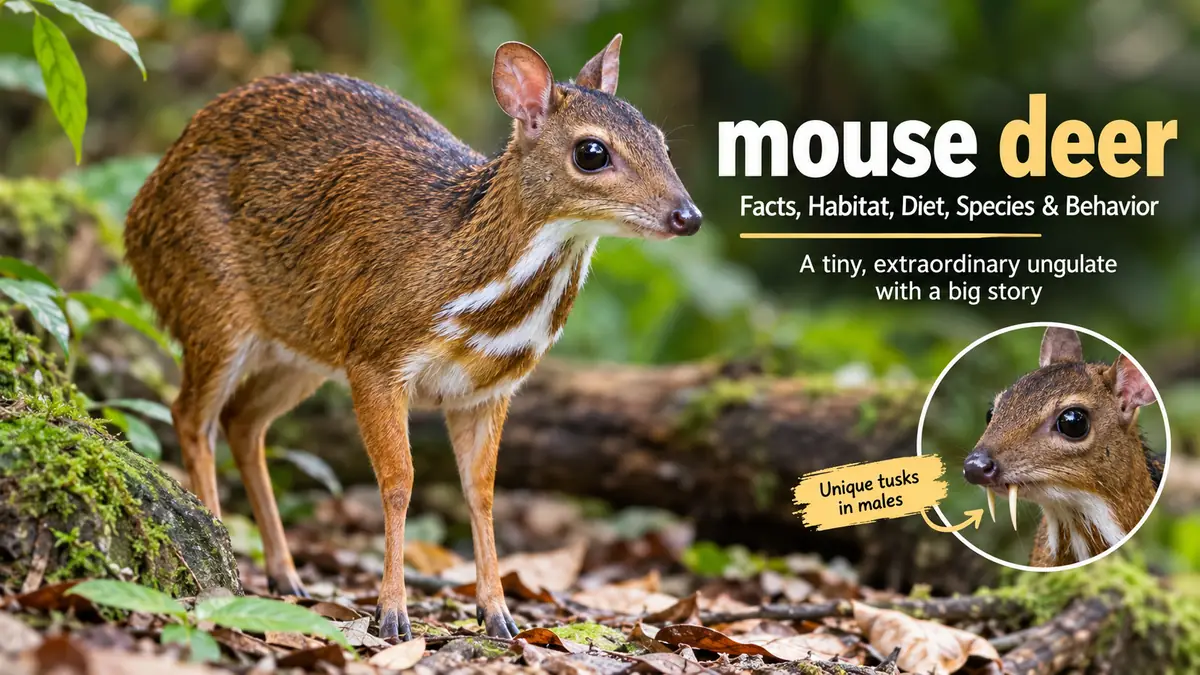

At first glance, a mouse deer looks almost imaginary: a tiny body, pencil-thin legs, huge dark eyes, small hooves, and—in males—fang-like teeth. Yet this unusual forest animal is neither a mouse nor a true deer.
A mouse deer is a small hoofed mammal belonging to the family Tragulidae, whose members are commonly called mouse-deer or chevrotains. They live mainly in tropical forests of South and Southeast Asia, with one living species in Africa. They are shy, mostly nocturnal animals that feed largely on fruit, leaves, shoots, and other plant material.
Mouse deer are especially interesting because they preserve several features associated with early ruminant evolution. Their combination of tiny size, tusk-like canine teeth, lack of antlers, secretive behavior, and ancient lineage makes them unlike almost any other living hoofed mammal.
What Is a mouse deer?
The term mouse deer commonly refers to members of the mammal family Tragulidae, a group of small even-toed ungulates. They belong to the same broad hoofed-mammal order that includes deer, cattle, giraffes, pigs, and hippopotamuses, but they form their own distinct evolutionary family.
The scientific classification commonly used for the group includes:
| Classification | Group |
|---|---|
| Kingdom | Animalia |
| Phylum | Chordata |
| Class | Mammalia |
| Order | Artiodactyla/Cetartiodactyla |
| Suborder | Ruminantia |
| Family | Tragulidae |
| Living genera | Tragulus, Moschiola, Hyemoschus |
Modern sources recognize 10 living species distributed among three genera. Most occur in Asia, while the water chevrotain represents the family in tropical Africa.
Is a mouse deer actually a deer?
No. Despite the name, mouse deer are not true deer.
True deer belong to the family Cervidae, whereas mouse deer belong to Tragulidae. The similarity comes mainly from their body shape, slender legs, brown coat, and hoofed feet.
They are also not rodents and are therefore unrelated to mice despite their mouse-like face and small size.
A useful way to think about them is as a separate, ancient branch of the ruminant family tree.
Why are they called chevrotains?
The name chevrotain comes from a French term related to a young goat or fawn. The words “mouse-deer” and “chevrotain” have historically been used interchangeably, although modern naming sometimes distinguishes species in different genera.
Species in Tragulus are commonly called mouse-deer, while spotted members of Moschiola are often called chevrotains. The African Hyemoschus aquaticus is generally known as the water chevrotain.
How Small Is a mouse deer?
Mouse deer include some of the smallest living hoofed mammals on Earth.
Their exact dimensions vary considerably between species.
The tiny Java mouse-deer (Tragulus javanicus) averages roughly 45 centimeters in body length and about 30 centimeters in height and may weigh only around 1–2 kilograms. By comparison, the much larger African water chevrotain can weigh roughly 7–16 kilograms.
The larger Malay mouse-deer (Tragulus napu) reaches about 75 centimeters in body length and roughly 34 centimeters at the shoulder. Smithsonian describes it as approximately rabbit-sized.
| Feature | Typical mouse deer characteristic |
|---|---|
| Body | Compact and rounded |
| Legs | Very slender |
| Head | Small and triangular |
| Snout | Narrow and pointed |
| Eyes | Large and dark |
| Coat | Brown, reddish-brown, spotted or striped depending on species |
| Antlers | None |
| Male canine teeth | Often elongated into tusks |
| Feet | Small hooves |
One characteristic gives many species an unusual silhouette: the hindquarters stand higher than the shoulders. This is particularly noticeable in the larger Malay mouse-deer.
What is the smallest mouse deer?
The Java mouse-deer, Tragulus javanicus, is widely described as the smallest living ungulate. Its extremely small body demonstrates just how different tragulids are from the larger deer, antelope, and cattle most people associate with hoofed mammals.
Why Does a mouse deer Have Fangs?
Perhaps the most surprising mouse deer feature is its teeth.
Mouse deer do not grow antlers or horns. Instead, adults have elongated upper canine teeth, especially pronounced in males. These canines can extend below the lips and resemble miniature tusks or fangs.
Males use them when competing with other males. Observations of larger Malay mouse-deer show that confrontations may involve short bouts of biting with these sharp canines.
The teeth are not evidence that mouse deer are carnivores. They remain predominantly plant eaters.
Like other ruminants, they also lack conventional upper front incisors and instead use a firm dental pad against the lower incisors when cropping vegetation.
Quick takeaway: The “fangs” of a mouse deer are enlarged canine teeth used mainly in social competition and defense. They replace neither antlers nor a carnivorous feeding system.
Where Do mouse deer Live?
Mouse deer occur naturally across parts of South Asia, Southeast Asia, Central Africa, and West Africa.
Asian species live in countries and regions including India, Sri Lanka, Thailand, Vietnam, Malaysia, Indonesia, the Philippines, and surrounding areas. Important island habitats include Sumatra, Borneo, Java, and Balabac.
The larger Malay mouse-deer is associated with Thailand, Indochina, the Malay Peninsula, Sumatra, and Borneo, particularly dense vegetation near water.
The water chevrotain (Hyemoschus aquaticus) occupies rainforest environments in Central and West Africa.
What habitat does a mouse deer prefer?
Typical mouse deer habitat includes:
- Tropical rainforest
- Lowland forest
- Dense forest undergrowth
- Primary and secondary woodland
- Vegetation around streams and rivers
- Mangrove thickets in some areas
- Rocky or heavily sheltered forest areas
Dense cover matters because concealment is one of their primary defenses.
Rather than relying on large horns, high speed across open plains, or group protection, these small animals often disappear into thick vegetation. Some repeatedly use narrow paths through the forest undergrowth between feeding and resting areas.
What Does a mouse deer Eat?
A mouse deer is primarily a herbivorous browser and fruit eater.
Common foods include fallen fruit, berries, tender leaves, buds, grasses, shrubs, shoots, and aquatic vegetation. Larger Malay mouse-deer have been documented feeding on many of these foods in the wild.
They are not necessarily strict vegetarians, however. Some tragulids may occasionally consume insects, other small invertebrates, or animal material. This opportunistic behavior does not make them predators; plant material still forms the core of their diet.
How does a mouse deer digest food?
Mouse deer are ruminants, meaning they rely on specialized digestive fermentation and microorganisms to break down fibrous plant food.
Their digestive anatomy is more primitive than that of many familiar ruminants. Scientific and wildlife-management references often describe tragulids as having three major functional stomach chambers rather than the fully developed four-compartment arrangement typical of cattle and true deer. This unusual digestive structure is one reason they are important in studies of ruminant evolution.
They can therefore extract nutrients from vegetation despite their tiny bodies and relatively simple-looking feeding habits.
mouse deer Behavior: Why Are They So Hard to See?
Finding a wild mouse deer is difficult even where the animals occur.
Most species are shy, secretive, solitary, and mainly nocturnal or crepuscular. They spend much of their time inside dense vegetation and often become more active after daylight fades.
Larger Malay mouse-deer typically live alone except around breeding periods. Individuals may maintain territories, and males mark areas using feces, urine, and secretions from a gland beneath the jaw.
This combination of small size and dense habitat helps explain why scientists can have difficulty estimating populations.
Do mouse deer make sounds?
They are generally quiet animals.
Some species may produce sharp calls when alarmed, but scent marking and physical signals are also important forms of communication. Lesser mouse-deer have been observed using glandular secretions to mark territories and individuals.
Why do mouse deer stamp their feet?
Foot stamping can act as an alarm or aggressive signal.
When disturbed or challenged, some males rapidly strike the ground with their hooves. Researchers have recorded this behavior in Malay mouse-deer, sometimes producing a surprisingly fast drumming sound for such a small animal.
Can mouse deer Swim?
Yes, and water can provide an important escape route for some members of the family.
The African water chevrotain is particularly associated with waterways and dense vegetation around rivers. Aquatic escape behavior has also been documented among Asian mouse-deer.
Entering water gives a small animal another way to evade predators that might otherwise catch it in dense forest.
That behavior is especially interesting from an evolutionary perspective because tragulids represent an ancient lineage of hoofed mammals. Researchers have therefore examined their relationship with water for clues about behavioral traits that may have existed deep in ungulate evolutionary history.
Major mouse deer Species
The living family Tragulidae contains three genera: Tragulus, Moschiola, and Hyemoschus. Modern classifications recognize 10 extant species.
Lesser and Java mouse-deer
Species in the Tragulus group include some of the world’s smallest ungulates.
The Java mouse-deer (Tragulus javanicus) is especially famous for its remarkably small dimensions. Lesser mouse-deer typically have warm brown coats, white markings around the throat, thin legs, and enlarged upper canines in males.
Greater or larger Malay mouse-deer
The larger Malay mouse-deer (Tragulus napu) is substantially larger than the smallest members of the genus but remains tiny compared with ordinary deer.
It inhabits dense tropical forest and generally stays close to water. Its diet includes fruit, berries, leaves, aquatic plants, shrubs, and grasses.
Philippine mouse-deer
The Philippine mouse-deer (Tragulus nigricans), also known as the Balabac chevrotain or pilandok, has a restricted distribution centered on Balabac and nearby islands southwest of Palawan.
It has distinctive dark coloring and contrasting white markings across the throat and chest. Like other members of the group, males carry prominent tusk-like canine teeth.
Vietnam mouse-deer
The Vietnam mouse-deer (Tragulus versicolor), often called the silver-backed chevrotain, became one of the most famous members of the family after conservationists confirmed that it still survived in the wild.
The species was originally described in 1910. After a confirmed record in 1990, decades passed without reliable observations, causing concern that it might have disappeared. Camera traps finally documented the species again in southern Vietnam in research announced in 2019.
Its rediscovery demonstrates why absence of sightings does not automatically mean extinction—especially for tiny, nocturnal mammals living in thick tropical forest.
Indian spotted chevrotain
The Indian spotted chevrotain (Moschiola indica) occurs in India and belongs to the spotted-chevrotain genus.
Its coat is generally olive-brown with pale spots or stripes, helping distinguish Moschiola from the more uniformly colored Tragulus mouse-deer. Indian wildlife research describes it as a small, elusive forest-dwelling ungulate and an evolutionarily distinctive ruminant.
Water chevrotain
The water chevrotain (Hyemoschus aquaticus) is the only living African representative of Tragulidae.
It is also the largest living chevrotain, reaching weights far above those of the tiny Asian species. Its connection with rainforest waterways makes it ecologically distinct from many of its Asian relatives.
How Does a mouse deer Reproduce?
Mouse deer may be tiny, but their reproductive biology is remarkably efficient.
The larger Malay mouse-deer breeds throughout the year. Gestation lasts about five months, and females generally give birth to one young at a time, although twins are possible.
Newborns develop quickly. Smithsonian reports that calves may stand and become active within about 30 minutes of birth. They are generally weaned at around two to three months and can reach sexual maturity when only a few months old.
One of the most extraordinary traits is how quickly females may reproduce again.
In larger Malay mouse-deer, mating can occur only a short time after giving birth. As a result, an adult female can spend much of her reproductive life pregnant.
A similar pattern has been reported in lesser Malay mouse-deer, highlighting the high reproductive potential of these otherwise secretive mammals.
How Long Does a mouse deer Live?
Lifespan varies between species and is easier to measure in captivity than in the wild.
The Smithsonian reports that larger Malay mouse-deer can live up to about 16 years in human care. Older demographic records for individual species commonly report captive averages around 12–14 years.
Wild lifespan is harder to establish because predation, hunting, disease, habitat conditions, and limited long-term observation all affect survival.
What Animals Hunt mouse deer?
Being one of the smallest hoofed mammals creates an obvious problem: many predators are larger than you.
Depending on location, potential predators may include:
- Large snakes
- Wild cats and other carnivorous mammals
- Large predatory birds
- Monitor lizards and other large reptiles
Their main defenses are not physical strength or antlers. Mouse deer instead rely heavily on camouflage, dense vegetation, quick movement, concealment, and in some cases water.
Males can also use their sharp canine teeth when necessary.
Why Are mouse deer Called Living Fossils?
The phrase “living fossil” is often used informally for chevrotains because their lineage retains a number of ancient anatomical features and has changed relatively little in overall body form across millions of years.
Smithsonian notes that larger Malay mouse-deer are often described this way because their general form has changed little in roughly 30 million years.
The phrase should not be taken literally. Modern mouse deer are not fossils frozen in evolutionary time. They continue to evolve like every other living organism.
What makes them scientifically valuable is that Tragulidae represents an early-diverging ruminant lineage. Features of their limbs, teeth, digestive system, and anatomy can therefore help researchers understand how later ruminants evolved.
Are mouse deer Endangered?
There is no single conservation status for every mouse deer because Tragulidae contains several different species, each with its own geographic range and threats.
Some populations remain relatively widespread, while others have restricted ranges or are poorly understood.
The larger Malay mouse-deer faces pressures including habitat loss, forest degradation, hunting, and wildlife trade.
The Philippine mouse-deer has a particularly limited island distribution, making habitat changes and hunting more serious concerns.
The Vietnam mouse-deer illustrates another conservation problem: scientists may simply lack enough reliable data to know how many individuals remain.
Major threats to mouse deer
Across their range, the most important pressures can include:
- Deforestation — removes the dense forest cover they depend upon.
- Forest fragmentation — separates populations and reduces secure habitat.
- Hunting — mouse deer have historically been hunted for meat in parts of their range.
- Snares — indiscriminate trapping can kill small forest mammals regardless of the hunter’s intended target.
- Wildlife trade — some species may be captured for the exotic-pet market.
- Limited population data — their secretive behavior can make declines difficult to detect early.
Protecting continuous forest habitat and reducing unsustainable hunting are therefore central to mouse deer conservation.
Are mouse deer Good Pets?
Their small size and unusual appearance may make mouse deer seem suitable as pets, but they are wild ungulates with specialized behavioral and environmental needs.
They naturally require dense cover, appropriate vegetation, opportunities for territorial behavior, suitable temperatures, and species-specific nutrition. Their shy temperament can also make frequent human interaction stressful.
Wildlife trade creates additional conservation and welfare concerns. Smithsonian specifically identifies the pet trade as one of the pressures affecting larger Malay mouse-deer and advises careful consideration before obtaining exotic animals.
Seeing one in an accredited zoological institution or responsibly observing one in its natural habitat is very different from trying to keep a wild chevrotain as a household animal.
mouse deer in Culture and Folklore
The mouse deer is not significant only to zoologists.
In Southeast Asian storytelling, the kancil, or mouse-deer, is famous as a clever trickster. Stories about Sang Kancil portray the tiny animal surviving situations through intelligence rather than physical strength.
The mouse-deer also appears in the traditional story of the founding of Malacca. According to the Malay Annals, Parameswara witnessed a small mouse-deer confront a hunting dog and interpreted the scene as a favorable sign for establishing a settlement there.
This cultural image fits the animal remarkably well: physically small, apparently fragile, yet surprisingly resourceful.
What Makes the mouse deer So Unusual?
Few mammals combine so many unexpected characteristics in such a small body.
A mouse deer can be rabbit-sized but still possess true hooves. It resembles a miniature deer yet belongs to a different family. It lacks antlers but males can carry sharp tusk-like canines. It is a ruminant, yet retains comparatively primitive digestive characteristics. Some members can use water as an escape route, while others may spend almost their entire lives hidden in dense tropical vegetation.
These are not simply miniature deer. They are members of Tragulidae, an ancient and distinctive branch of hoofed-mammal evolution.
Understanding the mouse deer means looking beyond its unusual name and appearance. Its habitat, diet, tusks, reproductive biology, evolutionary history, and conservation challenges reveal an animal that is far more remarkable than its tiny size suggests.
