
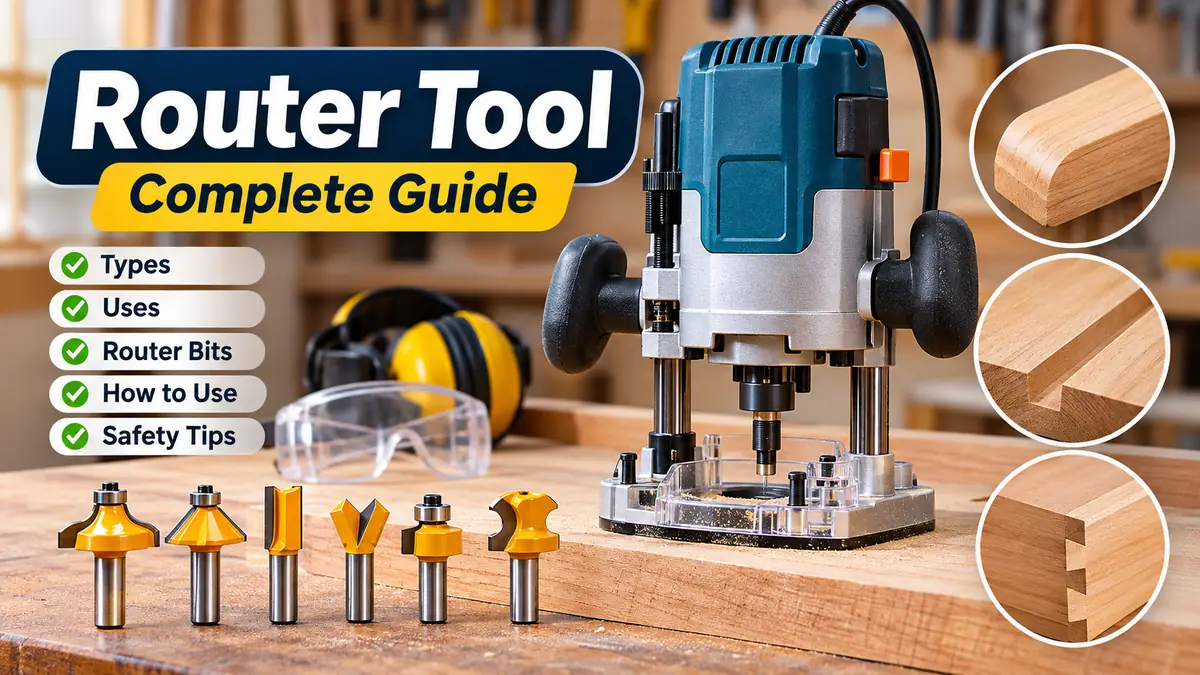

A simple piece of wood can become a polished cabinet door, decorative shelf, or precisely fitted joint with the right cutting technique. A router tool makes these transformations possible by shaping edges, cutting grooves, and creating detailed patterns.
Unlike a saw, which primarily separates material, a woodworking router removes material in controlled shapes. Understanding its bases, cutting bits, and operating techniques helps you achieve cleaner results while reducing mistakes and safety risks.
A router tool is a high-speed woodworking power tool that uses a rotating cutting bit to shape edges, create grooves, trim materials, and produce joints. Available in fixed-base, plunge, and compact designs, routers are widely used in furniture making, cabinetry, decorative woodworking, and precision joinery. Lowe’s+1
What Is a router tool and How Does It Work?
A router tool is a motor-driven cutting machine designed to remove material from wood and certain other compatible materials. Its cutting bit rotates at high speed while the operator guides the tool along a predetermined path.
The router’s versatility comes from interchangeable bits. A straight bit cuts a groove, a round-over bit smooths a sharp edge, and a dovetail bit creates the angled profile used in certain woodworking joints.
Main components of a woodworking router
Understanding the basic components makes operating and maintaining the tool easier.
- Motor: Provides rotational power to the cutting bit.
- Collet: Holds the bit shank securely inside the spindle.
- Base plate: Supports the router against the workpiece.
- Depth adjustment: Controls how far the bit extends into the material.
- Handles or grip: Help maintain stability and control.
- Speed control: Adjusts rotational speed on compatible models.
- Dust extraction port: Connects to a suitable vacuum or dust collection system.
- Spindle lock: Simplifies bit changes on models equipped with this feature.
Close up of a router bit in a wood router.
13
The motor rotates the bit, and the cutting edges remove material as the router moves. The depth setting determines how much material is removed vertically, while guides, fences, or templates control the cutting path.
How fast does a router tool spin?
Many woodworking routers operate at speeds ranging from roughly 8,000 to 30,000 revolutions per minute (RPM), depending on the model.
Smaller bits often operate at higher speeds, while larger-diameter bits generally require lower speeds. Always follow the router and bit manufacturer’s rated speed limits.
Excessive speed can damage a bit or create dangerous operating conditions. Insufficient speed or an unsuitable feed rate can also produce rough cuts.
Types of router tool for Woodworking
Woodworking routers come in several configurations, each suited to different cutting tasks.
SKIL RT1323-00 Corded 10 Amp Fixed Base Router – Tool Nut
1. Fixed-Base Router
A fixed-base router maintains a preset cutting depth during operation. It is commonly used for edge shaping, straight grooves, and repeated cuts.
Its stable base makes it suitable for controlled, consistent routing.
Bosch® Plunge Router, MRP23EVS, W/Plunge Base
2. Plunge Router
A plunge router allows the operator to lower the spinning bit into the workpiece while keeping the base supported.
It is particularly useful for mortises, stopped grooves, inlays, and interior recesses.
Bosch GKF12V-25N 12V Max EC Brushless Palm Edge Router (Bare Tool)
3. Compact or Trim Router
A compact router is smaller and lighter than a full-size model.
It works well for laminate trimming, small round-overs, chamfers, and light-duty decorative details.
Trend Router Tables | Trend Tool Technology
4. Router Table Setup
A compatible router can be mounted beneath a router table, allowing the workpiece to move past a stationary bit.
Router tables are useful for repeated edge profiles, certain joints, and controlled shaping with suitable guards and workholding.
Combination routers offer interchangeable fixed and plunge bases, providing flexibility without requiring two separate motors. Kreg Tool+1
Fixed-base vs. plunge router
| Feature | Fixed-base router | Plunge router |
|---|---|---|
| Depth adjustment | Set before cutting | Can plunge during operation |
| Edge profiling | Excellent | Excellent |
| Interior cuts | Less convenient | Well suited |
| Mortise cutting | Possible with appropriate setup | Particularly suitable |
| Beginner handling | Generally straightforward | Requires plunge control |
| Versatility | Strong for repeatable work | Strong for varied tasks |
For someone primarily making shelves or decorative edges, a fixed-base or compact router may be sufficient. A plunge router becomes particularly valuable when projects require cuts beginning inside the workpiece.
Common Uses of a router tool
A woodworking router can perform numerous operations that would otherwise require specialized hand tools or machinery.
1. Creating decorative edges
One of the most common applications is shaping the exposed edges of wooden boards.
Popular profiles include round-overs, chamfers, ogees, coves, and beads.
A round-over bit softens sharp corners, while an ogee bit creates a more elaborate curved profile.
These finishes are commonly used on tabletops, cabinet doors, shelves, and furniture components.
2. Cutting grooves and dadoes
A groove is a channel cut into a board, often running with the grain. A dado generally runs across the grain.
Routers can produce both using straight or spiral bits and a suitable guide.
These cuts are useful for shelving, cabinet construction, drawer components, and panel assemblies.
3. Making rabbets and woodworking joints
A rabbet is a recessed step cut along the edge of a board.
It provides space for another component, such as a cabinet back panel, to fit into the workpiece.
Routers can also help produce dovetails, mortises, tenons, and other joinery features when paired with suitable bits and jigs.
4. Trimming laminate and veneers
Compact routers are commonly used to remove overhanging laminate from countertops and furniture surfaces.
A flush-trim bit follows a reference edge or template, leaving the trimmed material aligned with the underlying surface.
5. Creating signs and decorative patterns
With V-groove or engraving bits, routers can carve lettering, lines, and decorative details.
Templates help reproduce consistent shapes, while freehand routing requires more experience and control.
6. Cutting mortises and recesses
Mortises are rectangular or shaped cavities designed to receive corresponding joinery components.
A plunge router with a straight or spiral bit can remove material from the interior of a workpiece in controlled passes.
This technique is also useful for hinge recesses and hardware installations.
7. Template routing
A template provides a repeatable reference shape.
Using a bearing-guided bit or guide bushing, the router follows the template to reproduce curves, edges, or cutouts.
Template routing is especially useful when making multiple identical furniture components.
Understanding Different Router Bits
The cutting bit determines the shape and type of cut a router produces.
Straight Router Bit Set, 5 Pieces, 1/2 Inch Shank – FindBuyTool
Straight bit
Used for grooves, dados, and recesses.
1/4-inch Shank 1-inch Cutting Dia 2 Flutes Corner Round Roundover Router Bit – Walmart.com
Round-over bit
Creates smooth, rounded edges.
1/2” Shank 7/8” Cutting Length Ball Bearing 45 Degree Chamfer Router Bit – Walmart.com
Chamfer bit
Produces angled edge profiles.
Freud Flush Trim Router Bit | Woodcraft
Flush-trim bit
Trims material to match a reference surface.
Whiteside D14-531 Dovetail Bit 14 Degree 1/4 SH 17/32 D x 1/2 C | Woodcraft
Dovetail bit
Cuts angled profiles for dovetail joints.
Whiteside 60° V-Groove CNC Bit 1/4″ SH 1/2″ D 2″ OL | Woodcraft
V-groove bit
Creates lettering and decorative channels.
Straight bits vs. spiral bits
Straight bits have cutting edges that run largely parallel to the bit shaft. They are useful for many general-purpose grooves and recesses.
Spiral bits use helical cutting edges. Their geometry can improve chip removal and surface quality in suitable applications.
Up-cut spiral bits tend to move chips upward, while down-cut bits push chips downward and can help protect the top surface of certain materials. Compression bits combine cutting directions and are often used for laminated sheet goods.
Router bit shank sizes
Common router bit shank sizes include 1/4 inch, 1/2 inch, 6 mm, and 8 mm, depending on the market and tool.
A 1/2-inch shank generally offers greater rigidity than a 1/4-inch shank of otherwise comparable design, but it requires a compatible collet.
Never use an incorrectly sized bit shank in a collet or attempt to compensate for a mismatch by overtightening.
How to Use a router tool Step by Step
Accurate routing begins before the motor is switched on.
What are the basic parts of routers?
Step 1: Select and install the correct bit
Disconnect the power source. Choose a bit compatible with the router, collet, material, and intended cut.
Insert and secure the bit according to the manufacturer’s instructions.
Bessey Tradesmen 8-inch F-Clamp: Set of 4 | RobCosman.com
Step 2: Secure the workpiece
Place the material on a stable surface and clamp it firmly.
Check that clamps and other obstructions are outside the bit’s travel path.
Bosch Oberfräse POF 1400 ACE (1.400 Watt, im Koffer) – zentis
Step 3: Set the cutting depth and speed
Adjust the bit depth for the desired result. Use multiple shallow passes for demanding cuts.
Set the speed within the bit and router manufacturers’ recommendations.
Using Straightedge Guides | Router Workshop
Step 4: Start and guide the router
With the bit clear of the material, start the motor and allow it to reach operating speed.
Keep the base supported, maintain control, and feed the router steadily in the correct direction.
Cutting Boards Made With Router – Instructables
Step 5: Finish and inspect
Complete the cut, switch off the router, and wait for the bit to stop completely before setting the tool down.
Inspect the result and make further adjustments only after disconnecting power.
These steps follow common manufacturer guidance for router setup and operation. Lowe’s+1
Which direction should you move a router?
For conventional handheld routing, the typical feed direction is counterclockwise around the outside edge of a workpiece and clockwise around an inside opening.
This keeps the cutting action working against the direction of travel.
Routing in the opposite direction is called climb cutting. It can cause the router to pull unexpectedly and should not be attempted casually.
Router-table feed direction differs because the router is mounted upside down. Always confirm the correct direction for the exact setup. documents.milwaukeetool.com+1
Choosing the Right router tool for Your Projects
The most suitable router depends on the materials, bit sizes, cutting depths, and frequency of use.
Motor power and performance
Compact routers are designed for relatively light work, while larger routers provide more power for demanding cuts.
Manufacturers may describe performance using horsepower, watts, or amperage.
However, these figures are not always directly comparable. Motor design, speed control, cutting efficiency, and operating conditions also influence performance.
Variable speed control
Variable speed is useful when switching between different bit diameters and materials.
Large bits generally require lower rotational speeds than smaller bits.
A router with electronic speed control may help maintain more consistent performance under changing loads.
Soft-start technology
Soft-start motors increase speed gradually rather than immediately reaching full operating speed.
This can reduce the sudden twisting force felt when switching on the tool.
It is especially useful with larger handheld routers.
Depth adjustment accuracy
Fine depth adjustment helps achieve consistent grooves, rabbets, and edge profiles.
Look for clearly marked controls, secure locking mechanisms, and repeatable settings.
Plunge routers may include turret stops for making several progressively deeper passes.
Dust collection compatibility
Routing creates chips and fine airborne dust.
A compatible extraction port helps keep the cutting area visible and reduces dust accumulation.
Use suitable respiratory protection and extraction, especially when cutting MDF or other engineered wood products.
Corded vs. cordless routers
| Feature | Corded router | Cordless router |
|---|---|---|
| Power supply | Electrical outlet | Rechargeable battery |
| Runtime | Continuous with available power | Limited by battery capacity |
| Portability | Restricted by cable | Greater freedom of movement |
| Weight | Depends on model | Includes battery weight |
| Typical use | Workshop and extended routing | Mobile and light-to-medium tasks |
Cordless routers can be convenient for trimming and smaller jobs, while corded models remain practical for long workshop sessions.
The actual performance difference depends on the individual models rather than the power source alone.
Essential router tool Safety Precautions
A router’s high-speed cutting bit can cause serious injury if the tool is used incorrectly.
Safe operation requires proper workholding, protective equipment, suitable accessories, and attention to the manufacturer’s instructions.
Personal protective equipment
Wear appropriate eye protection to guard against flying chips.
Hearing protection is important because routers can produce substantial noise.
Use suitable respiratory protection when dust exposure cannot be adequately controlled through extraction.
Avoid loose clothing, jewelry, or anything that could become caught in rotating components. Keep hair secured.
Safe operating practices
- Disconnect power before changing bits or making adjustments that require access to the cutter.
- Inspect the bit for cracks, damage, or excessive wear.
- Confirm that the collet and base adjustments are secure.
- Clamp the workpiece firmly before starting.
- Keep hands away from the cutter’s path.
- Use appropriate guides and multiple shallow passes when needed.
- Never exceed the bit manufacturer’s maximum rated RPM.
- Wait for the bit to stop completely before placing the router down.
Never hold a small workpiece in your hand while routing it. Use an appropriate jig, clamp, or other workholding method instead.
Training and supervised practice are advisable before attempting complex cuts. Forest Lake Presbyterian Church+1
Common routing mistakes and how to avoid them
| Problem | Likely cause | Practical solution |
|---|---|---|
| Burn marks | Dull bit, slow feed, excessive cutting load | Inspect bit, adjust feed, reduce cut depth |
| Rough edges | Tear-out, unsuitable bit or feed direction | Use sharp bit, support fibers, test on scrap |
| Uneven grooves | Poor guiding or unstable base | Use a secure fence or guide |
| Excessive vibration | Damaged bit, poor installation, unsuitable setup | Stop, disconnect power, inspect components |
| Inconsistent depth | Loose adjustment or unstable support | Check depth lock and base support |
| Motor bogging down | Excessive material removal | Make lighter passes |
If the router vibrates abnormally, stop using it until the cause has been identified and corrected.
Router Accessories That Improve Accuracy
The right accessories can make a router easier to control and more versatile.
Edge guides and fences
An edge guide keeps the router at a consistent distance from the side of a board.
It is useful for straight grooves, rabbets, and parallel cuts.
A securely clamped straightedge can also guide the router where an ordinary edge guide is unsuitable.
Guide bushings and templates
Guide bushings fit beneath compatible router bases and follow the edge of a template.
They are particularly useful for repetitive cutouts, inlays, and certain joinery operations.
The offset between the guide bushing and cutting bit must be considered when designing a template.
Router tables and lifts
A router table provides a stationary cutting setup for compatible routers.
A router lift, where supported, allows precise height adjustments from above the table.
Not every handheld router or plunge base is approved for table mounting. Check the exact manufacturer’s instructions before installation.
Dust extraction attachments
Dust shrouds, extraction adapters, and vacuum hoses help remove chips near the cutting area.
Keep extraction hoses positioned so they do not interfere with the router’s handles or movement.
Router Tool vs. Other Woodworking Tools
Routers, jigsaws, circular saws, and rotary tools can sometimes perform related tasks, but their strengths differ.
| Tool | Primary purpose | Common applications |
|---|---|---|
| Wood router | Precision shaping and profiling | Edges, grooves, joinery |
| Jigsaw | Curved and irregular cutting | Shapes, openings, rough curves |
| Circular saw | Straight-line cutting | Boards and sheet materials |
| Rotary tool | Small-scale grinding and detailing | Engraving, polishing, minor trimming |
| CNC router | Computer-controlled material removal | Repeated shapes, detailed machining |
Router vs. jigsaw
A jigsaw is useful for cutting irregular shapes through a board.
A router is better suited to producing precise profiles, controlled grooves, and repeated shapes using templates.
For some projects, a jigsaw first removes most of the unwanted material, and a router then trims the edge to its final shape.
Handheld router vs. CNC router
A handheld router is manually guided by the operator.
A CNC router uses computer-controlled movement to position the cutting tool along programmed paths.
CNC systems can reproduce complex designs consistently, but they require suitable software, setup, workholding, and machine-specific safety procedures.
Router Maintenance and Troubleshooting
Routine maintenance helps preserve accuracy and identify problems before they become hazardous.
Cleaning and inspection
Remove accumulated chips and dust according to the manufacturer’s instructions.
Inspect the collet for contamination or damage, and keep plunge mechanisms clean.
Check the power cord, switches, base plate, and adjustment controls regularly.
Do not use damaged electrical equipment or attempt internal repairs without appropriate qualifications.
Maintaining router bits
Inspect bits before each use.
Resin buildup can affect cutting quality and should be removed using cleaning methods compatible with the bit manufacturer’s recommendations.
Dull or damaged bits may require professional sharpening or replacement.
Why does a router burn wood?
Burn marks commonly result from excessive friction or heat buildup.
Possible causes include a dull cutting edge, moving too slowly, taking an overly demanding cut, or using an unsuitable speed.
Test adjustments on scrap material rather than experimenting directly on a finished project.
Why does a router cut unevenly?
Uneven cutting may result from an unstable base, a loose guide, an incorrectly secured bit, or inconsistent feed pressure.
Disconnect power before inspecting the tool or adjusting its components.
If the issue continues after basic checks, consult the manufacturer’s service guidance.
Practical Woodworking Projects for Beginners
Simple projects help new users develop control without requiring complicated joinery.
Rounded-edge shelf
A wooden shelf with softened edges is a useful starting project.
Use a compatible round-over bit, securely clamp the board, and make test cuts on scrap wood before working on the shelf.
Decorative picture frame
A router can add a decorative profile to frame stock.
A suitable bit can also create a rabbet for accommodating a backing board or other frame components.
Simple groove for a shelf panel
A straight bit and secure guide can produce a consistent groove.
This project introduces accurate depth adjustment and controlled routing along a straight path.
Template-shaped wooden component
A properly prepared template allows repeated shaping of matching wooden parts.
This technique is useful for furniture components and decorative panels.
Beginners should start with larger, securely clamped workpieces rather than small pieces that are difficult to control.
Final Thoughts on the router tool
A router tool is one of the most adaptable machines in a woodworking workshop. It can transform ordinary boards into accurately shaped components, decorative furniture details, and precisely fitted joints.
Fixed-base routers offer stable, repeatable cutting, plunge routers provide flexibility for interior cuts, and compact routers make lighter trimming tasks easier to manage.
The most important skills are selecting the correct bit, setting an appropriate cutting depth, maintaining a safe feed direction, and keeping the workpiece secure.
Start with simple edge profiles and practice on scrap wood. As your control and understanding improve, progress toward grooves, templates, and more demanding joinery techniques.
