
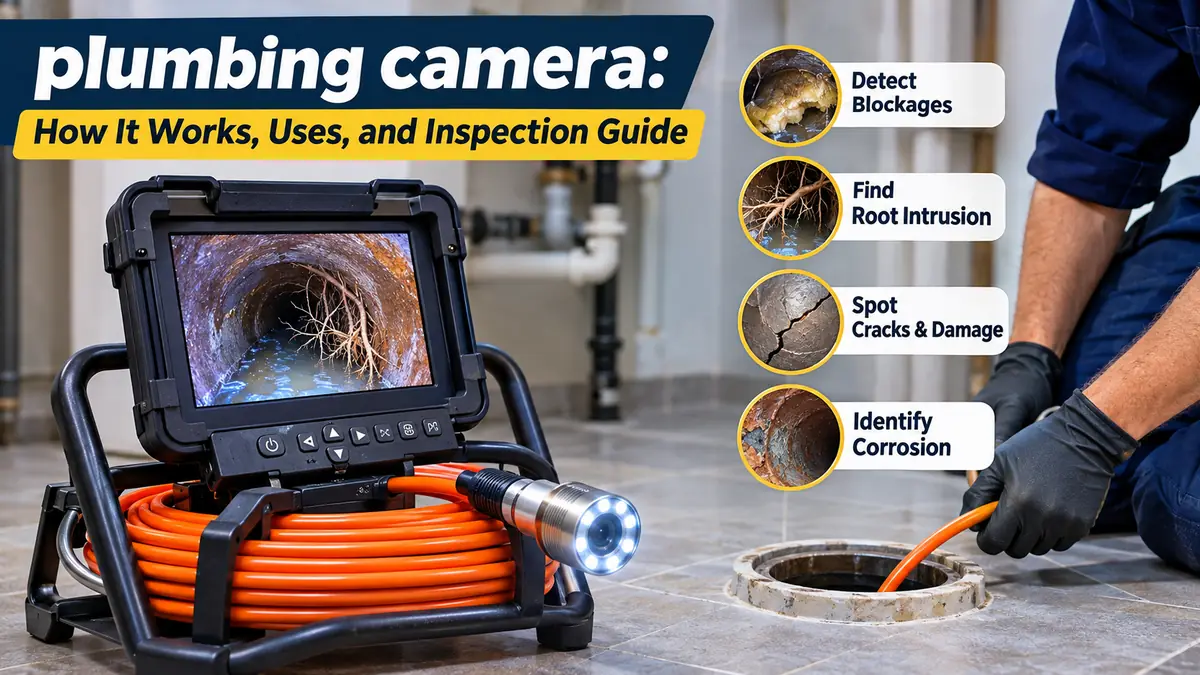

A slow drain can be caused by something as simple as accumulated grease or as serious as a damaged underground sewer pipe. The difficulty is that most of the plumbing system is hidden behind walls, beneath floors, or underground.
A plumbing camera allows technicians to see inside accessible pipes without immediately digging up a yard or opening a wall. Understanding how this technology works can help homeowners recognize drainage problems, interpret inspection findings, and avoid unnecessary repairs.
A plumbing camera is a waterproof inspection device equipped with a small camera head, flexible cable, and viewing monitor. It travels through drain or sewer pipes to reveal blockages, cracks, corrosion, root intrusion, and other visible defects. Some systems also include recording, distance measurement, and underground location capabilities.
What Is a plumbing camera?
A plumbing camera, also called a sewer inspection camera, drain camera, or pipe inspection camera, is a specialized tool used to examine the interior of plumbing and drainage systems.
Unlike a conventional camera, it is designed to operate inside wet, dark, confined environments. Its waterproof camera head typically contains LED lights that illuminate the pipe while transmitting images to a monitor.
The camera is attached to a flexible push cable or, in larger systems, a motorized crawler. The operator guides it through the pipe while watching live video.
Main components of a plumbing inspection camera
| Component | Function |
|---|---|
| Camera head | Captures images inside the pipe |
| LED lighting | Illuminates dark pipe interiors |
| Push rod or cable | Moves the camera through the pipe |
| Display monitor | Shows live inspection footage |
| Cable reel | Stores and organizes the push cable |
| Distance counter | Estimates how far the camera has traveled |
| Recording system | Saves inspection images and video |
| Sonde transmitter | Allows compatible locating equipment to identify the camera head’s position |
Not every system includes all these features. Basic models may provide only live video, while professional systems can record footage, display distance measurements, and assist with locating underground defects.
How Does a plumbing camera Work?
Long Range 3488T Sewer Camera with 400ft Cable and Meter Counter
A pipe camera inspection uses a combination of mechanical movement, lighting, video transmission, and sometimes electronic locating technology.
1. Accessing the plumbing system
The technician identifies a suitable entry point, such as a drain cleanout, accessible pipe opening, or disconnected plumbing fixture.
A cleanout is often preferred because it provides relatively direct access to the drainage system without requiring removal of a toilet or other fixture.
Before inserting the equipment, the operator considers the pipe’s approximate diameter, layout, and condition.
2. Inserting the camera head
The camera head is introduced into the pipe and advanced using the flexible push cable.
The cable must be stiff enough to move forward but flexible enough to navigate ordinary pipe bends.
Camera head diameter and cable stiffness matter. Equipment intended for large sewer lines may be unsuitable for narrow branch drains or tight bends.
3. Viewing the pipe interior
As the camera advances, its LEDs illuminate the inside of the pipe.
Live images appear on the display, allowing the operator to examine joints, pipe walls, accumulated debris, and visible structural defects.
Some cameras include self-leveling heads that keep the image upright as the cable rotates.
4. Recording and locating problems
Professional equipment may record video or capture still images for later review.
A distance counter can indicate the approximate cable length inserted into the pipe. However, this measurement is not necessarily the straight-line distance from the access point.
If the camera includes a sonde transmitter, a compatible above-ground receiver can help identify its location and approximate depth.
5. Interpreting the findings
The operator reviews the footage to determine whether the visible condition suggests a blockage, pipe defect, or another issue.
A camera shows what is visible inside the pipe; it does not automatically establish the cause of every drainage problem.
For example, standing water might indicate a low section of pipe, a downstream obstruction, or another condition requiring additional investigation.
What Problems Can a plumbing camera Detect?
One of the biggest advantages of a camera inspection is its ability to distinguish different kinds of drainage problems that can produce similar symptoms.
Blockages and accumulated debris
Drain cameras can reveal obstructions such as grease deposits, foreign objects, sediment, and accumulated waste.
Common examples include:
- Grease buildup inside kitchen drainage lines
- Hair and soap residue in bathroom drains
- Foreign objects lodged in waste pipes
- Sediment accumulation
- Debris trapped around damaged pipe joints
The camera may show the obstruction directly or reveal conditions that suggest a blockage farther downstream.
Tree root intrusion
Tree roots can enter underground sewer lines through cracks, separated joints, or other openings.
Once inside, roots may expand and trap toilet paper, waste, and debris.
A camera can show root masses inside a pipe and help identify where they are entering.
However, a camera cannot determine the complete extent of a tree’s root system outside the pipe.
Cracked or broken pipes
Camera footage may reveal visible cracks, fractured pipe sections, displaced joints, and broken pipe walls.
These defects can occur in materials such as clay, cast iron, PVC, and other drainage pipes.
Some fractures are obvious, while fine cracks may be difficult to identify when the pipe is dirty, submerged, or poorly illuminated.
Corrosion and deteriorating pipe interiors
Older metallic drainage pipes can develop corrosion, scale, and rough interior surfaces.
Cast iron pipes, for example, may accumulate substantial deposits that reduce the effective opening available for wastewater flow.
A camera can reveal visible scaling, deterioration, and internal surface irregularities.
It cannot reliably measure the remaining wall thickness of a corroded pipe.
Bellied or sagging sewer lines
A pipe belly occurs when part of a drainage line settles below its intended slope, creating a low section where water and debris can accumulate.
During an inspection, the camera may encounter standing water in the affected section.
This can suggest a slope or alignment problem, but standing water alone does not prove that a pipe has sagged.
Confirming the pipe’s grade may require additional measurements or surveying.
Misaligned joints and offsets
Pipe joints can shift because of soil movement, settlement, installation defects, or physical damage.
A camera may reveal a visible step or offset where two pipe sections meet.
Significant offsets can restrict flow and create locations where debris accumulates.
Pipe collapse
A severely damaged sewer pipe may partially or completely collapse.
A camera can reveal deformation, broken sections, or a point beyond which it cannot advance.
When the camera cannot pass an obstruction, additional investigation may be needed to distinguish a collapse from a dense blockage or another physical restriction.
Different Types of Plumbing Inspection Cameras
Not every camera is designed for the same pipe size or inspection task.
Cámara de inspección de tuberías ROSCOPE MINI
Handheld borescope cameras
Compact inspection devices used for accessible spaces and some small openings. Their short or flexible cables may not be suitable for navigating long drainage lines.
Push-rod sewer cameras
Commonly used for residential drain and sewer inspections. The operator manually advances a semi-rigid cable through the pipe.
Crawler inspection cameras
Motorized equipment designed primarily for larger pipelines. These systems may feature remotely controlled movement, adjustable lighting, and rotating camera heads.
Forbest 7/8″ HD 1080p 23mm Camera Head with 512Hz Transmitter
Locatable inspection cameras
Systems equipped with a transmitter that can be detected using compatible locating equipment above ground. Useful when identifying where a buried pipe defect is located.
Push-rod vs. crawler cameras
| Feature | Push-rod camera | Crawler camera |
|---|---|---|
| Movement | Manually pushed | Motorized |
| Typical application | Residential drains and sewers | Larger municipal and industrial pipes |
| Pipe access | Smaller accessible lines | Larger accessible pipelines |
| Equipment complexity | Lower | Higher |
| Inspection distance | Limited by cable and pipe conditions | Depends on crawler, cable, and pipeline |
| Camera positioning | Fixed or self-leveling head | Often remotely adjustable |
The appropriate equipment depends on pipe diameter, bends, inspection distance, access conditions, and the specific problem being investigated.
When Should You Use a plumbing camera Inspection?
Camera inspections are especially useful when the cause or location of a drainage problem remains uncertain.
Recurring drain clogs
A drain that repeatedly blocks after cleaning may have an underlying structural or alignment problem.
A camera inspection can help determine whether roots, damaged joints, rough pipe surfaces, or other conditions are contributing to recurring obstructions.
Multiple slow drains
When several fixtures drain slowly at the same time, the problem may involve a shared branch drain or the main sewer line.
For example, if a toilet, bathtub, and nearby floor drain all experience backups, inspecting the common drainage line may be more informative than treating each fixture independently.
Sewer odors and wastewater backups
Persistent sewage odors or wastewater returning through fixtures can indicate a drainage or venting problem.
A camera may help identify visible defects or obstructions in accessible drainage pipes. It cannot, however, detect sewer gases or identify every possible source of an odor.
Wastewater backups require prompt attention because sewage can contain harmful microorganisms. Avoid contact with contaminated water and keep affected fixtures out of use until the problem is addressed.
Before purchasing an older home
A sewer inspection can provide useful information about the condition of a property’s accessible underground drainage line.
This can be particularly valuable when the home has mature trees, older piping materials, or a history of sewer problems.
A clear camera inspection does not guarantee that every part of the plumbing system is defect-free, but it can identify visible conditions that might otherwise remain unnoticed.
After major drain cleaning or repairs
A follow-up inspection can help confirm that a blockage has been removed and assess the visible condition of the pipe.
It may also document completed pipe repairs, provided the repaired section is accessible and visible.
Benefits and Limitations of Sewer Camera Inspections
The greatest benefit of a plumbing camera is that it replaces some uncertainty with direct visual evidence.
However, it is a diagnostic tool, not a universal test of pipe condition.
| Benefits | Limitations |
|---|---|
| Reveals visible internal defects | Cannot see through pipe walls |
| Helps identify obstruction locations | Heavy debris can block the view |
| May reduce exploratory excavation | Cannot pass every blockage or bend |
| Supports targeted repair planning | Does not directly measure wall thickness |
| Provides visual documentation | Does not independently confirm leak tightness |
| Helps assess cleaning results | Cannot fully inspect submerged surfaces |
Can a plumbing camera Detect Leaks?
A camera can sometimes reveal evidence consistent with a leak, such as an open joint, visible crack, or water entering a drainage pipe.
However, a camera inspection alone cannot reliably confirm that a pipe is watertight.
Some leaks occur through tiny defects that are difficult to see. Others happen only when the system is under particular operating conditions.
Water supply pipes may require pressure testing, while drainage systems may need appropriate leak or integrity testing.
Can a plumbing camera See Through Water?
Most conventional drain cameras use visible light. They cannot see through opaque water, thick sludge, or heavy deposits.
If the camera head becomes submerged in murky wastewater, image quality may deteriorate substantially.
The pipe may need cleaning or the water level may need to be reduced before a useful inspection is possible.
Can a Camera Inspect Every Pipe?
No. Accessibility, pipe diameter, bends, obstructions, and equipment limitations determine how far an inspection can proceed.
A camera that is too large may become stuck, while an overly flexible cable may lack the pushing force needed for a long run.
The camera should never be forced through a tight obstruction or sharp bend.
Understanding plumbing camera Features and Specifications
Different inspection systems have different capabilities. Knowing the technical terms helps explain why one camera may perform better than another in a particular pipe.
Camera head diameter
The camera head must fit comfortably inside the pipe and navigate its bends.
Smaller heads are generally better suited to narrow pipes, but size alone does not determine maneuverability. Cable flexibility and the length of the camera head also matter.
For example, RIDGID’s SeeSnake Mini Pro uses a 25 mm camera head and is specified for approximately 1½- to 8-inch lines. RIDGID Tools
Cable length and stiffness
A longer cable does not guarantee a longer successful inspection.
The actual reach depends on pipe layout, friction, bends, deposits, and cable stiffness.
Professional systems may have cables extending hundreds of feet. The RIDGID SeeSnake Standard, for instance, offers a maximum run of 325 feet (99 meters) and is designed for larger pipes with relatively few turns. RIDGID Tools
Image quality and lighting
LED illumination is essential because drainage pipes contain little or no natural light.
Image clarity also depends on the camera sensor, lens condition, pipe cleanliness, and the amount of water or debris present.
High dynamic range (HDR) imaging can improve visibility in scenes containing both bright reflections and dark areas.
Self-leveling camera heads
A self-leveling camera keeps the displayed image upright even when the push cable rotates.
This makes it easier to understand the orientation of cracks, joints, and other features.
Some newer systems use digital self-leveling rather than a mechanically rotating camera assembly. RIDGID Tools
Sonde transmitters and underground locating
A sonde is a small electronic transmitter built into or attached near the camera head.
A compatible locator can detect its signal from above ground, allowing the operator to estimate the camera’s position and depth.
Some professional inspection cameras use 512 Hz sondes, although compatibility depends on the specific equipment. RIDGID Tools+1
This feature can be especially helpful when a defect is located beneath a driveway, landscaped area, or building floor.
How to Interpret a plumbing camera Inspection Report
A useful inspection report should do more than state that a pipe is blocked or damaged.
It should connect the visual findings to identifiable locations and explain what those observations mean.
Information commonly included
A report may document:
- Pipe material and estimated diameter
- Inspection entry point
- Direction of camera travel
- Distance to observed defects
- Visible blockages or deposits
- Joint condition and alignment
- Standing water or suspected low sections
- Camera access limitations
- Images or video of important findings
- Recommended additional investigation or corrective work
Professional sewer assessment programs may use standardized terminology to describe structural and operational conditions.
For example, the National Association of Sewer Service Companies (NASSCO) maintains the Pipeline Assessment Certification Program (PACP), which provides a standardized framework for recording sewer inspection observations. GENERAL
What different observations may mean
| Camera observation | Possible interpretation | Additional consideration |
|---|---|---|
| Dense roots at a joint | Root intrusion through an opening | Joint condition needs evaluation |
| Standing water | Possible low spot or downstream restriction | Slope may require confirmation |
| Heavy scale | Internal deposits or corrosion | Pipe wall condition may be uncertain |
| Visible joint offset | Pipe displacement | Severity depends on restriction and condition |
| Broken pipe wall | Structural damage | Extent may require further inspection |
| Camera cannot advance | Obstruction, tight bend, or collapse | Cause is not confirmed by access failure alone |
A report should distinguish what the camera actually shows from what the inspector suspects.
For example, describing a section as having standing water is an observation. Calling it a collapsed pipe without supporting images or other evidence is a conclusion that may not be justified.
Why recording footage matters
Recorded footage allows the findings to be reviewed later.
It also provides a reference for comparing conditions before and after cleaning or repairs.
Ideally, important images should be associated with their approximate location in the pipeline so they can be understood in context.
plumbing camera vs. Other Plumbing Diagnostic Methods
Camera inspections are often most useful when combined with other diagnostic techniques.
| Method | Primary purpose | Main limitation |
|---|---|---|
| Camera inspection | Visually examine pipe interiors | Only shows accessible, visible surfaces |
| Drain auger | Break through or retrieve certain obstructions | Does not fully diagnose pipe condition |
| Hydro jetting | Remove deposits using high-pressure water | Does not independently verify structural integrity |
| Pressure testing | Evaluate pressure retention or leakage | Does not show the exact internal defect |
| Acoustic leak detection | Help locate certain escaping-water sounds | Effectiveness depends on pipe and leak conditions |
| Pipe locating | Trace pipe routes or transmitter positions | Does not reveal interior pipe condition |
Is a Camera Better Than a Drain Snake?
They serve different purposes.
A drain snake or auger is designed to mechanically clear certain obstructions. A camera is designed to observe conditions inside a pipe.
A camera may help explain why a blockage keeps returning, while an auger may remove the immediate obstruction.
In some cases, cleaning the line before inspection produces better footage because accumulated debris no longer obscures the pipe walls.
Can Hydro Jetting and Camera Inspection Work Together?
Yes. Hydro jetting uses pressurized water to remove certain deposits and obstructions from drainage pipes.
A camera inspection before cleaning may identify the obstruction and reveal obvious structural concerns.
After cleaning, another inspection can show whether the deposits were removed and whether previously hidden defects are now visible.
The pipe’s condition should be considered before aggressive cleaning, particularly when it is old, brittle, or severely deteriorated.
Common Mistakes During Pipe Camera Inspections
Even advanced equipment can produce misleading results when used incorrectly.
Inspecting a heavily obstructed pipe
If grease, sludge, or debris covers the pipe walls, the camera may not reveal important defects.
A preliminary inspection can still be useful, but cleaning may be necessary before a meaningful condition assessment.
Assuming every pool of water indicates a belly
Water may accumulate because of a downstream blockage, pipe geometry, or temporary flow conditions.
A suspected sag should be assessed alongside the pipe layout and other available measurements.
Confusing cable distance with excavation distance
A distance counter measures cable travel, not necessarily the straight-line position of a defect.
Bends and changes in direction affect where the camera is located relative to the access point.
For accurate excavation planning, a compatible locator and appropriate site measurements are preferable to relying on cable length alone.
Ignoring camera compatibility
Using a large camera in a small pipe or a stiff cable through multiple tight bends can damage equipment or leave it trapped.
Pipe diameter, bends, cable specifications, and manufacturer instructions should be checked before insertion.
Treating a camera inspection as a complete plumbing evaluation
A sewer camera does not inspect every fixture, water supply line, vent, or concealed connection.
It is one component of a broader plumbing assessment.
Failing to document the findings
Without footage, photographs, or location notes, it can be difficult to verify a diagnosis or compare conditions after repairs.
Clear documentation makes inspection results more useful to property owners and future technicians.
Safety and Maintenance Considerations
Pipe inspection equipment is exposed to wastewater, moisture, contaminants, and mechanical stress.
Appropriate handling protects both the operator and the equipment.
Safe inspection practices
Operators should use suitable protective gloves and eye protection, avoid direct contact with sewage, and follow the equipment manufacturer’s cleaning instructions.
Cables should be advanced gradually. Excessive pushing force can damage the camera, buckle the cable, or cause equipment to become lodged.
Electrical components and connectors should remain within their specified environmental and waterproofing limits.
A camera rated for submersion does not mean every attached component is waterproof.
Cleaning and storing inspection equipment
After an inspection, contaminated cable surfaces and camera components should be cleaned and disinfected using products compatible with the equipment.
The camera lens should be checked for scratches, residue, or damage.
Before storage, inspect the cable for kinks, cuts, and excessive wear, and allow cleaned components to dry as recommended by the manufacturer.
Proper maintenance helps preserve image quality and reduces the risk of transferring contaminants between inspection locations.
Final Thoughts on plumbing camera Inspections
A plumbing camera provides a practical way to investigate hidden drainage problems without immediately resorting to destructive exploration.
It can reveal visible blockages, root intrusion, deteriorating joints, corrosion, and structural defects. With suitable locating equipment, it can also help identify where a problem lies beneath the ground.
Its limitations are equally important: a camera cannot see through opaque water, measure every aspect of pipe condition, or prove that a drainage system is leak-free.
The most useful next step after a plumbing camera inspection is to review the recorded evidence, identify which findings are confirmed, and determine whether cleaning, additional testing, monitoring, or repair is warranted.
