

A recurring drain blockage can feel simple until it comes back a week after the pipe has been cleared. The real problem may be much deeper underground: invading tree roots, a shifted joint, corrosion, a sagging pipe, or even a partially collapsed sewer line.
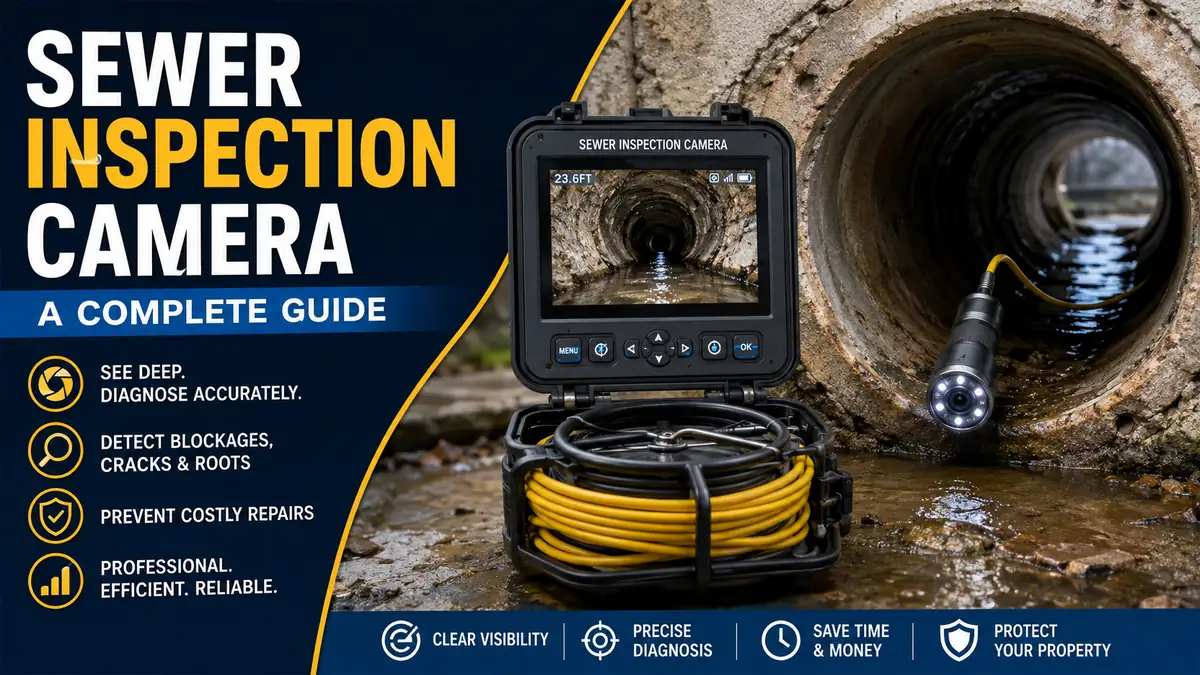
A sewer inspection camera provides a direct view inside a drain or sewer pipe without excavating it first. A waterproof camera head travels through the line on a flexible push rod and sends live video to a monitor. Depending on the system, technicians can identify blockages, roots, cracks, corrosion, offset joints, standing water, pipe deterioration, and other visible defects.
The technology is widely used by plumbers, drain-cleaning professionals, property inspectors, municipalities, and maintenance teams because it replaces much of the guesswork involved in diagnosing underground piping.
What Is a Sewer Inspection Camera?
A sewer inspection camera is a specialized video inspection system designed to travel through drain, waste, stormwater, and sewer pipes.
It is also commonly described as a:
- Sewer camera
- Drain camera
- Pipe inspection camera
- Plumbing camera
- Sewer scope
- CCTV drain camera
- Video inspection system
- Drain inspection camera
Unlike an ordinary borescope, professional sewer equipment typically combines a waterproof camera head with a long fiberglass-reinforced push rod, reel, monitor, LED illumination, and often recording and locating functions.
The camera is inserted through an accessible opening such as a sewer cleanout. As the operator pushes it farther into the line, live footage shows the internal condition of the pipe.
Professional systems are available in different configurations. For example, RIDGID’s SeeSnake range includes small systems intended for roughly 1- to 5-inch lines, compact systems for approximately 1½- to 8-inch applications, and larger camera reels for longer or larger pipe runs.
The Main Components
Although specifications vary, a typical system contains several important parts.
| Component | Purpose |
|---|---|
| Camera head | Captures video inside the pipe |
| LED lights | Illuminate the otherwise dark pipe interior |
| Push rod | Moves and guides the camera through the line |
| Reel | Stores and manages the push cable |
| Monitor/control unit | Displays the live camera feed |
| Distance counter | Estimates how much cable has entered the line |
| Sonde/transmitter | Sends a signal that can be detected above ground |
| Locator | Detects the sonde signal from the surface |
| Recording system | Saves video or images for documentation |
| Skid/guide | Helps center and protect the camera head |
Not every system includes every feature. A basic camera may provide only live video, while professional equipment can add self-leveling images, digital recording, text annotation, distance measurement, and underground locating.
How Does a Sewer Inspection Camera Work?
A sewer inspection camera works by sending a waterproof video camera through an existing access point while an operator watches the pipe interior on a monitor.
The procedure sounds simple, but useful inspection footage depends heavily on proper access, pipe condition, camera selection, and operator technique.
1. An Access Point Is Located
The first task is finding a suitable way into the drainage system.
A sewer cleanout is usually one of the most convenient options because it provides relatively direct access to the line. Depending on the plumbing system and inspection objective, another suitable drain opening may sometimes be used.
The technician also needs to determine which direction the pipe travels and which section needs to be examined.
2. The Camera Head Enters the Pipe
The waterproof camera head is attached to the end of a semi-rigid push cable.
The operator carefully feeds the cable into the pipe. The rod needs enough stiffness to push the camera over distance while remaining flexible enough to negotiate appropriate bends and fittings.
Camera-head diameter matters here.
A large head may produce excellent illumination and video but be unable to enter a narrow line or pass certain fittings. Smaller heads are more suitable for tighter drains. Professional selection therefore considers the smallest restriction along the intended route, rather than simply the diameter at the access opening.
3. LEDs Illuminate the Interior
A sewer pipe contains little or no usable natural light.
LEDs surrounding the lens illuminate the pipe walls and anything in front of the camera. The operator can then examine joints, deposits, roots, cracks, foreign material, and changes in pipe condition.
Brightness needs to suit the pipe size. Too little illumination makes defects difficult to interpret, while glare and dirty lenses can also reduce useful visibility.
4. Live Video Appears on a Monitor
The camera transmits its image back through the cable to the control unit.
Instead of diagnosing the problem entirely from symptoms such as a slow drain or recurring blockage, the operator can now inspect visible conditions directly.
The camera may reveal that what appeared to be an ordinary clog is actually related to roots, an offset joint, a damaged pipe, or heavy scale.
5. Problems Are Documented
Professional systems may record video, still images, distance readings, and inspection notes.
Documentation is particularly useful when:
- Comparing conditions before and after drain cleaning
- Planning a localized repair
- Investigating recurring blockages
- Assessing an older sewer lateral
- Conducting property inspections
- Reviewing rehabilitation work
- Providing evidence of a visible defect
Recording also lets the footage be reviewed later rather than requiring every decision to be made during the camera run.
6. A Sonde Can Help Locate the Camera
Many professional camera heads contain or work with a small transmitter known as a sonde.
The sonde emits a radio signal. A compatible handheld locator above ground detects that signal, allowing the operator to determine the approximate surface position of the camera.
A commonly encountered sewer-camera sonde frequency is 512 Hz, although compatibility between the transmitter and receiver must always be confirmed.
This distinction matters: knowing that the camera has traveled a certain distance into a pipe is not necessarily the same as knowing exactly where the defect lies beneath the property. A locator provides additional information for marking the position from above.
What Can a Sewer Inspection Camera Detect?
The biggest advantage of video inspection is the range of conditions it can reveal without exploratory excavation.
The camera does not diagnose every plumbing problem, but it is particularly effective at identifying visible abnormalities inside accessible piping.
Tree Root Intrusion
Roots are one of the most recognizable sewer-camera findings.
Tree and shrub roots seek moisture. If a root reaches a defective joint, opening, or crack, it may enter the sewer line and continue growing.
Early intrusion may appear as fine strands entering around a joint. Severe growth can develop into a dense root mass that catches toilet paper, wipes, solids, and other material.
Removing the roots may restore flow, but the camera can also help identify the location where they entered. Repeated root growth can indicate an underlying pipe or joint defect rather than simply a cleaning problem.
Grease, Scale and Debris Buildup
A camera can reveal material coating or obstructing the inside of a pipe.
Depending on the system, this can include:
- Grease
- Sludge
- Mineral scale
- Rust deposits
- Food waste
- Paper
- Wipes
- Foreign objects
- Other accumulated debris
The appearance and location of the buildup help explain why a line is draining poorly.
Heavy deposits can also reduce the effective diameter of a pipe long before it becomes completely blocked.
Cracks and Fractures
Visible cracks may indicate aging, ground movement, external loading, deterioration, or another structural issue.
Camera footage helps document where the damage occurs and how extensive it appears from inside the pipe.
However, visual appearance needs careful interpretation. A camera sees the interior surface—it does not automatically reveal everything happening through the entire pipe wall or surrounding soil.
Broken or Collapsed Pipe
More serious structural damage can also be visible.
A partially collapsed line may appear deformed or obstructed. A complete collapse may stop the camera from advancing any farther.
This is an important limitation as well as a useful finding. When the camera cannot physically pass the damaged section, it can document conditions only up to that point.
Offset or Misaligned Joints
Individual sections of pipe should connect with relatively smooth transitions.
Ground movement, settlement, installation problems, or deterioration can cause sections to move out of alignment.
The resulting offset joint creates a ledge inside the pipe. Waste and paper can catch on this edge, increasing the likelihood of recurring blockages.
More severe displacement may also restrict the camera itself.
Separated Joints
Pipe sections can sometimes pull apart rather than simply becoming misaligned.
A camera may reveal a visible gap between sections.
Joint separation deserves attention because it can create an opening through which roots or soil may enter the pipe.
Pipe Bellies and Standing Water
A sewer line normally depends on gravity to move wastewater.
If part of the pipe settles and creates a low area, water can collect rather than draining freely. This low section is commonly called a belly or sag.
During an inspection, the camera may enter standing water and later emerge from it.
Persistent pooling can collect solids and contribute to repeated drainage trouble.
A camera can reveal the presence of standing water, but footage alone should not be treated as a precise survey of pipe grade or slope.
Corrosion and Internal Deterioration
Older metallic pipes, particularly cast iron, can develop substantial internal deterioration.
The footage may show:
- Rust
- Scaling
- Rough surfaces
- Reduced internal diameter
- Deposits
- Visible deterioration
A rough internal surface can catch debris and make drainage problems more likely.
The camera is useful for observing this internal condition, but it cannot directly measure remaining wall thickness from ordinary video footage.
Foreign Objects
Objects that should never have entered a drainage system sometimes become lodged inside it.
Camera inspection can help distinguish an ordinary buildup from a discrete foreign object and determine approximately where it is located.
Changes in Pipe Material
An inspection may also reveal transitions between materials such as:
- PVC
- Cast iron
- Clay
- Other legacy piping
These transitions can matter because different materials age and fail differently.
They can also reveal previous modifications or repairs that are not obvious from the surface.
What a Sewer Inspection Camera Cannot Tell You
Seeing a pipe on video is extremely useful, but a camera is not an all-purpose underground diagnostic device.
Understanding its limitations prevents footage from being interpreted as evidence of something it cannot actually prove.
It Cannot See Through the Pipe Wall
The lens points at the interior.
It cannot look through solid PVC, clay, iron, concrete, or surrounding soil. That means it cannot show roots approaching the pipe from outside before they enter.
Similarly, exterior corrosion or soil conditions may remain hidden even when the inside looks relatively normal.
It Cannot Reliably Prove Every Leak
This is one of the most commonly misunderstood limitations.
A camera may clearly reveal a crack, hole, failed joint, or other condition capable of leaking. What it cannot necessarily determine from video alone is whether wastewater is actively escaping through a small defect into the surrounding soil.
A clean-looking video therefore should not automatically be treated as a leak test.
It Cannot See Through Dirty or Opaque Water
A submerged camera has limited visibility if the surrounding wastewater is cloudy or filled with debris.
Heavy standing water can hide portions of the pipe wall and make interpretation difficult.
Cleaning the line before a detailed condition assessment can sometimes produce much more useful footage.
It Cannot Pass Every Obstruction
Push cameras have physical limitations.
A complete blockage, crushed section, severe offset, tight fitting, or collapse may prevent the camera from moving forward.
In that situation, the inspection establishes where progress stopped but cannot reveal conditions beyond the inaccessible point.
It Does Not Clear a Blockage
A camera is primarily a diagnostic instrument.
It can show the obstruction but does not replace drain-cleaning equipment.
Depending on the actual problem, separate equipment may be needed for mechanical cleaning, hydro jetting, root cutting, retrieval, repair, rehabilitation, or replacement.
It Does Not Precisely Measure Pipe Slope by Itself
Standing water can suggest poor drainage, settlement, or a belly, but a conventional video inspection is not automatically a precision grading survey.
If exact elevations, grade, or depth are critical to engineering or replacement decisions, additional measurements may be required.
It Cannot Predict the Exact Remaining Life of a Pipe
Video captures the condition visible during the inspection.
It cannot tell you the exact day or year when a deteriorating pipe will fail.
A small root intrusion could progress, a joint could shift further, or an aging pipe could remain usable for years. The footage is evidence of current visible condition, not a guaranteed prediction of future performance.
Sewer Inspection Camera With Locator: Why the Sonde Matters
Finding damage on a screen solves only half the problem.
Suppose the footage shows a severe offset joint. The operator knows it is somewhere along the sewer lateral, but a repair crew needs to know where that point lies relative to the ground above.
That is where a sonde and locator become valuable.
Sonde vs. Locator
These two terms are sometimes treated as though they mean the same device, but they perform different jobs.
The sonde is the transmitter traveling inside the pipe, usually close to the camera head.
The locator is the receiver carried by the operator above ground.
The receiver detects the transmitter’s signal so the camera position can be marked at the surface. Systems can also provide an estimate of depth, although depth readings should be understood and verified according to the locator’s operating procedure.
Distance Counter vs. Electronic Locating
A cable counter might indicate that the camera is 40 feet into the line.
That does not automatically mean the problem is exactly 40 feet in a straight line from the cleanout.
The sewer may change direction, and the cable follows that route.
For a repair that requires excavation, electronic locating provides much more useful surface-position information than insertion distance alone.
Types of Sewer Inspection Camera Systems
Not every camera is designed for the same pipe.
The appropriate system depends on diameter, length, bends, access conditions, and inspection purpose.
Small-Diameter Drain Cameras
Compact camera heads and flexible cables are useful for smaller drain lines.
Their advantage is maneuverability.
The tradeoff is that smaller camera heads may provide less illumination or be less suitable for large-diameter pipelines.
Standard Push-Rod Cameras
Push-rod systems are the familiar choice for residential sewer laterals and many light-commercial drainage applications.
A fiberglass-reinforced cable is pushed manually through the line while the camera sends video to the control unit.
The combination of stiffness and flexibility is critical.
A cable that is too flexible can become difficult to push over a long distance. One that is too stiff may struggle with bends.
Self-Leveling Cameras
Without self-leveling, the video rotates whenever the camera head turns.
A self-leveling camera keeps the displayed image oriented upright as the head travels through the line.
This does not necessarily reveal additional defects, but it makes footage substantially easier to interpret, record, and present.
Camera Systems With Sonde Locating
These systems add a transmitter to help establish the camera’s underground position.
They are especially useful when an inspection is being performed to plan a targeted repair.
Recording Camera Systems
Professional control units can save video and still images.
Some also support text notes, footage counters, and other documentation functions.
Recording is valuable when several people need to review the condition later or when before-and-after inspection evidence is required.
Crawler Cameras
Push cameras are not ideal for every sewer.
Larger municipal pipelines may be inspected using remotely controlled crawler systems rather than manually pushed camera heads.
Crawler cameras can travel through larger mainlines, including manhole-to-manhole inspections. Push-rod systems are more commonly associated with smaller residential and commercial drains.
What Sewer Inspection Camera Specifications Actually Matter?
Specifications can look impressive on paper, but several have much greater practical impact than others.
Camera Head Diameter
Head diameter determines where the camera can physically travel.
The narrowest pipe, fitting, or restriction along the inspection route matters more than the size of the cleanout itself.
Common professional configurations vary significantly, so a camera suitable for a larger sewer lateral may not be appropriate for a small branch drain.
Push-Rod Length
Cable length determines theoretical maximum reach, but the advertised length should not be confused with guaranteed usable reach.
Bends and friction make long camera runs increasingly difficult.
A 100-foot cable does not guarantee that the head can be pushed 100 feet through every real plumbing layout.
Cable Flexibility
Push-rod flexibility affects both maneuverability and pushing power.
Flexible cables navigate tighter changes in direction more easily.
Stiffer rods are generally easier to push over long, relatively straight runs.
This is why choosing the longest cable alone is a poor way to judge a camera system.
Camera Resolution and Lighting
Good video quality makes small defects easier to interpret, but resolution is only one part of image quality.
Lighting, lens cleanliness, camera position, wastewater clarity, and pipe diameter all affect what appears on the screen.
Self-Leveling
Self-leveling footage is easier to watch because the displayed image remains upright.
It becomes particularly useful when recordings will be reviewed by someone who was not present during the inspection.
Sonde Frequency
If locating is required, the transmitter and receiver need compatible frequencies.
A 512 Hz sonde is common in sewer-camera applications, but the presence of a sonde does not automatically mean that every locator can detect it.
Recording and Reporting
For occasional visual checks, a live monitor may be sufficient.
For professional inspection work, recording can be far more important because it creates a visual record of what was observed.
When Is a Sewer Inspection Camera Useful?
A camera is most valuable when the cause or location of a drainage problem is uncertain.
Recurring Clogs
One isolated clog may simply result from material accumulating in the drain.
Repeated clogs in the same line deserve a closer look.
Roots, scale, damaged joints, bellies, or structural defects can repeatedly catch waste even after the line has been cleaned.
Multiple Slow Drains
When several fixtures connected to the same sewer line drain slowly, the problem may be farther downstream rather than at one individual fixture.
A camera can help investigate the shared line.
Repeated Sewer Backups
Repeated backups are a strong reason to determine what is physically happening inside the sewer rather than continuing to clear it without understanding the underlying cause.
Before Certain Sewer Repairs
If excavation or rehabilitation is being considered, visual evidence can help identify the affected section.
When combined with a sonde and locator, the inspection can also help establish its approximate surface position.
After Drain Cleaning
Post-cleaning inspection is particularly useful.
Before cleaning, grease, roots, debris, or standing wastewater may obscure the pipe wall. Once the obstruction has been removed, a second camera pass can reveal whether a crack, failed joint, corrosion, or another structural problem contributed to the original blockage.
Property Condition Investigations
A standard visual inspection of a building cannot show the entire buried sewer lateral.
A sewer scope can provide additional information about visible internal conditions in accessible portions of that line.
This can be particularly useful for older properties, although the findings still need to be interpreted within the limits of video inspection.
Should the Sewer Be Cleaned Before Camera Inspection?
It depends on the purpose of the inspection.
If the immediate goal is to discover what is causing a blockage, inspecting first may reveal roots, an object, or another obstruction in its existing position.
If the goal is a detailed structural assessment, however, heavy grease, sludge, scale, roots, or dirty standing water can hide defects.
A practical sequence for recurring problems is often:
- Inspect enough of the line to identify the obvious obstruction or condition.
- Perform the appropriate cleaning if the pipe can safely be cleaned.
- Run the camera again.
- Examine the exposed pipe walls and joints.
- Document remaining defects.
- Locate significant defects from the surface when necessary.
The post-cleaning camera pass is easy to overlook, yet it can be the part that explains why the blockage developed.
How to Read Sewer Camera Footage Correctly
Camera footage can look dramatic even when the finding is relatively minor—and apparently clean footage can sometimes provide false confidence.
Good interpretation requires context.
Look at the Entire Run
One defect should not automatically define the condition of the whole sewer.
Note where the camera started, how far it traveled, where material transitions occurred, and whether the complete intended section was actually inspected.
Distinguish a Symptom From Its Cause
A mass of roots is a blockage, but the roots may have entered through a defective joint.
Standing water is a finding, but the reason for it could involve settlement, obstruction, or another condition.
Heavy debris may be the immediate problem while a rough corroded surface is what repeatedly traps it.
The useful question is not simply, “What can I see?”
It is, “Why is this condition occurring here?”
Do Not Treat Distance as Exact Surface Location
A footage counter measures cable travel.
When excavation or highly targeted work depends on the defect’s position, use compatible locating equipment rather than assuming cable distance translates directly into an above-ground point.
Remember What the Camera Did Not Inspect
If the camera stopped at a collapse 55 feet into a 90-foot line, the remaining 35 feet has not been visually cleared.
Likewise, inspection of the main lateral does not automatically mean every smaller branch line and vent has been inspected.
A report should clearly distinguish between no defect observed and area not observed.
Common Sewer Camera Inspection Mistakes
The equipment can produce excellent information, but poor technique can undermine the result.
Moving Too Fast
Pushing rapidly through the line makes small cracks, joints, and changes in condition easy to miss.
Important areas should be examined slowly enough to interpret what is actually visible.
Inspecting Only Until the First Problem
Finding roots does not mean there cannot be another defect farther downstream.
If the camera can safely continue, the remaining accessible pipe should be examined.
Relying on Video Without Locating
A beautiful recording of a broken pipe is less useful for targeted excavation if nobody establishes where the break lies underground.
When location matters, the sonde and compatible receiver should be used while the camera is positioned at the defect.
Ignoring a Dirty Lens
Grease and debris can coat the camera head.
A blurry image may be caused by contamination rather than pipe condition. Cleaning the lens and repeating questionable sections can prevent misinterpretation.
Assuming the Camera Is a Leak Detector
Visible cracks and openings are valuable evidence.
They should not be confused with direct proof of the amount of water escaping outside the pipe.
Skipping the Post-Cleaning Inspection
This is one of the most consequential mistakes with recurring sewer problems.
Removing roots or debris can make the pipe flow again while leaving the underlying entry point, damaged joint, or deterioration unresolved.
A second inspection can expose what the blockage previously concealed.
Sewer Camera Inspection vs. Other Drain Diagnostic Methods
Different tools answer different questions.
| Method | Best Used For | Main Limitation |
|---|---|---|
| Sewer camera | Viewing internal pipe condition | Cannot see outside pipe |
| Sonde and locator | Locating camera underground | Does not show pipe condition |
| Distance counter | Estimating cable insertion distance | Not exact surface position |
| Drain snake | Breaking or retrieving certain obstructions | Limited diagnostic information |
| Hydro jetting | Removing substantial buildup and some obstructions | Does not diagnose structural condition by itself |
| Leak testing | Investigating leakage | Does not provide full internal video |
| Survey/grade measurement | Measuring elevations and slope | Different purpose from visual inspection |
The strongest diagnosis often comes from combining appropriate methods rather than expecting one tool to answer every question.
What Should a Useful Sewer Camera Inspection Record?
A useful inspection should provide more than random footage of the inside of a pipe.
Depending on the purpose, documentation can include:
- Inspection access point
- Direction of camera travel
- Pipe material
- Approximate diameter
- Distance traveled
- Changes in material
- Visible roots
- Deposits and obstructions
- Cracks or fractures
- Offset or separated joints
- Standing water
- Corrosion or scale
- Camera stopping point
- Surface location of major defects
- Video or still images when recording is available
Context makes the footage useful.
For example, “offset joint visible” provides less information than documenting where the joint appears, whether it restricts flow, whether debris has accumulated there, and whether its position was located above ground.
Can a Sewer Inspection Camera Find an Exact Blockage Location?
A camera can identify the blockage visually, but pinpointing it from the surface generally requires more than simply seeing it on a monitor.
A distance counter indicates how much cable has entered the line. A sonde near the camera head transmits a signal that a compatible surface locator can detect.
Together, visual footage and electronic locating provide a much better basis for determining where a defect lies than video alone.
This capability becomes especially valuable when the pipe runs beneath:
- Concrete
- Landscaping
- Driveways
- Floors
- Patios
- Roads
- Other finished surfaces
Targeted locating helps reduce unnecessary exploratory work.
Can a Sewer Inspection Camera See Tree Roots?
Yes—once the roots have entered the pipe and are within the camera’s field of view.
Fine roots may appear as thin strands around a joint or opening. More developed intrusion can form a thick fibrous mass that partially or almost completely fills the pipe.
What the camera cannot show is a root growing through the surrounding soil before it penetrates the sewer wall.
That distinction is important. Sewer video examines conditions inside the pipe, not the entire underground environment surrounding it.
Can a Sewer Inspection Camera Detect a Pipe Belly?
It can provide strong visual evidence of one.
When a camera enters a section containing persistent standing water and later emerges, a low area may be present. Repeated pooling in the same location is particularly relevant.
However, the camera image should not be mistaken for an engineering-grade measurement of slope.
If the precise grade or elevation profile matters, additional surveying or diagnostic methods may be necessary.
Does a Clear Sewer Camera Inspection Mean the Pipe Is Perfect?
No.
A clear video means no significant visible defect was observed in the portions that could be properly viewed at that time.
It does not prove that:
- The exterior wall is undamaged.
- Every tiny leak is absent.
- Wall thickness is uniform.
- The surrounding soil is stable.
- Every branch pipe was inspected.
- The pipe will never fail.
- Hidden sections beyond an obstruction are sound.
That is why inspection reports should describe what was actually observed rather than making absolute claims about conditions the camera cannot evaluate.
Why Sewer Inspection Camera Technology Is So Useful
The real value of a sewer inspection camera is not simply that it produces video.
It turns an underground problem into visible evidence.
Instead of assuming every recurring clog requires the same response, an inspection can distinguish between roots, buildup, corrosion, joint movement, standing water, structural damage, and foreign material. Locating equipment can then connect an important finding on the screen with an approximate position above ground.
The best results come from treating the camera as a diagnostic instrument rather than a magic answer. Understand its viewing limits, inspect the entire accessible run, document significant findings, use locating equipment when position matters, and consider a second inspection after cleaning when deposits initially obscure the pipe.
Used that way, a sewer inspection camera provides something that symptoms alone cannot: a direct look at what is actually happening inside an otherwise hidden drainage system.
