
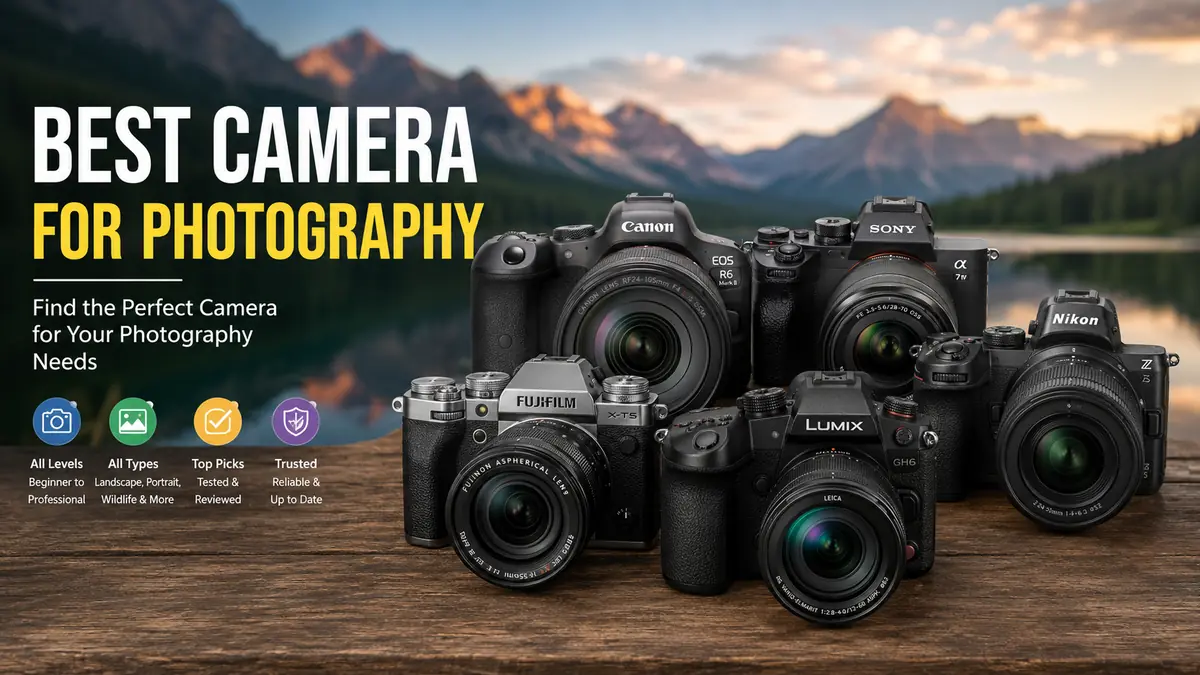

Choosing the best camera for photography is harder than comparing megapixels. Modern cameras are so capable that the better question is: which camera best fits the photographs you actually want to make?
A wildlife photographer needs fast autofocus and burst shooting. A landscape photographer may value dynamic range and resolution. A traveler probably cares more about weight and lens size. And someone learning photography needs controls that make sense without paying for professional features they may never use.
Quick answer: The best camera for photography depends on your subject, budget, sensor preference, and lens needs. The Sony A7 V is a strong full-frame all-rounder, the Fujifilm X-T5 excels as a compact high-resolution APS-C option, while cameras such as the Canon EOS R50 and R10 make photography easier for beginners.
This guide explains how those choices differ and, more importantly, which specifications actually matter when taking photographs.
What Is the Best Camera for Photography in 2026?
There is no single camera that is objectively best for every photographer.
Current recommendations from major camera-testing publications illustrate the point. TechRadar currently places the Sony A7 V at the top of its broad photography recommendations, while Amateur Photographer highlights models for individual needs, including the Nikon Z5II for full-frame value and Fujifilm X-T5 for APS-C photography.
That difference is useful rather than confusing. It shows why cameras should be compared according to their intended job.
| Photography need | Camera worth considering | Why it stands out |
|---|---|---|
| All-round photography | Sony A7 V | 33MP full-frame sensor, fast autofocus and strong overall versatility |
| Beginners | Canon EOS R50 / EOS R10 | Easy controls, reliable subject detection and APS-C portability |
| Full-frame value | Nikon Z5II | Strong image quality and feature set without flagship pricing |
| APS-C photography | Fujifilm X-T5 | 40.2MP sensor, compact design and photography-focused controls |
| Professional/action | Sony A1 II | High resolution combined with high-speed performance |
| Wildlife/action | Nikon Z9 | Fast shooting, subject detection and professional construction |
| Maximum image quality | Hasselblad X2D II 100C | 100MP medium-format imaging |
| Lightweight photography | OM System OM-1 II | Compact Micro Four Thirds system and strong stabilization |
These aren’t interchangeable choices. A 100MP medium-format camera can produce extraordinary detail, but it would make little sense as the default recommendation for someone photographing birds in flight or carrying a camera around a city all day.
The most useful rule
Choose a camera system, not simply a camera body.
The body will eventually be replaced. Your lenses may stay with you through several generations of cameras.
That makes lens availability, lens prices, autofocus compatibility and the long-term health of the mount almost as important as the sensor inside the camera.
Best Camera for Photography for Beginners
For a first interchangeable-lens camera, simplicity matters more than an enormous specification sheet.
A beginner-friendly camera should provide:
- dependable autofocus
- automatic and semi-automatic exposure modes
- a usable electronic viewfinder or screen
- RAW and JPEG capture
- interchangeable lenses
- straightforward controls
- manageable weight
- enough manual control to grow into
The Canon EOS R50 is particularly approachable. It uses a 24.2MP APS-C sensor, offers subject-detection autofocus and has a compact mirrorless body. RTINGS currently identifies it as a strong budget choice for beginning photographers, while Amateur Photographer also rates it highly for its compact dimensions, touchscreen interface and autofocus performance.
The Canon EOS R10 is another sensible step up. It gives photographers more room to develop their skills while remaining relatively accessible, and TechRadar currently recommends it as its beginner choice within its broader photography-camera guide.
What should a beginner actually prioritize?
Don’t make megapixels your first filter.
A 24MP APS-C camera is already capable of producing detailed photographs suitable for large prints, websites, social media and normal professional work.
Instead, pay attention to autofocus, ergonomics and lenses.
For example, someone interested in portraits might benefit more from buying an affordable 50mm or 85mm-equivalent prime lens than spending the same money upgrading to a higher-resolution body.
Is a DSLR still good for beginners?
Yes, particularly when buying used.
The Nikon D3500 remains a good example. Its 24MP APS-C sensor, simple interface, excellent battery endurance and built-in Guide Mode make it easy to understand. Its major limitation is that it belongs to an older DSLR ecosystem rather than the mirrorless direction in which most major manufacturers are now concentrating development.
That makes used DSLRs attractive when the price is significantly lower than a comparable mirrorless kit.
For a new system you intend to expand for years, however, mirrorless is usually the more practical starting point.
Quick Takeaway: Beginners should prioritize comfortable controls, reliable autofocus and affordable lenses. A modest camera you enjoy carrying will teach you more than an expensive flagship that stays at home.
Best Mirrorless Camera for Photography
Mirrorless cameras have become the default choice for most photographers shopping for a new interchangeable-lens system.
Unlike a DSLR, a mirrorless camera doesn’t require a reflex mirror to direct light into an optical viewfinder. Instead, the sensor continuously feeds the electronic viewfinder or rear display.
That architecture allows manufacturers to offer sophisticated features such as:
- subject-recognition autofocus
- eye detection
- real-time exposure preview
- in-body image stabilization
- high electronic burst rates
- detailed electronic viewfinders
- advanced video functions
Among current all-round options, the Sony A7 V deserves attention. Its 33MP full-frame sensor provides substantial resolution without pushing file sizes to the extremes of specialist high-resolution cameras. TechRadar’s current testing also highlights its 30fps burst capability, responsive autofocus and battery performance.
Sony’s mature E-mount ecosystem is another advantage. Lens choice matters enormously once the initial camera purchase is over.
RTINGS makes a similar point when discussing the earlier Sony A7 IV, noting that Sony’s established E-mount includes both native and third-party lens options.
Canon, Nikon, Sony or Fujifilm?
Brand matters less than the complete ecosystem.
Sony E-mount has an extensive selection covering everything from compact primes to professional telephoto lenses, including considerable third-party support.
Canon RF combines modern EOS R bodies with an expanding collection of RF and RF-S lenses. Canon cameras such as the EOS R50 and R10 are especially accessible for newcomers.
Nikon Z has grown into a strong system spanning DX-format APS-C bodies through professional full-frame cameras such as the Z9.
Fujifilm X-mount is particularly attractive to photographers who prefer APS-C. Instead of treating the format purely as an entry-level stepping stone, Fujifilm has built serious enthusiast and professional-oriented cameras and lenses around it.
There isn’t a universally superior mount. Look at the lenses you are likely to want over the next several years before committing.
Full Frame vs APS-C vs Micro Four Thirds
Sensor size affects image quality, camera size, lens design, depth of field and cost. It should therefore be considered as part of a system rather than as a simple ranking.
Full-frame cameras
A full-frame sensor is approximately the size of a traditional 35mm film frame.
Its larger surface area can provide advantages in low light and make shallow depth of field easier to achieve with equivalent framing. Full-frame systems also offer some of the industry’s broadest professional lens selections.
They work particularly well for:
- portraits
- weddings
- events
- landscapes
- astrophotography
- professional commercial work
- low-light photography
The downside is usually cost and size, especially once lenses are included.
A small full-frame body stops being a small kit when paired with a large f/2.8 zoom or fast telephoto prime.
APS-C cameras
APS-C is one of the best compromises between image quality, price and portability.
Cameras such as the Fujifilm X-T5 demonstrate why APS-C should not automatically be viewed as an entry-level format. Its 40.2MP X-Trans CMOS 5 HR sensor offers substantial resolution in a smaller system, while its photography-oriented controls and X-mount lens selection make it attractive to serious stills shooters.
APS-C can be particularly useful for:
- travel
- street photography
- wildlife
- family photography
- everyday photography
- enthusiasts who want a smaller kit
The crop factor also narrows the field of view produced by a given focal length compared with full frame. That can be useful when photographing distant subjects.
Micro Four Thirds
Micro Four Thirds uses a smaller sensor again.
Its main strength is system size. Bodies and especially telephoto lenses can be considerably easier to carry than equivalent full-frame equipment.
The OM System OM-1 II, for example, combines a compact format with strong image stabilization and action-oriented capabilities.
For hiking, wildlife and travel, reducing several kilograms of equipment to a more manageable kit can matter more in practice than achieving the largest possible sensor.
Medium format
Digital medium-format cameras use sensors larger than full frame.
A model such as the Hasselblad X2D II 100C, with its 100MP resolution, targets photographers who place extremely high image quality and detail above speed or affordability. TechRadar currently lists it as its pure-image-quality choice.
Medium format makes the most sense for controlled applications such as:
- studio portraits
- fashion
- fine art
- commercial photography
- highly detailed landscapes
It isn’t automatically better for every photograph.
Best Camera for Photography by Genre
The subject you photograph often reveals more about your ideal camera than any benchmark.
Portrait photography
Portrait photographers generally benefit from good eye-detection autofocus, pleasing skin tones, sufficient dynamic range and access to fast prime lenses.
Full-frame cameras are popular because lenses such as 50mm f/1.8 and 85mm f/1.8 can create strong subject separation without becoming prohibitively expensive.
But sensor format alone doesn’t create good portraits.
Lighting, focal length, distance from the subject and the photographer’s ability to direct a person usually have a much larger effect on the final photograph.
Look for:
- human eye autofocus
- reliable face detection
- good RAW dynamic range
- comfortable ergonomics
- tethering if you work in a studio
- affordable portrait lenses
Landscape photography
Landscape photographers often value resolution and dynamic range over burst speed.
High-resolution cameras provide more room for large prints and cropping. The Fujifilm X-T5’s 40.2MP APS-C sensor is an interesting portable option, while high-resolution full-frame and medium-format bodies move further toward maximum detail.
Useful landscape features include:
- high-resolution sensor
- strong dynamic range
- weather sealing
- in-body stabilization
- low base ISO
- exposure bracketing
- good battery endurance
- sharp wide-angle lens availability
A tripod and excellent lens can be more valuable than upgrading between two already-capable camera bodies.
Wildlife photography
Wildlife changes the priorities dramatically.
Resolution is useful because animals are frequently distant, but autofocus, burst rate and lens selection become equally important.
Look for animal and bird subject detection, deep buffers, fast continuous shooting and long telephoto lenses.
Professional cameras such as the Nikon Z9 and Sony A1 II combine high resolution with the speed needed for demanding action. TechRadar’s current photography guide highlights both among its professional options.
APS-C and Micro Four Thirds systems are also compelling here because their smaller formats can make long-reach setups more portable.
Sports and action photography
Sports photographers need predictability.
A camera that can technically shoot an enormous number of frames per second isn’t very useful if autofocus regularly misses the subject or the buffer stops the camera at the decisive moment.
Prioritize:
- subject-tracking autofocus
- continuous autofocus accuracy
- burst speed
- buffer depth
- fast memory-card support
- telephoto lens selection
- battery endurance
- weather-resistant construction
Electronic shutters can provide extraordinary burst rates, although photographers should also consider rolling-shutter behavior under fast movement or certain artificial lighting.
Street photography
Street photography rewards discretion.
A compact camera with a small prime lens often works better than an imposing professional body.
Around a 35mm full-frame-equivalent focal length remains particularly popular because it provides a natural balance between environmental context and subject emphasis. Current street-lens recommendations commonly include compact options around the 35–40mm equivalent range.
The Ricoh GR series, compact Fujifilm bodies and small interchangeable-lens mirrorless cameras illustrate this philosophy.
Useful features include:
- compact dimensions
- quiet shutter
- fast startup
- unobtrusive styling
- customizable controls
- good autofocus
- easy exposure compensation
The best street camera is often simply the one you will actually carry.
Travel photography
Travel photographers face a different problem: everything has to come with you.
A theoretically better camera can become worse in practice if its lenses make your backpack too heavy.
APS-C and Micro Four Thirds systems are therefore especially attractive.
Consider the total kit:
camera + everyday zoom + optional prime/telephoto + batteries + charger
rather than comparing body weights alone.
Weather sealing also becomes valuable if your camera will encounter dust, rain, beaches or cold conditions.
How Many Megapixels Do You Really Need?
Megapixels are easy to advertise because they give buyers a simple number to compare. Photography isn’t that simple.
A 24MP image contains roughly 24 million pixels. That is already enough resolution for most online use and substantial prints.
More resolution becomes particularly useful when you:
- make very large prints
- crop heavily
- photograph wildlife
- shoot detailed landscapes
- reproduce artwork
- work in commercial studios
- need significant retouching flexibility
For many photographers, approximately 24–33MP is an excellent balance.
Higher-resolution cameras in the 40–60MP class can preserve finer details but also produce larger files. That means more storage, larger memory cards and greater computer demands.
A 100MP medium-format file takes that requirement further again.
More megapixels don’t automatically mean better photographs
Resolution is only one component of image quality.
The final result also depends on:
- lens sharpness
- focus accuracy
- shutter speed
- camera movement
- subject movement
- exposure
- sensor performance
- RAW processing
- lighting
A perfectly focused 24MP photograph taken through a sharp lens can contain far more useful detail than a slightly blurred 60MP image.
Why Autofocus Matters More Than Many Buyers Expect
Modern autofocus is one of the strongest reasons to upgrade from an older digital camera.
Current mirrorless systems can recognize people, eyes, animals, birds and, on some models, vehicles or other subjects.
This changes the photographer’s job.
Instead of repeatedly moving a focus point over an eye, you can concentrate more attention on timing, composition and expression while the camera tracks the subject.
For portraits and family photography, eye autofocus is particularly useful. For wildlife and sports, subject recognition can make an even larger practical difference.
Don’t judge autofocus by the number of focus points
The specification sheet doesn’t tell the entire story.
What matters is how reliably the camera:
- detects your subject
- selects the correct subject
- finds an eye
- continues tracking through movement
- recovers after an obstruction
- focuses in low light
Real-world autofocus reliability is more useful than an impressive focus-point count.
Image Stabilization: When IBIS Is Worth Having
IBIS, or in-body image stabilization, moves the camera sensor to compensate for small movements made by the photographer.
It is particularly useful with stationary subjects.
Suppose you would normally need 1/125 second to avoid visible camera shake. Effective stabilization may allow you to use a significantly slower shutter speed when the subject isn’t moving.
That can help with:
- interiors
- architecture
- landscapes
- travel
- night scenes
- static low-light subjects
It doesn’t freeze subject movement.
If a football player is running across the frame, stabilization can reduce your own camera shake, but you still need a sufficiently fast shutter speed to freeze the athlete.
Some lenses also contain optical stabilization. Depending on the camera system, lens and in-body stabilization may work together.
RAW vs JPEG: Does the Camera Matter?
Most interchangeable-lens cameras can capture both.
JPEG files are processed by the camera. They’re smaller, ready to share and influenced by the manufacturer’s color profiles.
RAW files preserve substantially more sensor data for post-processing.
RAW becomes especially valuable when adjusting:
- highlights
- shadows
- white balance
- exposure
- color
- noise reduction
- sharpening
This is one reason experienced photographers frequently discuss dynamic range rather than simply asking which camera creates the nicest JPEG.
Fujifilm deserves special mention for photographers who enjoy finished images directly from the camera. Its film-simulation approach has made in-camera JPEG styling an important part of the X-series experience.
But RAW processing gives photographers much greater control regardless of brand.
Lens Selection Can Matter More Than the Camera
This is one of the easiest lessons to learn too late.
Imagine having $2,000 available for photography equipment.
Spending almost all of it on a premium body and attaching the cheapest available lens may give you fewer photographic possibilities than buying a moderately priced body plus two carefully selected lenses.
Different lenses fundamentally change what you can photograph.
| Lens type | Common uses |
| Ultra-wide | Architecture, interiors, landscapes, astrophotography |
| Standard zoom | Travel, everyday photography, events |
| 35mm prime | Street, documentary, environmental portraits |
| 50mm prime | Portraits, everyday photography, low light |
| 85mm prime | Portraits |
| Macro | Insects, products, flowers, close-ups |
| 70–200mm | Sports, events, portraits |
| 100–400mm or longer | Wildlife, birds, distant action |
This is why the lens mount deserves serious attention.
Sony E, Canon RF, Nikon Z, Fujifilm X and Micro Four Thirds each provide different combinations of native and third-party lenses.
Before choosing a body, write down three lenses you could realistically want later. Check their availability, size and cost.
That simple exercise can completely change which camera system makes sense.
Quick Takeaway: Camera bodies determine capabilities, but lenses determine many of your creative possibilities. Budget for the whole system rather than spending everything on the body.
DSLR vs Mirrorless: Which Is Better for Photography?
A DSLR can still produce outstanding photographs.
The difference is that mirrorless systems now receive most of the industry’s new development. TechRadar notes that manufacturers largely see mirrorless as photography’s future, while current models benefit from modern autofocus and performance improvements.
Mirrorless advantages
Modern mirrorless cameras typically offer:
- sophisticated subject detection
- electronic viewfinders
- exposure preview
- smaller flange distances
- high electronic burst rates
- strong hybrid photo/video features
- newer lens ecosystems
DSLR advantages
A DSLR may still provide:
- excellent optical viewfinders
- long battery life
- straightforward handling
- large used-lens markets
- excellent secondhand value
The Nikon D3500, for example, can exceed 1,500 shots per charge under its rated conditions and remains appealing as a simple still-photography tool despite its age.
Should you replace a DSLR just because it is old?
No.
If your current DSLR focuses accurately, produces the image quality you need and already works with good lenses, switching systems isn’t automatically an upgrade.
Mirrorless becomes particularly attractive when you need better subject detection, eye autofocus, electronic-viewfinder functionality, quieter operation or newer lenses.
What Camera Is Best for Low-Light Photography?
Low-light performance involves more than maximum ISO.
Sensor size can help because larger sensors can collect more light under comparable conditions, but the lens is equally important.
A full-frame body with an f/4 lens isn’t automatically the ideal low-light setup if another camera can use a much faster f/1.4 or f/1.8 lens.
For handheld low-light photography, think about four things together:
sensor + aperture + stabilization + shutter speed
A fast prime lens can make an enormous difference.
For static scenes, IBIS may let you use slower shutter speeds and lower ISO values. For moving people or animals, however, you’ll still need a sufficiently fast shutter, making lens aperture and high-ISO performance more significant.
Does Sensor Size Really Matter?
Yes—but not as much as internet arguments sometimes suggest.
A larger sensor has genuine technical advantages. Under equivalent conditions, it can gather more total light and can make shallow depth of field easier to achieve.
That doesn’t mean smaller sensors produce poor photographs.
Modern APS-C cameras can deliver professional-quality files. TechRadar specifically points out that APS-C isn’t limited to amateurs, with high-performance systems built around the format.
Micro Four Thirds goes further toward portability and can be particularly effective when telephoto reach and equipment weight matter.
Instead of asking, “Which sensor is best?” ask:
Which sensor gives me the best balance of image quality, lenses, weight and cost for what I photograph?
That’s a much more useful question.
How to Choose the Best Camera for Photography
Camera shopping becomes easier when you stop comparing every model simultaneously.
Use this process instead.
1. Decide what you photograph most
Write down your top two subjects.
For example:
- portraits + family
- landscapes + travel
- wildlife + birds
- sports + events
- street + documentary
This immediately establishes which features matter.
2. Set a complete-system budget
Don’t budget only for the camera.
Include:
- body
- lens
- memory card
- spare battery
- bag
- editing/storage requirements
If you have $1,500, a $1,500 body probably isn’t your ideal $1,500 camera system.
3. Choose an appropriate sensor format
Full frame makes sense when low-light performance, depth-of-field control and professional lens options outweigh size and cost.
APS-C provides an excellent balance.
Micro Four Thirds can reduce overall kit size considerably.
Medium format serves photographers whose work genuinely benefits from exceptional resolution and image quality.
4. Investigate lenses before buying
Check the lenses required for your subjects.
A wildlife photographer should investigate telephoto prices before choosing a mount.
A portrait photographer should check 50mm and 85mm options.
A traveler should look at compact zooms and primes.
5. Compare autofocus for your subjects
Don’t simply ask which autofocus system is “best.”
Ask whether it reliably recognizes what you photograph.
Bird detection matters enormously to a wildlife photographer and almost not at all to someone photographing buildings.
6. Consider ergonomics
Specifications cannot tell you whether a grip fits your hand.
If possible, handle the camera.
Check:
- grip comfort
- dial position
- viewfinder
- menu layout
- touchscreen
- button customization
- weight with your intended lens
A technically superior camera can become frustrating if you dislike operating it.
7. Decide how much resolution you need
For general photography, enormous files may offer little benefit.
Choose high resolution when cropping or large output genuinely demands it.
Otherwise, moderate resolution usually gives you smaller files, easier editing and plenty of detail.
8. Check real-world battery and storage needs
Fast burst shooting and large RAW files consume storage quickly.
High-resolution cameras can also create a hidden upgrade cost: faster cards, additional drives and potentially a more powerful editing computer.
9. Think several years ahead
Your first lens probably won’t be your last.
Consider where you might progress.
If you can imagine wanting a macro, portrait prime and telephoto zoom later, make sure the system gives you realistic options at prices you can afford.
Common Camera-Buying Mistakes
The most expensive mistakes often happen before anyone takes a photograph.
Buying based on megapixels alone
A higher number doesn’t guarantee better photographs.
Resolution matters, but autofocus, lenses, light and technique frequently matter more.
Spending the entire budget on the body
Leave money for glass.
A capable mid-range body paired with an appropriate lens can be much more useful than a flagship body with the wrong lens.
Assuming full frame is automatically professional
It isn’t.
Professional photography is about producing reliable results for a particular job. APS-C and Micro Four Thirds cameras are perfectly capable of professional work when their characteristics suit that work.
Ignoring weight
A camera isn’t useful when you stop carrying it.
This matters especially for travel, hiking and street photography.
Buying for specifications you don’t use
An extreme burst rate sounds impressive.
But if you photograph landscapes from a tripod, paying heavily for sports-oriented speed provides little practical benefit.
Ignoring used equipment
Previous-generation cameras can offer excellent value.
Image quality does not suddenly deteriorate because a replacement model appears.
Used DSLRs are particularly inexpensive in many markets as photographers migrate toward mirrorless systems.
Check shutter condition, sensor condition, controls, battery health and seller reputation before purchasing.
Is a Smartphone Enough Instead?
For many people, yes.
Modern smartphones are remarkably effective for everyday photography because computational processing handles exposure blending, HDR, noise reduction and sharpening automatically.
They’re also always available.
A dedicated camera becomes much more useful when you need:
- interchangeable lenses
- long telephoto reach
- genuine optical control
- consistent subject tracking
- RAW flexibility
- physical controls
- larger sensors
- flash systems
- studio accessories
- shallow depth of field
- specialized macro or wildlife lenses
The biggest advantage isn’t simply “better image quality.”
It’s control.
A dedicated camera allows you to choose the lens, aperture, shutter speed, ISO, focus behavior and lighting according to the photograph you are trying to create.
How Much Should You Spend on a Camera?
Spend according to the photographs you need to make rather than the maximum amount you can afford.
For beginners, an affordable APS-C mirrorless camera with a kit lens is often enough to learn exposure, composition and focusing.
Enthusiasts may benefit from better controls, IBIS, weather sealing, larger viewfinders or specialized lenses.
Professionals have different requirements. Dual card slots, durability, autofocus consistency, battery systems, workflow integration and service support can justify much more expensive equipment.
The price of the camera should therefore follow the requirement—not define it.
A useful budgeting principle
Instead of:
“What’s the most expensive camera I can afford?”
Ask:
“What’s the least expensive system that reliably does everything I need?”
The money left over can go toward lenses, lighting, travel, printing or simply more time taking photographs.
Which Camera Specifications Matter Most?
If a specification sheet feels overwhelming, focus on these:
| Specification | Why it matters |
| Sensor format | Influences size, low-light performance, depth of field and lens design |
| Resolution | Determines available detail and cropping flexibility |
| Autofocus | Critical for people, animals, sports and movement |
| Burst rate | Important for action and wildlife |
| Buffer | Determines how long high-speed shooting can continue |
| IBIS | Helps reduce camera shake |
| Viewfinder | Affects composition and shooting comfort |
| Weather sealing | Valuable outdoors |
| Card slots | Important for redundancy and professional workflows |
| Lens mount | Determines your future lens choices |
| Battery life | Important for travel, events and long sessions |
Video specifications matter only if you’re actually going to use them.
A camera with advanced 8K recording isn’t automatically a better stills camera for someone who never records video.
So, What Is the Best Camera for Photography?
For most photographers, there isn’t one universally correct answer.
The Sony A7 V is currently one of the strongest choices for photographers seeking a versatile full-frame mirrorless camera, combining a 33MP sensor with fast shooting and modern autofocus.
For photographers who prefer a smaller APS-C system, the Fujifilm X-T5 remains particularly compelling thanks to its 40.2MP sensor, in-body stabilization, photography-focused controls and established X-mount ecosystem.
Beginners should look closely at cameras such as the Canon EOS R50 and Canon EOS R10, which combine manageable APS-C bodies with capable autofocus and enough manual control to support developing skills.
Professionals photographing demanding action may justify cameras such as the Sony A1 II or Nikon Z9, while photographers prioritizing maximum resolution can move toward high-resolution full-frame or medium-format systems.
But the most useful way to find the best camera for photography is to work backward from your photographs.
Start with what you shoot. Decide which lenses those subjects require. Choose the sensor format and autofocus capabilities that support them. Then find a body that fits your hands, your bag and your budget.
The camera with the biggest specification sheet isn’t necessarily the best one.
The best camera is the system that gives you the tools you need—and makes you want to go out and take photographs.
