

A blocked or slow drain tells you something is wrong, but it rarely tells you where the problem is or what caused it. Digging, dismantling pipes, or repeatedly clearing the same blockage without knowing the cause can waste time and create unnecessary damage.
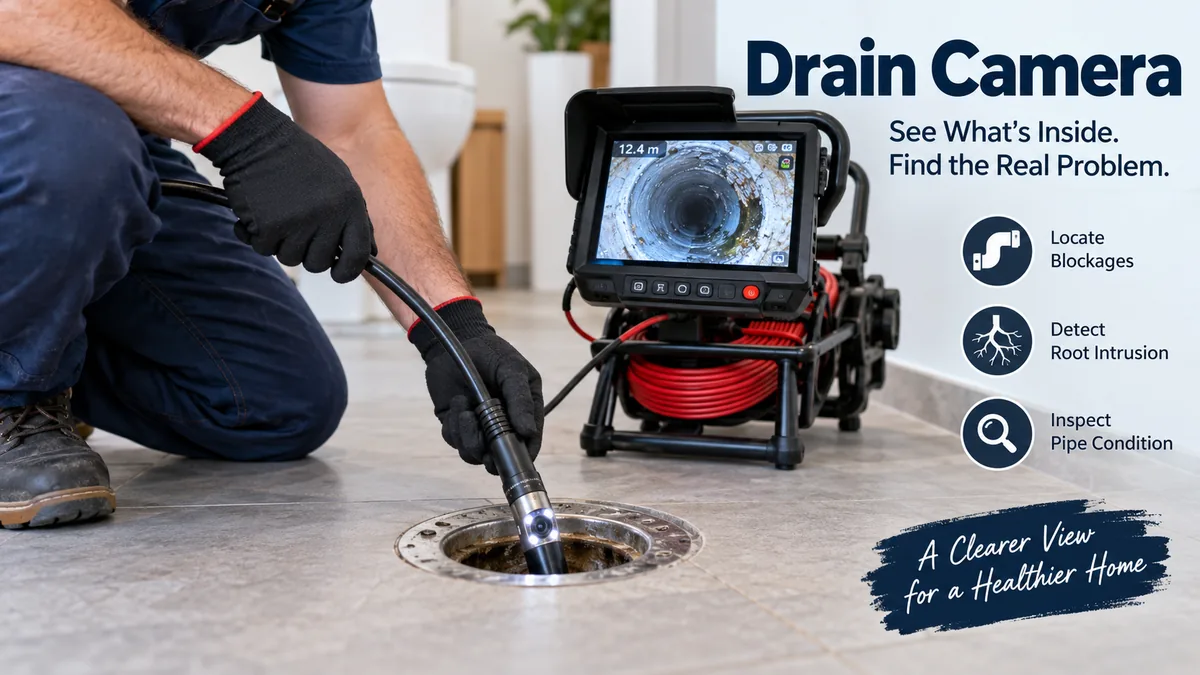
A drain camera is a waterproof video camera attached to a flexible cable or push rod and guided through a drain or sewer pipe. It sends live images to a monitor, allowing the operator to identify visible blockages, roots, cracks, displaced joints, corrosion, standing water, and other internal pipe conditions without excavation.
Modern camera inspections are used in residential plumbing, commercial drainage systems, municipal sewer networks, property inspections, and pipe-maintenance work. They are especially useful when a problem keeps returning and ordinary drain cleaning has not explained why.
What Is a drain camera?
A drain camera—also called a sewer camera, pipe inspection camera, CCTV drain camera, sewer scope, or drain inspection camera—is designed to provide a visual inspection of the inside of a drainage pipe.
A typical system includes:
- A waterproof camera head
- LED illumination
- A flexible push rod or cable
- A reel for storing and feeding the cable
- A monitor or display
- Video or image recording capability
- A distance counter on some systems
- A transmitter, often called a sonde, on some professional systems
- A surface locator that can detect the sonde
The basic idea is straightforward. Instead of trying to diagnose a buried pipe from symptoms alone, the operator places a camera inside it and observes the internal condition directly.
The U.S. Environmental Protection Agency describes CCTV inspection as a widely used sewer condition-assessment method capable of documenting sediment, debris, roots, sags, deflections, offset joints, cracks, leaks, and service connections.
Drain camera vs. borescope
A drain camera and a general-purpose borescope are related technologies, but they are not necessarily interchangeable.
Small borescopes and inspection cameras are useful for short, accessible spaces. A professional sewer camera normally has a stronger and much longer push cable, a camera head suited to pipe environments, brighter illumination, recording features, and sometimes locating equipment.
For a short fixture drain, a compact camera may be enough. Long underground sewer laterals generally require equipment designed specifically for sewer inspection.
How Does a drain camera Work?
A camera inspection follows the pipe rather than trying to diagnose it from outside.
The process generally works like this:
- An access point is selected.
The technician identifies a suitable cleanout, drain opening, or other safe access point. - The camera head enters the pipe.
A waterproof camera is carefully pushed into the drainage line using its flexible cable or push rod. - LED lights illuminate the interior.
Drain pipes are completely dark, so built-in lighting around the camera lens makes the walls, joints, deposits, and obstructions visible. - Live video appears on a monitor.
The operator watches the footage while advancing the camera through the line. - Defects and obstructions are documented.
Suspicious areas may be recorded as video or still images. Distance measurements can help establish how far the problem lies from the entry point. - A locator may be used above ground.
If the camera incorporates a sonde transmitter, compatible locating equipment can help determine the camera head’s approximate position from the surface. - The footage is interpreted.
The operator assesses the visible condition and relates it to symptoms such as repeated blockages, slow drainage, backups, or sewer odors.
Large municipal CCTV systems can be more sophisticated than residential push cameras. EPA material describes equipment ranging from simple pushrod cameras to remotely controlled crawler systems; larger systems may also provide pan, tilt, and zoom capabilities.
Quick Takeaway: The camera does not scan through the pipe like an X-ray. It physically travels through the accessible interior and records what its lens can see.
What Problems Can a drain camera Detect?
This is where camera inspection becomes particularly valuable. Different drainage faults can produce almost identical symptoms from above ground.
A slow drain, for example, might result from grease accumulation, roots, pipe deformation, a foreign object, or a structural defect. Video provides additional evidence for separating those possibilities.
Tree root intrusion
Roots naturally grow toward moisture. If a pipe has an opening at a joint or defect, roots may enter and continue growing inside it.
Camera footage can show fine root strands, thicker root masses, or severe root intrusion restricting the pipe.
EPA sewer-assessment research specifically identifies roots among the conditions detectable through CCTV inspection.
The important distinction is that a camera sees roots after they have entered the visible interior. It cannot show tree roots that remain outside an intact pipe.
Grease, scale, sediment, and debris
Material can accumulate on pipe walls and gradually reduce the available opening.
Depending on the system, footage may reveal:
- Grease deposits
- Sediment
- Mineral scale
- Sludge
- Loose debris
- Paper or wipes
- Foreign objects
- Other accumulated material
EPA field testing has documented grease, sediment, debris, and similar operation-and-maintenance problems using CCTV systems.
The appearance of the buildup also helps distinguish an ordinary obstruction from an underlying structural issue.
Cracks and fractures
Visible cracks, fractures, holes, and broken sections may appear clearly when the camera passes them.
Not every visible crack has the same significance. Its position, extent, pipe material, surrounding defects, and effect on pipe performance all matter.
That is one reason raw footage should be interpreted rather than treating every visible line as proof that an entire sewer requires replacement.
Offset or separated joints
Pipes are commonly assembled from multiple sections. Ground movement, settlement, installation problems, or deterioration can cause adjoining sections to move out of alignment.
A camera may reveal:
- Offset joints
- Open joints
- Separated connections
- Vertical or horizontal misalignment
- Roots entering through a joint
- Debris catching on an offset
EPA guidance has long identified abnormal joint conditions and misalignment among problems observable during television sewer inspection.
Bellies, sags, and standing water
A pipe belly or sag is a low section where wastewater can collect rather than continuing to flow freely downhill.
On video, the camera may enter standing water and later emerge from it. Persistent pooling can be an indication that the pipe’s grade or support has changed.
CCTV inspection can provide evidence of pipe sags and deflections, according to EPA condition-assessment guidance.
However, video alone does not necessarily provide a precise engineering measurement of the pipe’s slope.
Collapsed or badly deformed pipe
A severely damaged pipe may become partially or completely obstructed.
A camera can often reveal the beginning of a collapse or deformation, but there is an obvious limitation: if the passage is completely closed, the camera cannot continue beyond it.
The stopping point still provides useful information, particularly when combined with cable-distance measurements and electronic locating equipment.
Corrosion and deterioration
Older metallic drainage pipes, particularly cast iron, may develop internal corrosion, scale, rough surfaces, or other deterioration.
The camera can document what is visible on the inside surface.
It cannot, however, measure the remaining wall thickness simply by looking at that surface. External corrosion may also be hidden from view.
Foreign objects
Unexpected objects sometimes enter drainage systems.
Depending on the size of the pipe and visibility, an inspection may reveal an item obstructing flow or a collection of material trapped around it.
Seeing the object can be useful because the appropriate response to a removable obstruction can be very different from the response to a cracked, collapsed, or badly offset pipe.
Service connections and changes in pipe condition
A camera may also help document lateral connections, changes in pipe material, unusual fittings, protrusions, and other visible features.
EPA guidance includes the location and condition of service connections among the information CCTV inspection can provide.
What a drain camera Cannot Tell You
Camera footage is powerful precisely because it provides direct visual evidence. But it is still visual evidence, not a complete structural scan.
Understanding that limitation prevents one of the most common mistakes: assuming a clean-looking video proves that every part of the drainage system is healthy.
It cannot see through the pipe wall
The lens looks at the interior surface.
It does not normally show:
- Soil surrounding the pipe
- Underground voids outside it
- Roots that have not entered
- Exterior-only deterioration
- The full thickness of the pipe wall
- Damage hidden behind an apparently intact inner surface
EPA research specifically notes that CCTV cannot identify voids in surrounding backfill and soil, cracks that have not surfaced internally, or deterioration confined to the pipe’s exterior.
It cannot see clearly through dirty standing water
If the lens is submerged in murky wastewater, the operator’s view may be severely restricted.
EPA guidance notes that CCTV essentially provides visual information about the interior surface above the waterline, and inspection quality is affected by flow level and picture quality.
This matters with pipe bellies and major blockages because the most interesting part of the pipe may be underwater.
It may not pass a complete blockage
A push camera has to physically travel through the pipe.
A dense root mass, hard obstruction, severe offset, tight configuration, or complete collapse can prevent further movement.
Professional CCTV specifications account for this problem; NASSCO guidance, for example, describes attempting inspection from the opposite direction when an obstruction prevents completing a sewer section.
For a residential line, clearing an obstruction first may allow a more complete inspection afterward.
It does not automatically prove a leak
A camera may reveal a crack, hole, displaced joint, or other condition associated with leakage. That does not mean ordinary video footage precisely measures how much liquid is escaping into surrounding soil.
Other testing or assessment methods may be required when the central question is watertightness rather than visible internal condition.
It cannot predict exactly when a pipe will fail
A camera records conditions at the time of inspection.
A small defect may remain stable or worsen. Root intrusion may return. Soil can move. Corrosion can progress.
Good footage provides evidence for assessing current condition; it is not a guarantee of future performance.
Quick Takeaway: A drain camera is best understood as an internal visual inspection tool—not an X-ray, leak meter, wall-thickness gauge, or soil scanner.
When Is a drain camera Inspection Useful?
Not every slow sink requires a camera. A simple localized blockage can often be diagnosed and cleared without one.
Camera inspection becomes more useful when symptoms suggest a deeper or recurring problem.
Repeated drain blockages
If a sewer line is cleared but continues clogging, the important question becomes why it keeps happening.
Repeated blockage can indicate roots, an offset joint, a sag, deterioration, or another condition that ordinary clearing does not correct.
Running a camera after the line has been adequately cleared can provide a much better view of the underlying cause.
Several drains are slow at once
One slow fixture often points to a local issue.
Multiple fixtures draining poorly—especially toilets, tubs, and floor drains—can indicate a problem farther downstream in a shared drain or main sewer lateral.
A camera can then help inspect that common section.
Sewer backups
A sewage backup deserves more than repeated guesswork, particularly when it has happened more than once.
Once conditions are safe and the obstruction has been addressed as necessary, camera footage can reveal whether the backup is associated with roots, buildup, a damaged joint, deformation, or another visible restriction.
Unexplained sewer odors
Odor by itself does not identify a pipe defect. Plumbing traps, vents, seals, and other components can also be involved.
When other evidence points toward a drain or sewer-line problem, however, a camera may help reveal visible damage or unusual conditions requiring further investigation.
Before certain repairs
Knowing the pipe’s condition before choosing a repair method can prevent unnecessary work.
The difference between a removable buildup and a structurally damaged line is substantial. Camera footage gives the technician visual evidence to combine with other diagnostic information before deciding what work is justified.
After drain cleaning
One of the most useful times to inspect a problematic line is after accumulated material has been removed.
A cleaner pipe provides a better view of:
- Joints
- Cracks
- Root entry points
- Pipe walls
- Corrosion
- Remaining deposits
- Deformation
The post-cleaning inspection can also help determine whether the cleaning addressed only the symptom or exposed an underlying defect.
During property evaluation
A conventional property inspection cannot provide a full visual assessment of a buried sewer lateral from the surface.
A sewer scope can document the accessible interior condition at the time of inspection, which can be particularly useful for older properties, properties with mature trees, or buildings with a history of drainage trouble.
It should still be understood as a snapshot of accessible pipe—not a warranty that every underground component is defect-free.
What Happens During a Professional Drain Camera Inspection?
Although equipment and procedures differ, a useful inspection should be systematic rather than simply pushing a camera down the line for a few minutes.
1. Symptoms are reviewed
The technician first needs context.
Recurring blockage, slow drainage, previous root removal, backups, known repairs, pipe age, and the affected fixtures can all help determine which section needs inspection.
2. An appropriate access point is found
A cleanout often provides straightforward access to a sewer lateral.
Access matters because a camera must physically enter the relevant section of pipe. Not every branch or fitting can be reached from every opening.
3. The condition of the line is considered
If the pipe is completely blocked, meaningful camera travel may not be possible.
The line may need to be cleared before the camera can inspect the sections beyond the obstruction.
4. The camera is advanced carefully
The operator feeds the push rod while watching the monitor.
Good inspection technique matters. Moving too quickly can make small defects easy to miss, while poor image quality, high flow, or dirty lenses can reduce the usefulness of the footage.
EPA research emphasizes that CCTV assessment quality depends partly on picture quality, flow conditions, and operator interpretation.
5. Important observations are recorded
The operator may document the distance to a defect and record video or still images.
Typical observations include roots, joints, buildup, fractures, standing water, connections, changes in material, and the point where the camera cannot advance.
6. Surface locating may be performed
A sonde-equipped camera head emits a signal that compatible locating equipment can detect from above ground.
This helps translate “the defect is somewhere down the line” into a more useful surface location for further investigation or targeted work.
The locator should not be confused with the camera itself. The camera supplies the visual information; the sonde and receiver help establish location.
7. Findings are interpreted
This step matters as much as the camera hardware.
EPA research notes that CCTV condition assessment is affected by operator interpretation.
An experienced technician should distinguish ordinary features from defects and explain what the footage actually supports rather than making a major repair recommendation from a vague image.
Understanding Drain Camera Equipment and Specifications
Camera systems vary considerably. A compact tool for a short household drain has different requirements from equipment intended for a long sewer main.
Camera head diameter
The camera must fit the pipe being inspected.
Smaller heads can negotiate tighter lines and fittings, while larger systems may provide features suited to bigger sewer pipes.
Matching the head and cable to the expected pipe diameter is more useful than simply choosing the largest camera.
Push rod length and stiffness
Cable length determines potential inspection reach, but reach is not the same thing as usable performance.
A very long cable provides little benefit if it is too flexible to push through the intended pipe. Conversely, a stiff push rod may be difficult to navigate through tight bends.
Professional equipment balances length, stiffness, and flexibility for its intended pipe range.
Camera resolution
Clear images make it easier to distinguish cracks, deposits, roots, joint edges, and pipe texture.
Resolution matters, but advertised pixel count is only part of image quality. Lighting, focus, lens cleanliness, pipe conditions, and the monitor all influence what the operator can actually see.
LED lighting
A sewer line provides no useful natural light.
Integrated LEDs illuminate the pipe wall around the camera. Adjustable lighting can be helpful because excessive glare from wet surfaces can sometimes obscure detail just as inadequate light can.
Self-leveling camera heads
Some systems keep the image upright as the camera rotates inside the pipe.
This does not change what defects physically exist, but it can make footage easier to interpret and present.
Recording
Video and still-image recording create a permanent record of the inspection.
For important decisions, retaining the footage can be valuable because it allows findings to be reviewed instead of relying entirely on a verbal description.
Distance counter
A distance counter estimates how much cable has been fed into the line.
It helps describe a defect’s position relative to the access point, although cable distance should not automatically be treated as an exact surface location.
Sonde and locator
A transmitter built into or near the camera head can emit a locatable signal.
When a defect is identified, the operator can stop the camera and use a compatible receiver at the surface to help determine its approximate position and, depending on the equipment and conditions, estimated depth.
This feature is particularly useful when targeted excavation or additional investigation may be necessary.
Drain Camera vs. Other Drain Diagnostic Methods
No single diagnostic method answers every plumbing question.
| Method | Best suited to | Main limitation |
|---|---|---|
| Drain camera/CCTV | Viewing internal pipe condition | Cannot see through pipe walls |
| Drain snake/auger | Mechanically clearing many obstructions | Does not provide a complete visual diagnosis |
| Hydro jetting | Removing suitable grease, sludge, roots, and deposits | Primarily a cleaning method, not structural imaging |
| Sonde locator | Locating a transmitter from the surface | Does not show the pipe interior |
| Smoke testing | Investigating certain leaks, connections, or venting problems | Does not provide internal video |
| Specialized leak/condition testing | Answering questions beyond visual condition | May require different equipment and expertise |
The distinction between diagnosis and treatment is important.
A drain camera observes. A snake or jetting system clears. A locator helps establish position. Repair methods address structural defects.
Sometimes several of these tools are used in sequence.
Can You Use a drain camera Yourself?
Consumer inspection cameras exist, and there are situations where an experienced homeowner may be able to inspect a short, readily accessible drain.
The difficulty is not simply getting a picture.
Useful sewer inspection requires the ability to:
- Choose appropriate access
- Navigate bends without damaging equipment
- Recognize pipe materials
- Distinguish deposits from defects
- Interpret joints correctly
- Identify meaningful standing water
- Avoid misreading shadows or glare
- Understand when the camera cannot provide an answer
- Work safely around sewage and sewer gases
A cheap camera can produce a video without producing a reliable diagnosis.
There is also a genuine safety issue around sewer infrastructure. OSHA warns that hydrogen sulfide can occur in sewers and accumulate in low-lying or enclosed spaces. It is toxic, flammable, and potentially deadly; smell is not a dependable warning because the ability to detect its odor can disappear with exposure.
Never enter a sewer, manhole, tank, or other confined space simply to inspect a pipe. Professional confined-space procedures involve hazards far beyond owning a camera.
Common Mistakes When Interpreting Drain Camera Footage
Camera footage can look convincing even when the interpretation is weak.
Assuming every crack means total replacement
Visible defects vary greatly in significance.
A recommendation should consider the defect’s severity, location, pipe material, symptoms, and overall condition—not simply the existence of one suspicious frame.
Inspecting through a dirty, blocked line
A camera cannot provide a useful view of a wall hidden behind grease, sewage, debris, or opaque standing water.
If cleaning is appropriate, a second inspection afterward may reveal far more than the initial camera run.
Treating the camera as a leak detector
Seeing a crack and proving active leakage are different questions.
The footage may support further investigation without conclusively establishing what is occurring outside the wall.
Confusing cable distance with exact location
Knowing that a defect appears after a certain amount of cable has entered the line is useful, but pipe routes are not always straight.
For targeted location work, a sonde/receiver or other locating method is preferable to guessing from cable length alone.
Accepting a diagnosis without seeing the evidence
When practical, ask to see the relevant section of footage and understand what feature is being identified.
The goal is not to become a sewer-inspection expert. It is to make sure that the explanation matches what the inspection actually documented.
How Are Professional Sewer Defects Documented?
For larger sewer systems, inspection is more structured than simply recording video.
The National Association of Sewer Service Companies (NASSCO) maintains the Pipeline Assessment Certification Program, commonly called PACP, for standardized pipeline condition assessment. NASSCO also publishes guidance relating to CCTV inspection and sewer pipe cleaning.
Standardized documentation becomes particularly important for municipalities, utilities, engineering work, asset-management programs, and large drainage networks because defects need to be described consistently.
Residential homeowners do not necessarily need a PACP-coded survey for every clogged drain. Still, the underlying principle is useful: good inspection involves both clear imagery and consistent interpretation.
How Accurate Is a drain camera Inspection?
A camera can be extremely effective for answering a specific question:
What visible condition exists inside this accessible portion of the pipe right now?
For that task, CCTV is one of the most useful tools available.
Accuracy becomes less certain when someone tries to make the camera answer questions it was not designed to answer.
EPA research identifies several variables that affect CCTV assessment, including:
- Operator interpretation
- Picture quality
- Flow level
- Visibility of the internal surface
- The type of defect being investigated
It also distinguishes visual CCTV from other technologies capable of assessing aspects such as pipe-wall integrity or surrounding soil conditions.
So a “clear camera inspection” should be interpreted precisely: the accessible and visible interior did not show the defect being sought. It does not necessarily mean the entire underground drainage system has been proven structurally perfect.
What Should a Useful Drain Camera Report Show?
For anything beyond a quick exploratory look, useful documentation should make it possible to understand what was inspected and what was found.
Depending on the purpose, that can include:
- Inspection date
- Access point
- Pipe section inspected
- Approximate inspection distance
- Pipe material where identifiable
- Visible obstructions
- Root intrusion
- Cracks or fractures
- Joint condition
- Standing water or suspected sagging
- Corrosion or deposits
- Locations where the camera could not continue
- Still images or recorded video
- Distance measurements for significant findings
- Surface location information where a locator was used
For a serious structural finding, the report should separate what the camera actually showed from the interpretation or recommended response.
That distinction makes the information much more useful for comparing opinions or planning further investigation.
Is a Drain Camera Inspection Worth Doing?
It depends on the problem.
For a simple, isolated clog with an obvious cause, video inspection may add little. For repeated blockages, suspected sewer-line damage, root intrusion, unexplained main-line problems, or an older buried lateral, seeing inside the pipe can provide information that symptoms alone cannot.
Its biggest advantage is not that it makes every diagnosis certain.
It is that it replaces a significant amount of guesswork with visible evidence.
The EPA describes CCTV as a cost-effective technology providing a broad base of information for sewer condition assessment, while also recognizing that it cannot provide every type of structural or surrounding-soil data.
That is the right way to think about the technology.
Final Thoughts on Using a drain camera
A drain camera gives homeowners, plumbers, inspectors, and sewer professionals a direct look at otherwise hidden sections of drainage pipe. It can reveal tree roots, debris, grease, cracks, fractures, offset joints, sags, standing water, corrosion, service connections, and severe structural damage without digging simply to discover what is inside.
Its limitations are just as important. The camera sees the accessible internal surface; it cannot see through the pipe wall, fully assess surrounding soil, measure every leak, or inspect beyond an obstruction it cannot physically pass.
The most reliable approach is therefore simple: use the drain camera as a diagnostic tool, preserve clear footage when the findings matter, and interpret the images alongside the pipe layout, drainage symptoms, cleaning history, and any additional testing required. That turns a video from an interesting view inside a pipe into genuinely useful evidence for understanding the drainage system.
