
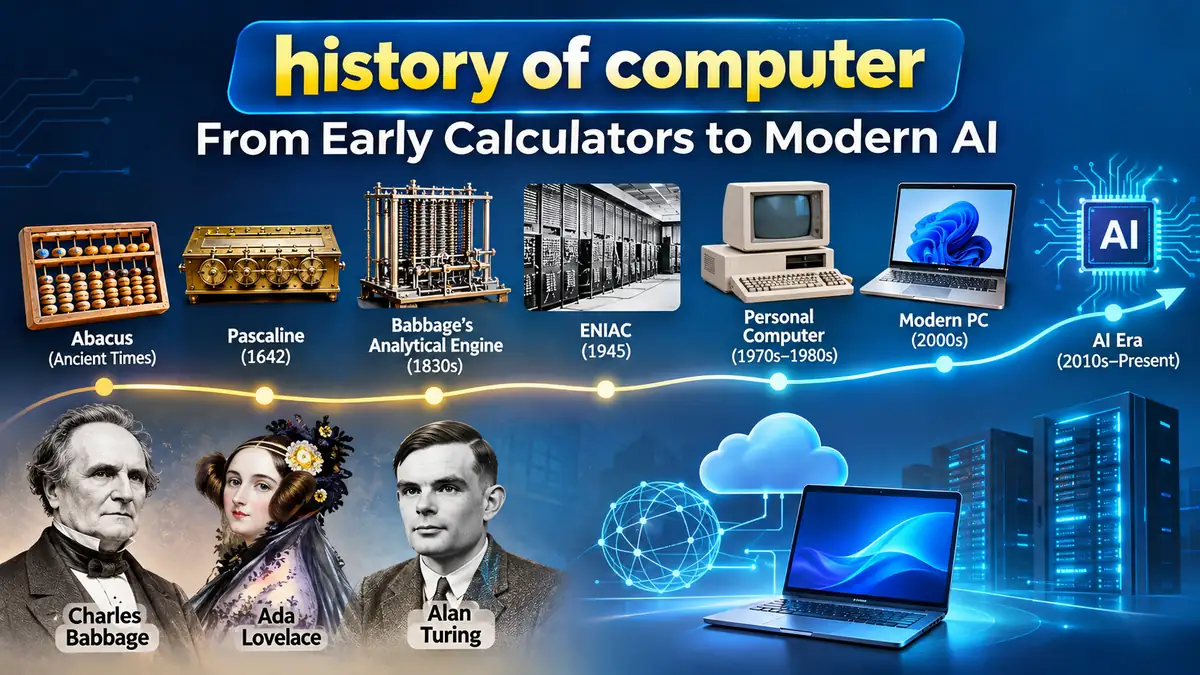

The computer on your desk or in your pocket is the result of centuries of inventions, experiments, and scientific discoveries. Long before electronic computers existed, people were developing tools to calculate numbers, organize information, and automate complicated tasks.
The history of computer technology traces the development of calculating devices into programmable electronic machines. It begins with ancient tools such as the abacus, progresses through mechanical calculators and Charles Babbage’s designs, and continues with vacuum-tube computers, transistors, microprocessors, personal computers, the internet, and artificial intelligence.
Understanding this evolution explains not only how computers became faster and smaller, but also how they transformed education, business, communication, science, and everyday life.
What Is a Computer and How Did Its History Begin?
A computer is an electronic device that accepts data, processes it according to instructions, stores information, and produces results. Modern computers perform these operations using hardware and software.
The term computer originally described a person who performed mathematical calculations. Over time, it became associated with machines designed to carry out similar work.
Early computing developed because people needed reliable ways to perform arithmetic, track trade, predict astronomical events, and manage increasingly complex records.
The first calculating devices
Abacus — Ancient origins
Abacus closeup Stock Photos, Royalty Free Abacus closeup Images | DepositPhotos
Iniciativa Ciudadana Europea .IA
File:Pascaline-CnAM 823-1-IMG 1506-black.jpg – Wikimedia Commons
The abacus is among the oldest known calculating tools. Its origins stretch back thousands of years, and different forms appeared in several civilizations.
By moving beads or counters, users could perform addition, subtraction, multiplication, and division. The abacus did not execute stored programs, but it established a lasting principle: a physical device could help people manipulate numerical information.
Other important early inventions included:
- Antikythera mechanism: An ancient Greek geared device, generally dated to around the second or first century BCE, used to model astronomical cycles.
- Napier’s bones (1617): Calculation rods developed by Scottish mathematician John Napier to simplify multiplication and division.
- Slide rule (17th century): A calculating instrument based on logarithmic scales, widely used by scientists and engineers before electronic calculators.
- Pascaline (1642): A mechanical arithmetic machine developed by Blaise Pascal to assist with addition and subtraction.
These devices demonstrated that mathematical work could be supported by mechanisms rather than mental calculation alone.
Leibniz and mechanical arithmetic
In the 1670s, German mathematician Gottfried Wilhelm Leibniz developed a design for a stepped-drum calculator capable of performing multiple arithmetic operations.
Leibniz also made major contributions to the study of binary arithmetic, which later became fundamental to digital computing.
Binary notation represents numbers using two symbols, 0 and 1. Modern digital circuits use two-state representations to encode and process information.
However, Leibniz’s calculator was mechanical, not a modern binary electronic computer. His mathematical work and his calculating-machine designs were distinct contributions to computing history.
history of computer: Major Milestones and Timeline
The development of computers was gradual. No single invention produced the modern computer overnight.
Instead, advances in mathematics, mechanical engineering, electronics, programming, and manufacturing combined over several centuries.
| Year or period | Invention or milestone | Historical significance |
|---|---|---|
| Ancient times | Abacus | Supported arithmetic calculations |
| 1617 | Napier’s bones | Simplified mathematical operations |
| 1642 | Pascaline | Mechanized addition and subtraction |
| 1670s | Leibniz’s calculator | Advanced mechanical arithmetic |
| 1801 | Jacquard loom | Used punched cards to control weaving patterns |
| 1822 | Difference Engine | Babbage’s design for automated mathematical tables |
| 1830s | Analytical Engine | Introduced concepts of general-purpose programmable computing |
| 1843 | Ada Lovelace’s notes | Described an algorithm intended for the Analytical Engine |
| 1890 | Hollerith tabulating system | Processed U.S. Census data using punched cards |
| 1936 | Turing machine concept | Established a theoretical model of computation |
| 1941 | Zuse Z3 | Demonstrated programmable electromechanical computing |
| 1943–1944 | Colossus | Performed electronic codebreaking computations |
| 1945–1946 | ENIAC | Established large-scale electronic general-purpose computing |
| 1947 | Transistor invention | Laid the foundation for smaller electronic computers |
| 1951 | UNIVAC I | Brought commercial electronic computing to the United States |
| 1958–1959 | Integrated circuits | Combined electronic components on semiconductor chips |
| 1971 | Intel 4004 | Introduced a commercially available single-chip microprocessor |
| 1975–1981 | Early personal computers | Expanded individual access to computing |
| 1989–1991 | World Wide Web | Made linked digital information accessible over the internet |
| 2000s | Smartphones and cloud computing | Expanded portable and network-based computing |
| 2010s–2020s | Modern AI systems | Advanced machine learning and generative computing |
The timeline shows how computing progressed from physical calculation tools to programmable systems capable of processing enormous amounts of information.
Charles Babbage and the Birth of Programmable Computing
The Greatest Scientists of All Time – Ranked | Make Lists, Not War
Charles Babbage (1791–1871)
Charles Babbage was an English mathematician and inventor whose designs anticipated several essential features of modern computers. He is frequently called the Father of the Computer because of his pioneering work on automatic calculating machines.
The Difference Engine
In 1822, Babbage proposed the Difference Engine, a mechanical machine designed to calculate and print mathematical tables.
At the time, mathematical tables were essential for navigation, astronomy, engineering, and scientific research. Human calculations and transcription could introduce serious errors.
The Difference Engine was intended to reduce those mistakes through automation.
Babbage did not complete his original full-scale machine during his lifetime. Later reconstructions demonstrated that his underlying design was mechanically workable.
The Analytical Engine
During the 1830s, Babbage developed the concept of the Analytical Engine, a much more ambitious machine.
Unlike the Difference Engine, which was designed for a specialized mathematical task, the Analytical Engine was intended to perform different calculations based on instructions.
Its proposed architecture included:
- A store for holding numbers, resembling computer memory.
- A mill for performing arithmetic, comparable in function to a processor.
- Punched-card mechanisms for controlling operations.
- Input and output arrangements.
- Support for repeated operations and conditional execution.
These concepts anticipated important elements of modern computer architecture.
The complete Analytical Engine was never built in Babbage’s lifetime, but its design helped establish the intellectual foundations of general-purpose computing.
Ada Lovelace and the first computer algorithm
Ada Lovelace, première programmeuse de l’Histoire | National Geographic | National Geographic
Ada Lovelace (1815–1852)
Ada Lovelace, an English mathematician, worked with Babbage’s ideas and recognized possibilities beyond numerical calculation. In 1843, she published extensive notes accompanying her translation of an article about the Analytical Engine.
One of her notes described a method for calculating Bernoulli numbers using the proposed machine. It is widely recognized as an early published computer algorithm intended for execution by a machine.
Lovelace also suggested that such a device might manipulate symbols representing music and other information, provided the relationships could be expressed mathematically.
This was a remarkable conceptual step: computers might eventually work with far more than numbers.
The Development of Early Electronic Computers
The transition from mechanical computing to electronic computing accelerated during the first half of the twentieth century.
Scientists and engineers needed machines capable of solving problems that were too large or time-consuming for manual calculation.
Herman Hollerith and punched-card data processing
In the late nineteenth century, American inventor Herman Hollerith developed electromechanical tabulating equipment that used punched cards to represent data.
His technology was used in processing the 1890 United States Census.
Punched-card systems later became important in business accounting, government administration, and early computer input methods.
Hollerith’s company eventually became part of the corporate lineage of IBM.
Alan Turing and the theory of computation
In 1936, British mathematician Alan Turing described a theoretical computing machine that could manipulate symbols according to precisely defined rules.
The Turing machine was not a physical computer. It was a mathematical model used to investigate which problems could be solved through systematic computation.
Turing’s work helped establish computer science as a formal intellectual discipline.
During World War II, he also contributed to British codebreaking work at Bletchley Park.
Konrad Zuse and the Z3
German engineer Konrad Zuse completed the Z3 in 1941.
It was a programmable, automatic electromechanical digital computer that used binary arithmetic and floating-point calculations.
The Z3 was an important achievement, although its architecture differed from the stored-program computers that later became standard.
Colossus and wartime computing
Five facts on Colossus showing how far computing has come in 75 years
75 years ago, the world’s first modern computer made its public debut
Retro Workshop (@RetroWorkshop) on X
6
The Colossus machines were developed in Britain during World War II to assist in cryptanalysis.
The first became operational in 1944, following development work in 1943. Engineer Tommy Flowers played a central role in their construction.
Colossus used thousands of vacuum tubes and performed electronic digital processing at speeds far beyond conventional manual methods.
It was programmable for its specialized codebreaking purpose, but it was not a general-purpose stored-program computer.
ENIAC and electronic general-purpose computing
The Electronic Numerical Integrator and Computer, or ENIAC, was developed by John Mauchly and J. Presper Eckert at the University of Pennsylvania.
Completed in 1945 and publicly unveiled in 1946, ENIAC was among the earliest large-scale, electronic, general-purpose digital computers.
It used approximately 18,000 vacuum tubes and occupied a substantial room.
Programming its original configuration required physically setting switches and connecting cables. Later modifications improved its ability to use stored instructions.
ENIAC demonstrated the enormous potential of electronic computation, particularly for scientific and military calculations.
Which was the first computer in the world?
There is no universally correct single answer because the definition of first computer depends on the technology being considered.
| Computer | Year | Distinguishing achievement |
|---|---|---|
| Z3 | 1941 | Programmable automatic electromechanical digital computer |
| Atanasoff–Berry Computer | 1939–1942 | Early electronic digital machine for specialized mathematical problems |
| Colossus | 1944 | Programmable electronic digital machine for cryptanalysis |
| ENIAC | 1945 | Early electronic general-purpose digital computer |
| Manchester Baby | 1948 | First machine to run a program stored electronically in memory |
| EDSAC | 1949 | Early practical stored-program electronic computer |
The Atanasoff–Berry Computer, developed by John Atanasoff and Clifford Berry, used electronic components and binary arithmetic but was not a general-purpose programmable computer.
The Manchester Baby, developed at the University of Manchester, successfully executed its first stored program on June 21, 1948.
EDSAC, built at the University of Cambridge under Maurice Wilkes, became operational in 1949 and provided a practical stored-program computing service.
These distinctions explain why historians recognize multiple pioneers rather than attributing every computing breakthrough to one invention.
Five Generations of Computers Explained
The five-generation model is a common educational framework for describing the evolution of computer hardware and capabilities.
It is useful for introductory study, although actual technological development overlapped between generations and did not follow perfectly defined boundaries.
From Tally Marks to Modern Computers — The Early Evolution of Census Data Processing
First Generation: Vacuum Tubes (approximately 1940s–1950s)
Early electronic computers used vacuum tubes for switching and amplification. They were generally large, expensive, energy-intensive, and required substantial maintenance.
Examples include ENIAC, UNIVAC I, and IBM 701.
File:IBM 1401 at CHM.jpg – Wikimedia Commons
Second Generation: Transistors (approximately mid-1950s–mid-1960s)
Transistors replaced vacuum tubes in many computer designs, reducing size and power requirements while improving reliability.
Examples include IBM 1401 and IBM 7090. Languages such as FORTRAN and COBOL became important during this period.
Third Generation: Integrated Circuits (approximately mid-1960s–early 1970s)
Integrated circuits combined multiple electronic components into compact semiconductor devices.
Systems such as the IBM System/360 family helped establish compatible computer architectures and supported increasingly sophisticated operating systems.
Apple II Computer with Apple Monitor II, Disk II Drives, and Software
Fourth Generation: Microprocessors (1970s onward)
Microprocessors integrated central processing functions onto semiconductor chips, making smaller and more affordable computers practical.
Personal computers, laptops, and many embedded devices grew from advances associated with this era.
95%对40%背后:GPT-6 Astra赢了机械臂测试,但赢得不太干净 – ic.work
Fifth Generation: Artificial Intelligence and Advanced Computing
In many educational classifications, the fifth generation refers to systems emphasizing artificial intelligence, parallel processing, natural-language interaction, and advanced computing capabilities.
Unlike earlier generations, it has no universally agreed start date or exclusive hardware technology.
Comparison of computer generations
| Generation | Main technology | Typical characteristics |
|---|---|---|
| First | Vacuum tubes | Large, power-intensive electronic machines |
| Second | Transistors | Smaller, more reliable hardware |
| Third | Integrated circuits | Greater component density and improved performance |
| Fourth | Microprocessors | Personal and portable computing |
| Fifth | AI and advanced architectures | Intelligent software and specialized parallel processing |
Modern computers still rely heavily on microprocessors and integrated circuits. Artificial intelligence represents an additional capability rather than a complete replacement of earlier hardware principles.
The Invention of the Microprocessor and Personal Computer
The invention of the microprocessor was one of the most significant turning points in the history of computer technology.
Before microprocessors, computer processors typically required multiple circuit boards or numerous separate electronic components.
A microprocessor placed central processing functions on a single integrated circuit.
Intel 4004 and the microprocessor revolution
In 1971, Intel introduced the 4004, a commercially available single-chip microprocessor.
The chip was developed through contributions from Federico Faggin, Ted Hoff, Stan Mazor, and Masatoshi Shima.
The Intel 4004 was a 4-bit processor initially associated with calculator applications.
Later processors, including the Intel 8008, Intel 8080, and Intel 8086, helped expand the capabilities and commercial applications of microprocessor technology.
How personal computers became popular
世界初のパーソナルコンピュータと称されるApple II スタンダードお披露目
【當年今周】個人電腦砌機概念源頭誕生 IBM 5150帶來的PC革命
Several landmark systems contributed to the rise of personal computing.
Altair 8800 (1975): This microcomputer kit attracted electronics hobbyists and helped stimulate the emerging personal computer industry. Its success also contributed to the early growth of Microsoft.
Apple II (1977): Developed by Apple, the Apple II offered an integrated keyboard, color graphics capabilities, and an expanding software ecosystem. It became influential in homes, schools, and businesses.
IBM PC (1981): The IBM Personal Computer, model 5150, helped establish a widely adopted business computing platform. Its architecture encouraged a large market for compatible hardware and software.
Personal computing changed the relationship between people and machines. Computers were no longer accessible only through universities, governments, or major corporations.
Graphical user interfaces and the mouse
Early personal computers frequently relied on typed commands.
Graphical user interfaces made computing more approachable by allowing users to interact with windows, icons, menus, and pointing devices.
Research at Xerox PARC played an important role in developing graphical interfaces and related technologies.
The Xerox Alto, introduced in 1973, demonstrated several concepts that later influenced commercial personal computers.
Apple’s Lisa (1983) and Macintosh (1984) brought graphical interfaces to commercial desktop systems, while Microsoft Windows later helped popularize GUI-based computing across IBM-compatible PCs.
The computer mouse, developed through work led by Douglas Engelbart in the 1960s, became a central input device for graphical computing.
The Evolution of Computer Software, Operating Systems, and the Internet
Computer hardware became increasingly powerful, but software determined how people could use that power.
A computer program is a set of instructions that directs a machine to perform tasks. An operating system manages hardware resources and provides services for applications.
The development of programming languages
Early computer programs were written in machine instructions or assembly language.
Higher-level programming languages made software easier to develop, understand, and maintain.
Important milestones include:
- FORTRAN (1957): Developed at IBM under a team led by John Backus, it became influential in scientific and engineering computing.
- COBOL (1959): Designed for business data processing and administrative applications.
- BASIC (1964): Created by John Kemeny and Thomas Kurtz to make programming more accessible to students.
- C (early 1970s): Developed by Dennis Ritchie at Bell Labs and widely used for systems software.
- C++ (1980s): Extended C with additional programming features, including object-oriented facilities.
- Python (1991): Created by Guido van Rossum and later became widely used in automation, education, scientific computing, and AI.
- Java (1995): Introduced by Sun Microsystems, emphasizing portability across computing environments.
- JavaScript (1995): Created by Brendan Eich and became fundamental to interactive web applications.
Each language reflected changing needs, from scientific calculation to business automation and networked software.
UNIX, Windows, Linux, and macOS
Operating systems also evolved substantially.
UNIX emerged at Bell Labs in 1969 through work by Ken Thompson, Dennis Ritchie, and colleagues. Its design influenced many later operating systems.
Microsoft released MS-DOS for the IBM PC ecosystem in 1981, followed by Windows in 1985.
In 1991, Linus Torvalds began developing the Linux kernel. Combined with other software, Linux became the foundation for numerous operating systems used in servers, supercomputers, embedded devices, and personal computers.
Apple’s modern macOS evolved from the NeXTSTEP and UNIX-related technology that became part of Mac OS X in 2001.
These operating systems helped shape modern software development, networking, security, and user interaction.
From ARPANET to the World Wide Web
A short history of the internet | National Science and Media Museum
The internet and the World Wide Web are closely related, but they are not the same technology.
The internet is a global network infrastructure that connects computer networks using standardized communication protocols.
The World Wide Web is an information system built on top of the internet, using technologies such as HTTP, HTML, and URLs.
ARPANET, a pioneering packet-switched network, began operating in 1969. It connected research institutions and contributed to the development of modern computer networking.
On January 1, 1983, ARPANET adopted TCP/IP, a major milestone in the development of the internet.
In 1989, Tim Berners-Lee proposed the World Wide Web while working at CERN. By 1990, he had developed foundational web software, and the project became publicly accessible in 1991.
Web browsers subsequently made online information much easier to navigate.
The Mosaic browser, released in 1993, played an influential role in popularizing graphical web browsing.
Together, these developments transformed computers from largely independent machines into interconnected communication and information systems.
Modern Computers: Smartphones, Cloud Computing, and Artificial Intelligence
The twenty-first century expanded computing beyond traditional desktop machines.
Today, computing capabilities are embedded in phones, vehicles, appliances, industrial systems, medical equipment, and global digital infrastructure.
Laptops and mobile computing
Portable computers existed before the modern laptop became widespread.
Early systems such as the Osborne 1 (1981) demonstrated transportable personal computing, although they were bulky compared with contemporary devices.
Advances in batteries, displays, processors, and semiconductor manufacturing eventually enabled lightweight laptops with substantial processing capabilities.
Smartphones extended this transformation.
The introduction of the iPhone in 2007 and the first commercial Android phone in 2008 accelerated the adoption of modern mobile computing platforms.
Smartphones combine processors, memory, storage, cameras, sensors, wireless connectivity, and sophisticated operating systems in compact devices.
Cloud computing and distributed systems
Cloud computing allows individuals and organizations to access computing resources over networks instead of maintaining every system locally.
Common services include remote storage, virtual machines, databases, software applications, and large-scale data processing.
Cloud platforms use extensive data-center infrastructure to provide computing capacity that can be allocated according to demand.
Distributed computing also allows multiple machines to cooperate on large problems.
These technologies support activities ranging from video streaming and online collaboration to scientific simulations and global business operations.
Artificial intelligence and machine learning
Artificial intelligence refers to computational methods designed to perform tasks associated with capabilities such as learning, prediction, perception, language processing, and reasoning.
The field has roots in earlier computer science research, including Turing’s 1950 paper on machine intelligence and the Dartmouth research project of 1956.
Machine learning enables systems to identify patterns from data rather than relying entirely on individually specified rules.
Deep learning uses multilayer neural networks and has become particularly important in computer vision, speech recognition, language processing, and scientific research.
Modern generative AI systems can produce text, images, code, and other forms of content based on patterns learned during training.
Their capabilities depend on powerful processors, large datasets, mathematical models, and extensive computing infrastructure.
AI systems can still produce incorrect outputs, reflect biases in training data, and require careful evaluation, particularly in high-stakes applications.
Supercomputers and quantum computers
Supercomputers use large numbers of processors working together to solve computationally intensive problems.
They support weather forecasting, climate modeling, molecular simulations, engineering research, and other scientific applications.
Their performance is often measured in floating-point operations per second, or FLOPS.
Quantum computers use quantum-mechanical principles, including superposition and entanglement, to process information in ways that differ from classical computers.
Rather than conventional bits alone, quantum systems use quantum bits, or qubits.
Quantum computing remains an active research and development field. It may provide advantages for particular problems, but it is not a general replacement for classical computing.
How Computers Have Changed Human Society
The history of computer development is also a history of changes in how people work, communicate, learn, and solve problems.
Computers have reshaped nearly every major sector of modern society.
Education and research
Educational institutions use computers for digital textbooks, virtual classrooms, research databases, simulations, and learning management systems.
Scientists use computational tools to analyze experimental results, model physical systems, and explore problems that would be impractical to solve manually.
Business and industry
Businesses rely on computing for accounting, inventory management, customer records, communication, manufacturing, and financial analysis.
Industrial automation uses sensors, controllers, and software to monitor and operate equipment.
Computers have also enabled entirely new industries, including software development, digital services, and online commerce.
Healthcare
Computing supports medical imaging, electronic health records, laboratory analysis, hospital administration, and biomedical research.
Advanced systems can help analyze medical data, although clinical decisions still require appropriate professional oversight and validation.
Communication and entertainment
Email, instant messaging, video calls, social platforms, streaming services, and interactive games all depend on computing technology.
Digital communication allows people to exchange information across long distances almost instantly.
However, this progress has also introduced concerns about privacy, cybersecurity, misinformation, digital inequality, and dependence on connected systems.
Understanding computer history means recognizing both the opportunities and the challenges created by technological development.
The Future of Computer Technology
Computers will continue to evolve through improvements in hardware architecture, semiconductor manufacturing, networking, and software.
Several developments are especially significant.
More specialized processors
General-purpose CPUs remain central to computing, but specialized processors are increasingly used for graphics, artificial intelligence, and other demanding workloads.
Graphics processing units (GPUs), neural processing units (NPUs), and application-specific integrated circuits (ASICs) can accelerate tasks suited to their architectures.
This approach helps improve performance and energy efficiency without depending entirely on faster conventional CPUs.
Energy-efficient computing
Energy consumption has become a major concern for data centers, mobile devices, and large-scale AI systems.
Researchers are exploring improved chip designs, cooling systems, memory technologies, and software optimization techniques.
The goal is not simply to increase computing speed, but to perform useful work with fewer resources.
Edge computing
Edge computing processes data closer to where it is generated instead of always sending it to a distant data center.
Applications include industrial sensors, connected vehicles, smart infrastructure, and devices that require rapid local responses.
This approach can reduce network latency and bandwidth demands, although its advantages depend on the application.
Human-computer interaction
Voice interfaces, accessibility technologies, augmented reality, and AI-assisted software are changing how people interact with computers.
Future interfaces may increasingly combine language, images, gestures, and contextual information.
Yet the essential principles remain recognizable: computers receive information, execute instructions, manipulate data, and produce useful outputs.
Why Studying the history of computer Matters
Studying the history of computer technology helps explain why modern machines work as they do.
Many concepts that appear contemporary have surprisingly old foundations.
Programmable instructions were anticipated in Babbage’s nineteenth-century designs. Binary mathematics predates electronic computers. Networked communication developed through decades of research before the modern web became popular.
This historical perspective also corrects common misconceptions.
Charles Babbage did not build the first modern electronic computer. ENIAC was not the first computing machine of every kind. The internet and the web were developed at different times. Artificial intelligence is not a technology that appeared suddenly in the 2020s.
Instead, each major innovation built upon earlier discoveries.
For students, the subject provides a foundation for computer science, information technology, and digital literacy. For general readers, it offers a clearer understanding of the technology used every day.
Conclusion
The history of computer development spans thousands of years, from early counting instruments to sophisticated electronic systems capable of processing immense amounts of data.
The contributions of Charles Babbage, Ada Lovelace, Alan Turing, Konrad Zuse, and many other pioneers helped establish the principles behind modern computing. Later breakthroughs involving transistors, integrated circuits, microprocessors, software, and global networks made computers faster, smaller, more accessible, and more powerful.
Today’s artificial intelligence systems, cloud platforms, smartphones, and supercomputers are extensions of that long technological journey.
The most useful way to understand computer history is to follow how each generation solved the limitations of the one before it. That pattern of experimentation, improvement, and new possibilities continues to shape the future of computing.
