
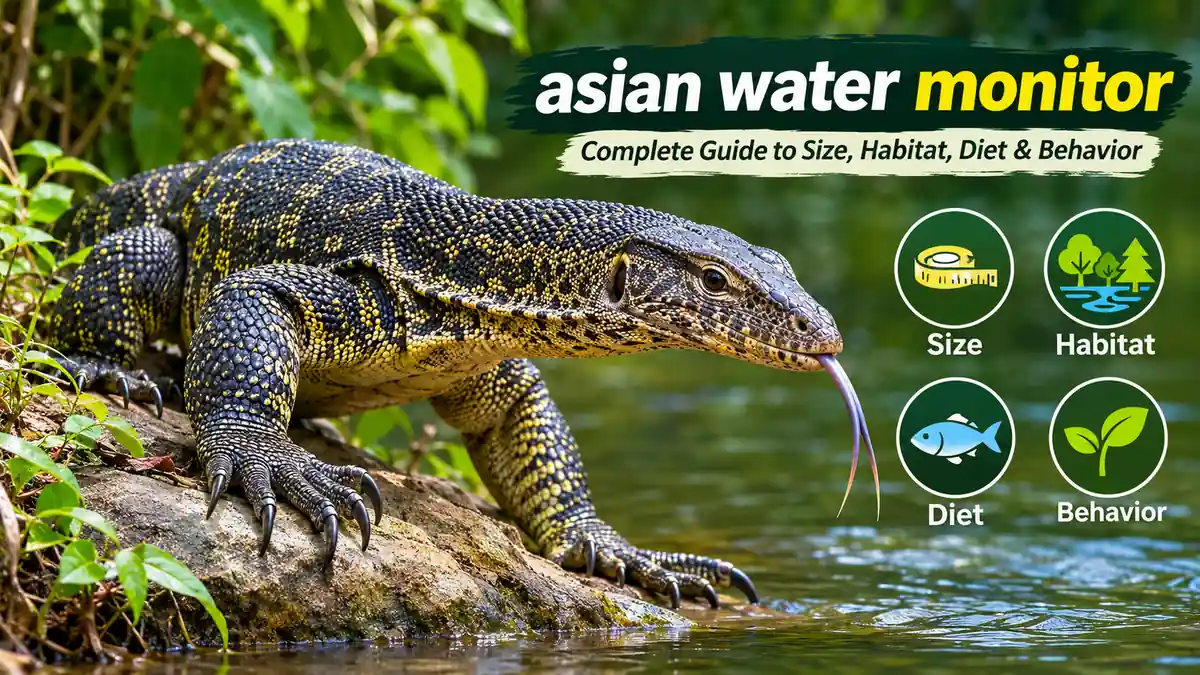

The asian water monitor is one of the largest living lizards, with a powerful tail, sharp claws, and an extraordinary ability to thrive around rivers, wetlands, forests, and even busy cities. Despite its intimidating appearance, this reptile plays an important ecological role by hunting animals and consuming carrion.
The asian water monitor (Varanus salvator) is a large, semiaquatic monitor lizard native to South and Southeast Asia. It can exceed 2 meters (6.6 feet) in total length, feeds opportunistically on fish, crabs, rodents, birds, and carrion, and is an excellent swimmer. Although generally wary of people, it can inflict serious injuries if threatened or handled.
What Is an Asian Water Monitor?
Common Water Monitor (Varanus salvator) on the grass.
Asian Water Monitor (Varanus salvator)
12
The Asian water monitor belongs to the family Varanidae, a group of reptiles known for their elongated bodies, muscular tails, strong limbs, and active hunting behavior.
Its scientific name is Varanus salvator. The species is widely distributed across parts of tropical Asia and is especially associated with water-rich environments.
Like other monitor lizards, it uses its forked tongue and a highly developed chemosensory system to investigate its surroundings. The tongue collects chemical particles, which are analyzed through the vomeronasal organ, also called Jacobson’s organ.
Asian Water Monitor Quick Facts
| Feature | Details |
|---|---|
| Scientific name | Varanus salvator |
| Family | Varanidae |
| Common name | Asian water monitor |
| Animal type | Reptile |
| Typical adult length | Approximately 1.5–2 meters |
| Maximum length | Can exceed 3 meters in exceptional individuals |
| Weight | Highly variable; large adults can exceed 20 kg |
| Natural habitat | Rivers, wetlands, mangroves, forests, canals |
| Diet | Carnivorous, opportunistic |
| Activity | Primarily diurnal |
| Reproduction | Egg-laying |
| Lifespan | Often 10–20 years or more under managed care |
| Conservation status | Least Concern under widely cited IUCN assessments |
Size, longevity, and ecological characteristics vary with geography, sex, environmental conditions, and the population being studied.
Asian Water Monitor Size and Physical Appearance
The Asian water monitor is among the world’s heaviest lizard species. Its body is built for swimming, climbing, digging, and capturing prey.
How Big Does an Asian Water Monitor Get?
Most mature individuals measure roughly 1.5–2 meters (5–6.6 feet) in total length, including the tail. Particularly large specimens may exceed 2.5 meters, while exceptional individuals can reach or surpass 3 meters.
Males generally grow larger and heavier than females, a pattern known as sexual size dimorphism.
| Growth stage | Approximate total length |
|---|---|
| Hatchling | 25–40 cm |
| Juvenile | 40–100 cm |
| Subadult | 1–1.5 m |
| Adult | 1.5–2 m or more |
| Exceptional large adult | Over 2.5–3 m |
These are broad descriptive ranges rather than strict age-based growth standards. Food availability, temperature, genetics, and sex influence development.
Distinctive Physical Features
An Asian water monitor can be recognized by several characteristics:
- Muscular tail: Long and laterally compressed, helping propel the animal through water.
- Strong claws: Useful for climbing, digging, gripping surfaces, and handling prey.
- Forked tongue: Detects chemical signals from food, other monitors, and the environment.
- Powerful jaws: Equipped with sharp, backward-curving teeth.
- Scaly skin: Provides physical protection and helps limit water loss.
- Dark coloration: Many individuals display brown, gray, or black bodies with yellowish spots or bands.
Juveniles often have more noticeable contrasting markings, while adults may become darker with age.
Asian Water Monitor vs. Komodo Dragon
The Komodo dragon (Varanus komodoensis) is generally heavier and more robust than the Asian water monitor.
| Characteristic | Asian water monitor | Komodo dragon |
|---|---|---|
| Scientific name | Varanus salvator | Varanus komodoensis |
| Geographic range | South and Southeast Asia | Selected Indonesian islands |
| Typical habitat | Wetlands, forests, waterways | Dry forests, savannas, coastal habitats |
| Swimming ability | Highly adapted to swimming | Capable swimmer |
| Diet | Broad range of animal prey and carrion | Large vertebrates and carrion |
| Conservation status | Least Concern | Endangered |
Both species belong to the genus Varanus, but their habitats, body proportions, and ecological specializations differ substantially.
Asian Water Monitor Habitat and Geographic Distribution
Water Monitor Lizard basking on the bank
Asian water monitor, Varanus salvator, in front of a lake in a park in Bangkok
14
Asian water monitors occur across a broad region that includes parts of South Asia and Southeast Asia.
Their distribution includes populations in countries such as Sri Lanka, India, Bangladesh, Myanmar, Thailand, Malaysia, Singapore, Indonesia, and neighboring areas. Taxonomic revisions have separated some historically included populations into distinct species, so older distribution maps may not match current classifications.
Where Do Asian Water Monitors Live?
These lizards occupy several environments:
- Tropical rainforests and forest edges
- Freshwater rivers and streams
- Swamps and marshes
- Mangrove forests and coastal wetlands
- Lakes, ponds, and reservoirs
- Agricultural canals and irrigation systems
- Urban parks and drainage networks
Their adaptability allows them to survive in natural and human-modified landscapes.
Water provides opportunities for hunting, thermoregulation, escape, and movement between habitats.
Why Are Water Monitors Common in Bangkok?
In Bangkok, Thailand, large monitor lizards are frequently observed near canals, lakes, and public parks.
Lumphini Park is particularly well known for sightings of these reptiles.
The combination of water, shelter, suitable basking areas, and available food helps explain their presence.
However, a monitor lizard living in a city remains a wild animal. Feeding it or approaching it closely can create dangerous interactions.
Can Asian Water Monitors Live in Saltwater?
Asian water monitors tolerate coastal environments, including mangroves and brackish waterways. They are also capable of swimming across stretches of marine water.
However, they are not exclusively marine reptiles.
Freshwater habitats remain especially important for many populations, and their use of coastal waters should not be confused with the specialized marine lifestyle of sea snakes or sea turtles.
Asian Water Monitor Diet and Hunting Behavior
The Asian water monitor is an opportunistic carnivore, meaning it consumes many kinds of animal food depending on availability.
It can function as both an active predator and a scavenger.
What Do Asian Water Monitors Eat?
Their diet may include:
| Food source | Examples |
|---|---|
| Fish | Freshwater fish and other aquatic species |
| Crustaceans | Crabs and similar invertebrates |
| Amphibians | Frogs and tadpoles |
| Reptiles | Snakes, lizards, and eggs |
| Birds | Small birds, chicks, and eggs |
| Mammals | Rodents and other small mammals |
| Carrion | Dead fish, mammals, and other animals |
| Human-associated food waste | Discarded animal remains and scraps |
Diet composition changes with habitat, body size, and seasonal food availability.
Young monitors generally capture smaller prey, including insects and other invertebrates. Larger individuals can exploit a wider range of vertebrate prey.
How Do They Find Food?
Water monitors rely heavily on chemical detection.
Their forked tongues collect scent particles from the air and surfaces. Information from these particles helps the lizard locate prey or carrion, sometimes even when the food source is hidden.
They also use vision to detect movement and respond to opportunities.
When hunting, a monitor may search along a riverbank, investigate vegetation, enter shallow water, or explore burrows.
Do Asian Water Monitors Eat Snakes?
Yes. Snakes are among the potential prey of large Asian water monitors.
However, snakes are not necessarily a dominant food source in every population. Fish, crustaceans, rodents, and carrion may be more readily available in certain habitats.
Do They Eat Crocodiles?
Large monitors may raid reptile nests and consume eggs or small hatchlings when opportunities arise.
They are not generally predators of healthy adult crocodiles. Adult crocodiles can themselves pose a danger to monitor lizards.
Their Role as Scavengers
Carrion consumption is a valuable ecological function.
By feeding on dead animals, water monitors help process animal remains and move nutrients through food webs.
This does not mean they eliminate all disease risks or completely clean ecosystems. Their scavenging is one part of a broader decomposition process involving insects, microorganisms, and other animals.
Asian Water Monitor Behavior and Intelligence
Asian water monitors are active, observant reptiles with complex behaviors that help them survive in changing environments.
Unlike mammals, they do not depend on social cooperation for most everyday activities. Nevertheless, they can learn from experience, recognize environmental patterns, and adjust their behavior in response to food availability and potential threats.
Are Asian Water Monitors Intelligent?
Monitor lizards are widely regarded as behaviorally sophisticated reptiles.
They demonstrate abilities associated with:
- Learning where food is regularly available.
- Remembering familiar routes and shelter locations.
- Investigating unfamiliar objects.
- Adjusting hunting strategies to different environments.
- Recognizing repeated environmental cues.
These behaviors suggest flexible learning rather than purely automatic responses.
However, claims that monitors think exactly like dogs, recognize human emotions, or form human-style emotional bonds go beyond what current evidence reliably establishes.
Are Asian Water Monitors Aggressive?
Wild Asian water monitors generally prefer to avoid direct confrontation with people.
When disturbed, they may attempt to escape into vegetation, climb a tree, or enter nearby water.
A cornered animal can become defensive and may hiss, inflate its body, lash its tail, scratch, or bite.
Aggression is more likely when the lizard is restrained, injured, protecting an escape route, or repeatedly approached.
A calm-looking monitor should never be assumed harmless.
Can Asian Water Monitors Climb Trees?
Yes. Their strong limbs and curved claws make them capable climbers.
Juveniles frequently use trees to escape predators and access sheltered resting locations.
Larger adults can also climb, although their substantial body weight makes some branches unsuitable.
How Fast Can Asian Water Monitors Run?
Asian water monitors can accelerate quickly over short distances, particularly when escaping danger.
Some online sources provide precise running speeds, but reliable standardized measurements for the species are limited.
Rather than relying on an unsupported maximum-speed figure, it is more accurate to describe them as agile reptiles capable of rapid bursts of movement on land and efficient propulsion in water.
Asian Water Monitor Swimming and Aquatic Adaptations
Asian water monitor lizard swimming in river
Swimming is one of the Asian water monitor’s most recognizable abilities.
Its elongated body and muscular, laterally compressed tail allow it to move effectively through rivers, canals, and wetlands.
How Do Asian Water Monitors Swim?
Water monitors primarily propel themselves through lateral movements of the tail.
Their limbs assist with steering, stability, and maneuvering near submerged obstacles.
Their aquatic abilities allow them to:
- Cross waterways between feeding areas.
- Escape terrestrial predators or disturbances.
- Search for fish and aquatic invertebrates.
- Move through flooded forests.
- Reach islands and coastal habitats.
They can also dive below the surface to investigate underwater areas or avoid threats.
How Long Can an Asian Water Monitor Stay Underwater?
Asian water monitors can remain submerged for several minutes, and longer dives have been reported.
However, the maximum duration varies with the animal’s activity, temperature, physiological condition, and circumstances.
Claims that every water monitor can remain underwater for a particular number of minutes should be treated cautiously unless supported by controlled observations.
Water monitors breathe air using lungs. They cannot extract oxygen directly from water like fish.
Can Asian Water Monitors Breathe Underwater?
No. Asian water monitors are air-breathing reptiles.
They must eventually return to the surface to breathe.
Their ability to hold their breath is an adaptation for diving, not underwater respiration.
Asian Water Monitor Reproduction and Life Cycle
Asian water monitors reproduce sexually and lay eggs rather than giving birth to live young.
Their reproductive success depends on environmental conditions, suitable nesting sites, and food availability.
Mating and Breeding Behavior
Breeding activity varies geographically, with seasonal rainfall and local environmental conditions influencing reproductive timing.
Males may compete for access to females, while courtship involves physical contact and chemical investigation.
Females select nesting locations that offer protection and appropriate incubation conditions.
How Many Eggs Do Asian Water Monitors Lay?
Clutch sizes vary substantially, but roughly 10–30 eggs are commonly reported, with smaller or larger clutches possible.
Females may deposit eggs in:
- Underground burrows
- Termite mounds
- Decaying logs
- Sheltered soil cavities
- Protected riverbanks
Some observations indicate females may remain near nesting sites, although the extent of parental care varies and is not fully understood. Species Profile+1
Incubation and Hatching
Egg incubation depends heavily on temperature, humidity, and nesting conditions.
Incubation often lasts several months, with approximately six to nine months frequently described in husbandry accounts.
Newly hatched monitors are independent and must locate food, shelter, and safe temperatures.
They face threats from snakes, birds, larger reptiles, and mammals.
How Long Do Asian Water Monitors Live?
Longevity varies between wild and captive environments.
Individuals under managed care may survive 15–20 years or longer, while the lifespan of wild animals is harder to establish because many disappear from observation before their natural deaths.
Diet, disease, injury, predation, and environmental conditions all influence survival.
Are Asian Water Monitors Dangerous to Humans?
Asian water monitors are powerful wild reptiles capable of causing serious injuries. However, they do not normally seek out humans as prey.
The greatest risk usually comes from attempting to capture, handle, feed, or corner an animal.
Can an Asian Water Monitor Bite?
Yes. Their jaws contain sharp teeth capable of producing deep cuts and puncture wounds.
Large monitors also have considerable jaw strength, and their bites can damage soft tissue.
Any serious bite requires medical evaluation because of the possibility of tissue damage, infection, and other complications.
Are Asian Water Monitors Venomous?
Monitor lizards possess oral glands associated with biologically active secretions, and research on monitor-lizard venom has challenged the older assumption that these reptiles rely entirely on mechanical biting injuries.
However, the clinical significance of venom-related effects differs among species and remains incompletely characterized for Asian water monitors.
Their bites should not be treated as equivalent to bites from highly venomous snakes.
The immediate medical concerns generally include physical injury, bleeding, and infection.
What Should You Do If You Encounter One?
If you see an Asian water monitor in a park, garden, or near a canal:
- Remain calm and avoid sudden movements toward the animal.
- Keep a safe distance and allow an escape route.
- Never attempt to touch, restrain, or chase it.
- Keep children and pets away.
- Avoid feeding it or leaving animal food nearby.
- Contact local wildlife authorities if it is trapped, injured, or creating an immediate hazard.
If bitten, wash the wound with clean running water, control bleeding with gentle pressure, and seek prompt medical care. Deep wounds, uncontrolled bleeding, or signs of systemic illness require urgent attention. A clinician can assess infection risk and tetanus protection.
Do Asian Water Monitors Attack Dogs or Cats?
Large monitors may opportunistically prey on small animals, and defensive encounters with domestic pets are possible.
Nevertheless, not every encounter between a monitor and a dog or cat results in an attack.
Keeping pets supervised and away from wildlife reduces the risk to both animals.
Asian Water Monitor vs. Other Monitor Lizards
Several monitor species share similar body shapes but differ in size, distribution, habitat, and behavior.
| Species | Scientific name | Main distinguishing feature |
|---|---|---|
| Asian water monitor | Varanus salvator | Large, strongly associated with waterways |
| Nile monitor | Varanus niloticus | African species associated with aquatic habitats |
| Bengal monitor | Varanus bengalensis | South Asian species often found in terrestrial habitats |
| Savannah monitor | Varanus exanthematicus | African species adapted to savannas and seasonal environments |
| Komodo dragon | Varanus komodoensis | Exceptionally large and heavy Indonesian monitor |
Asian Water Monitor vs. Nile Monitor
The Nile monitor is another large, semiaquatic lizard.
Both species swim effectively, consume diverse animal prey, and use powerful tails and claws.
Their main distinction is geographic: Nile monitors are native to Africa, whereas Asian water monitors occur naturally in Asia.
Asian Water Monitor vs. Bengal Monitor
The Bengal monitor occurs across parts of South Asia and neighboring regions.
Although Bengal monitors can swim, they are generally more associated with terrestrial habitats than Asian water monitors.
Body proportions, coloration, head shape, and habitat preferences can help distinguish them.
Is the Asian Water Monitor the Second-Largest Lizard?
The Asian water monitor is frequently described as the world’s second-largest living lizard after the Komodo dragon.
That description generally refers to overall body size, particularly mass, but rankings depend on whether maximum length, average length, or body weight is being compared.
Other species, including the crocodile monitor (Varanus salvadorii), can achieve exceptionally long total lengths because of their elongated tails.
Consequently, the Asian water monitor is best described as one of the largest living lizard species rather than assigning an unconditional ranking for every measurement. cites.unia.es+1
Asian Water Monitor Conservation Status and Threats
The Asian water monitor is classified as Least Concern in the IUCN assessment reported by the IUCN SSC Monitor Lizard Specialist Group.
However, Least Concern does not mean that every population is secure or that the species faces no conservation challenges.
Major Threats to Asian Water Monitors
Important pressures include habitat loss, hunting, persecution, and wildlife trade.
Habitat destruction: Wetland drainage, mangrove clearance, agricultural expansion, and urban development can reduce feeding and nesting habitats.
Commercial harvesting: Water monitors have been harvested for meat and skins, particularly for leather production.
Human-wildlife conflict: Individuals may be killed because people fear them or believe they threaten livestock and pets.
Road mortality: Monitors moving between fragmented habitats may be struck by vehicles.
Illegal or poorly regulated trade: Collection and transport can create welfare problems and threaten vulnerable local populations.
Are Asian Water Monitors Endangered?
Globally, Varanus salvator is not currently classified as Endangered under the widely cited 2018 IUCN assessment.
Nevertheless, regional assessments can differ from the global classification. For example, Bangladesh has assessed the species as Vulnerable nationally. IUCN SSC MONITOR LIZARD+1
This distinction matters because a species can remain widespread overall while declining substantially in particular countries or habitats.
CITES Protection and International Trade
The Asian water monitor is included in Appendix II of the Convention on International Trade in Endangered Species of Wild Fauna and Flora (CITES).
Appendix II does not prohibit all international trade. Instead, it establishes controls intended to ensure that international trade does not threaten the species’ survival.
Export permits and other documentation may be required, depending on the transaction and applicable national regulations.
Local wildlife laws may impose additional protections. IUCN SSC MONITOR LIZARD+1
Why Taxonomy Matters for Conservation
The Asian water monitor has historically been treated as part of a geographically widespread species complex.
Taxonomic research has distinguished several related monitor species that were previously classified within or closely associated with Varanus salvator.
Recognized subspecies have included V. s. salvator, V. s. macromaculatus, V. s. bivittatus, V. s. andamanensis, V. s. celebensis, and V. s. ziegleri.
Some island populations still require further taxonomic investigation.
Accurate classification is essential because a widespread species complex may contain smaller populations with different conservation needs. IUCN SSC MONITOR LIZARD+1
Can Asian Water Monitors Be Kept as Pets?
Asian water monitors sometimes appear in the exotic reptile trade, including selectively bred color forms.
However, their impressive appearance can obscure the difficulty of meeting their long-term welfare needs.
These are exceptionally large, strong, intelligent reptiles requiring specialized environments and experienced management.
Space and Environmental Requirements
A mature water monitor needs substantially more room than a conventional reptile enclosure provides.
Appropriate professional husbandry must account for:
- Extensive floor space and secure enclosure construction.
- A large water area suitable for immersion and swimming.
- Controlled temperature gradients and basking opportunities.
- Appropriate humidity and ventilation.
- Suitable substrates and secure hiding locations.
- Species-appropriate nutrition and veterinary care.
- Environmental enrichment that encourages natural behavior.
Requirements vary with the animal’s age, size, and health. There is no universally appropriate small enclosure for a fully grown adult.
Are Asian Water Monitors Good Beginner Pets?
No. They are unsuitable for most beginner reptile keepers.
Their potential adult size, powerful jaws, claws, long lifespan, and demanding environmental requirements create significant welfare and safety challenges.
A juvenile may appear manageable, but its eventual size must be considered from the beginning.
Professional reptile facilities are better equipped to provide the specialized care these animals need.
Can Asian Water Monitors Recognize Their Owners?
Captive monitors can learn routines and associate familiar people with food or predictable activities.
Some individuals become more tolerant of routine husbandry interactions.
However, tolerance does not guarantee affection, safety, or domestication.
Even an animal accustomed to people may respond defensively when frightened, restrained, or experiencing discomfort.
Why Releasing Pet Water Monitors Is Dangerous
Releasing an unwanted monitor into the wild can harm both the animal and local ecosystems.
Outside their native range, released reptiles may compete with native wildlife, prey on local species, or introduce pathogens.
The United States Geological Survey has documented introduced Asian water monitors associated with escaped or released animals, although its species profile does not identify an established U.S. population. Species Profile+1
Owners unable to care for a monitor should seek assistance from appropriate licensed reptile rescue organizations or wildlife authorities rather than releasing it.
Ecological Importance of Asian Water Monitors
Asian water monitors occupy several roles within tropical ecosystems.
As predators, they influence populations of smaller animals. As scavengers, they help process dead organisms. They also serve as prey for larger predators, especially during their juvenile stages.
Natural Population Control
By consuming rodents, aquatic animals, and other prey, water monitors participate in the regulation of local food webs.
Their ecological effects depend on habitat conditions and the availability of alternative predators.
It would be misleading to suggest that water monitors alone control rodent populations or prevent disease outbreaks.
Nutrient Cycling
Scavenging moves nutrients from dead animals back into biological systems.
Other scavengers, decomposers, and microorganisms subsequently contribute to breaking down remaining organic material.
Water monitors therefore participate in a larger network of nutrient recycling.
Importance of Healthy Wetlands
Healthy wetlands provide food, shelter, breeding sites, and movement corridors for Asian water monitors.
Protecting these habitats also benefits fish, amphibians, waterbirds, invertebrates, and many other species.
Conservation efforts focused on wetland connectivity and responsible human-wildlife coexistence can support entire ecological communities.
Interesting Asian Water Monitor Facts
Several characteristics make this reptile particularly remarkable.
1. It is one of the largest living lizards. Exceptionally large individuals can exceed 3 meters in total length.
2. It is an excellent swimmer. Its powerful tail provides propulsion through freshwater and coastal environments.
3. It uses chemical sensing to find food. The forked tongue helps gather environmental information.
4. It can climb trees. Strong claws allow juveniles and adults to navigate elevated surfaces.
5. It lives near major cities. Populations occur in urban parks, canals, and other modified habitats.
6. It consumes both live prey and carrion. This flexibility helps it exploit different food sources.
7. Its markings change with age. Juveniles often display brighter spots and bands than older individuals.
8. It lays eggs. Females use sheltered nesting locations, including burrows and termite mounds.
9. Its conservation status varies regionally. Global Least Concern classification does not exclude local population declines.
10. It is part of a complex taxonomic group. Research continues to clarify relationships among regional populations and related species.
Final Thoughts on the asian water monitor
The asian water monitor is an impressive example of reptilian adaptation. Its large body, muscular swimming tail, chemical-sensing tongue, and flexible feeding habits allow it to thrive in environments ranging from tropical mangroves to urban waterways.
Although these lizards can appear intimidating, wild individuals generally avoid unnecessary confrontation with people. Respecting their space, avoiding feeding or handling them, and protecting their habitats are the most practical ways to coexist safely.
Understanding the Asian water monitor’s biology and ecological role also helps explain why healthy wetlands and responsible wildlife management are essential for its long-term conservation.
