
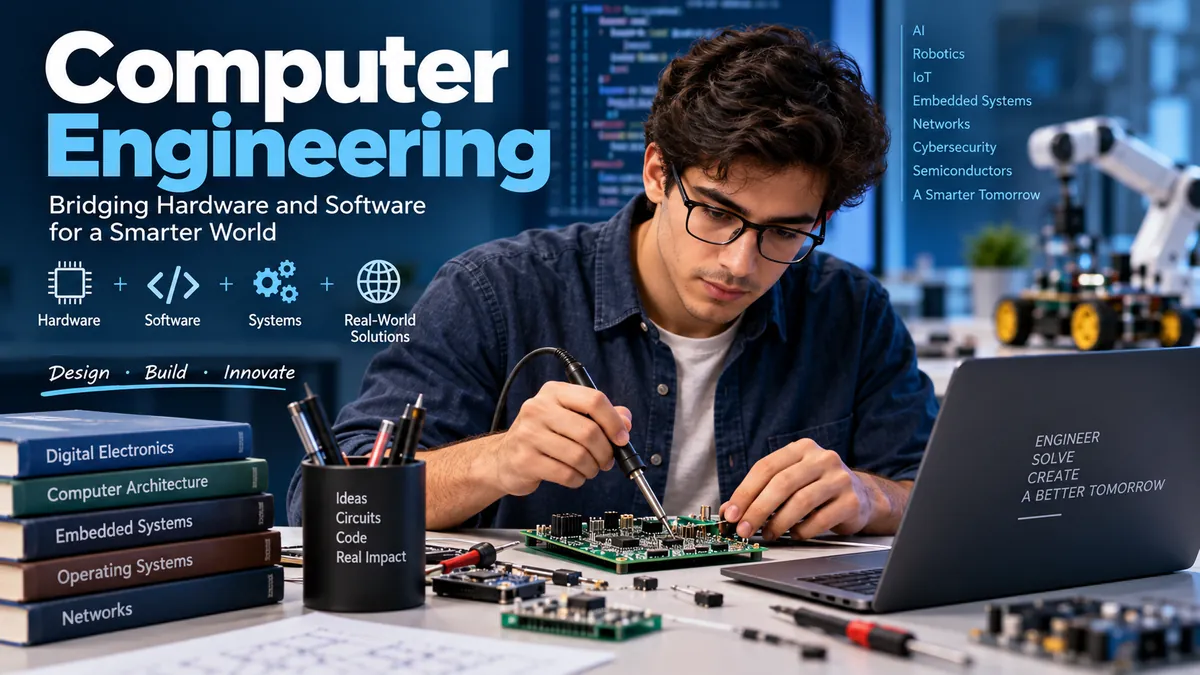

Modern technology rarely depends on hardware or software alone. Smartphones, cars, medical equipment, robots, servers, smart appliances, and industrial machines all rely on physical electronics working closely with code.
That intersection is where computer engineering sits.
Computer engineering is an engineering discipline that combines computer science and electrical engineering to design, build, program, test, and improve computer-based systems. It covers processors, digital circuits, embedded systems, computer architecture, networks, firmware, operating systems, and software that communicates directly with hardware.
The field is broader than simply building desktop computers. Computer engineers may work on semiconductor chips, autonomous machines, cybersecurity systems, Internet of Things devices, artificial intelligence hardware, telecommunications equipment, or cloud infrastructure.
What Is computer engineering?
Computer engineering focuses on designing computing systems in which hardware and software operate as one complete system.
A computer engineer might design a circuit board, program a microcontroller, optimize processor performance, develop firmware for a medical device, or troubleshoot communication between software and electronic components.
ABET’s engineering criteria illustrate this combination clearly. Programs carrying the “computer” engineering designation are expected to include mathematics, science, computing science, and engineering topics required to analyze and design complex devices and systems containing both hardware and software. Discrete mathematics is also specifically included in the criteria for computer-related engineering programs.
The field generally combines knowledge from three areas:
| Area | What You Learn |
|---|---|
| Electrical engineering | Circuits, electronics, signals, digital logic and hardware |
| Computer science | Programming, algorithms, data structures and operating systems |
| Systems engineering | How hardware, software and networks work together |
This combination makes the discipline particularly useful wherever computing must interact with the physical world.
What does a computer engineer actually do?
Computer engineers research, design, develop, test, and maintain computing devices and systems.
Typical tasks can include:
- Designing processors, circuit boards, memory systems, and digital electronics
- Programming microcontrollers and embedded processors
- Developing firmware
- Testing hardware prototypes
- Designing computer architecture
- Integrating hardware with operating systems and applications
- Developing Internet of Things devices
- Building robotic and automation systems
- Designing computer networks
- Testing system performance and reliability
- Finding hardware or software compatibility problems
- Improving energy efficiency and processing performance
- Supporting semiconductor and chip-development projects
- Implementing cybersecurity protections at hardware and system levels
The U.S. Bureau of Labor Statistics describes computer hardware engineers specifically as professionals who research, design, develop, and test computers and related equipment. They commonly work alongside software developers because modern products are frequently developed as integrated hardware-software systems.
What Do You Study in a computer engineering Degree?
A bachelor’s program normally combines mathematics, physics, electronics, programming, laboratory work, and engineering design.
Exact curricula vary between universities, but the underlying structure is remarkably consistent.
Mathematics and engineering foundations
Students usually begin with subjects such as:
- Calculus
- Linear algebra
- Differential equations
- Discrete mathematics
- Probability and statistics
- Physics
- Engineering mathematics
These subjects are not simply academic requirements. They provide the mathematical language engineers use to analyze circuits, signals, processors, algorithms, control systems, and communication networks.
ABET’s 2026–2027 accreditation criteria require accredited engineering programs to include substantial mathematics/basic science and engineering content, while computer-named programs must include discrete mathematics.
Programming and software development
Computer engineers need programming knowledge because even hardware-oriented systems depend on software.
Courses may cover:
- Programming fundamentals
- Object-oriented programming
- Data structures
- Algorithms
- Operating systems
- Software engineering
- Database fundamentals
- Computer networks
Common languages include C, C++, Python, Java, and assembly language.
C and C++ are especially valuable for embedded systems because they allow relatively low-level control over processors and memory.
Assembly language helps students understand what happens between high-level software and the processor itself.
Digital logic and electronics
Digital systems are a central part of the discipline.
Students typically learn:
- Boolean algebra
- Logic gates
- Combinational circuits
- Sequential circuits
- Flip-flops
- Registers
- Counters
- Memory
- Digital system design
These concepts explain how binary information becomes functioning hardware.
A student might eventually design a digital circuit using an FPGA, or field-programmable gate array, rather than simply writing software for an existing computer.
Computer architecture and processors
Computer architecture examines how processors actually execute instructions.
Topics can include:
- Central processing units
- Instruction sets
- Memory hierarchy
- Cache memory
- Pipelining
- Input/output systems
- Parallel processing
- Multiprocessor systems
Understanding architecture is valuable because software performance is influenced heavily by hardware design.
For example, two programs that perform the same calculation may have dramatically different execution speeds depending on memory access patterns, processor architecture, and cache behavior.
Microprocessors and microcontrollers
Microcontrollers are small computing systems integrated onto individual chips.
They are found in products such as:
- Cars
- Washing machines
- Medical equipment
- Drones
- Security systems
- Smart thermostats
- Industrial machinery
- Wearable electronics
Students learn how to connect processors with sensors, motors, displays, memory, and communication interfaces.
This leads directly into one of the largest computer engineering specialties: embedded systems.
Embedded Systems and the Internet of Things
An embedded system is a computer designed to perform a dedicated function inside another product.
Unlike a laptop, which runs thousands of different applications, an embedded computer may have one highly specific responsibility.
Examples include:
- Controlling an anti-lock braking system
- Reading temperature sensors
- Managing a drone’s flight controls
- Operating a medical monitoring device
- Controlling an industrial robot
Engineers working in embedded systems often deal with both hardware and firmware.
Where IoT fits
The Internet of Things (IoT) extends embedded computing by connecting devices to networks.
A smart sensor, for example, may:
- Measure temperature.
- Process the measurement with a microcontroller.
- Send the information through Wi-Fi or another wireless protocol.
- Store it in a cloud platform.
- Trigger an automated action.
Computer engineers may be involved at almost every step.
Programs increasingly reflect these technologies. Current university computer engineering curricula commonly include areas such as embedded systems, artificial intelligence, machine learning, computer networks, cybersecurity, cloud computing, IoT, robotics, and digital system design.
Major computer engineering Specializations
Computer engineering is not a single narrowly defined occupation. Students and professionals can specialize in several areas.
1. Computer hardware engineering
Hardware engineers work directly with physical computing components.
Projects might involve:
- Processors
- Memory devices
- Printed circuit boards
- Servers
- Storage systems
- Computer peripherals
Hardware development usually includes schematic design, simulation, prototyping, testing, debugging, and sometimes manufacturing support.
2. Embedded systems
Embedded engineers create computing systems built into products.
They frequently work with:
- Microcontrollers
- Real-time operating systems
- C and C++
- Sensors
- Actuators
- Communication buses
- Firmware
Automotive electronics, aerospace systems, appliances, industrial automation, and medical technology all depend heavily on embedded computing.
3. Semiconductor and chip design
At the lowest hardware level, engineers help develop integrated circuits and semiconductor devices.
Areas can include:
- Digital integrated circuits
- Processor architecture
- Very-large-scale integration (VLSI)
- FPGA design
- Verification
- Chip testing
This area requires particularly strong knowledge of digital logic and electronics.
4. Robotics
Robotics combines several engineering disciplines.
Computer engineers may develop:
- Embedded controllers
- Motion-control software
- Computer vision systems
- Sensor interfaces
- Navigation algorithms
- Communication systems
Robotics therefore overlaps with electrical engineering, mechanical engineering, artificial intelligence, and control engineering.
5. Computer networks
Network-focused engineers work with systems that move information between devices.
Students may study:
- Network architecture
- Routing
- Switching
- Wireless communication
- Network protocols
- Distributed computing
These skills are useful in telecommunications, enterprise networking, cloud infrastructure, and IoT development.
6. Cybersecurity
Security increasingly extends beyond software.
Computer engineers may work on:
- Secure hardware
- Device authentication
- Network security
- Cryptographic systems
- Embedded device protection
- Secure boot systems
- Firmware security
Protecting connected devices has become particularly important because vulnerabilities can exist at the processor, firmware, operating-system, application, or network layer.
7. Artificial intelligence and machine learning systems
Computer engineering also contributes to AI infrastructure.
Instead of focusing only on developing machine-learning algorithms, computer engineers may work on the systems that run them efficiently.
Examples include:
- AI accelerators
- GPUs
- Edge-computing devices
- Neural-processing hardware
- Robotics platforms
- High-performance computer architectures
Machine learning is increasingly being incorporated into computer engineering programs alongside traditional hardware subjects.
Computer Engineering vs. Computer Science
One of the most common questions students ask is whether computer engineering and computer science are basically the same degree.
They overlap, but their emphasis differs.
| Computer Engineering | Computer Science |
|---|---|
| Hardware + software | Primarily software and computation |
| Electronics | Algorithms |
| Digital circuits | Data structures |
| Microcontrollers | Application development |
| Computer architecture | Software systems |
| Embedded systems | Databases |
| Firmware | Artificial intelligence |
| Hardware-software integration | Computational theory |
Computer science generally goes deeper into algorithms, programming, software systems, computation, and data.
Computer engineering usually goes deeper into electronics, processors, digital systems, architecture, and hardware-software integration.
There is still substantial overlap.
A computer engineering graduate can become a software developer, and a computer scientist can work in systems-oriented fields. The degree simply changes where the student’s technical foundation is strongest.
Computer Engineering vs. Electrical Engineering
Computer engineering grew largely from electrical engineering and computer science.
Electrical engineering covers a wider range of electrical technologies, including:
- Power systems
- Electronics
- Telecommunications
- Control systems
- Electromagnetics
- Signal processing
Computer engineering concentrates more heavily on digital electronics and computing systems.
A simple way to think about the distinction is:
Electrical engineering studies electrical and electronic systems broadly; computer engineering concentrates on electronic systems that compute, process, store, or communicate information.
Because the fields overlap, some universities operate both under one Electrical and Computer Engineering department.
Computer Engineering vs. Software Engineering
Software engineering concentrates on designing and maintaining large software systems.
Typical software-engineering subjects include:
- Requirements analysis
- Software architecture
- Testing
- Verification
- Software development processes
- Project management
- Application development
Computer engineering reaches further toward hardware.
A firmware engineer programming a microcontroller is therefore closer to computer engineering, while a developer building a large web application is normally closer to software engineering.
ABET reflects this distinction. Its software engineering criteria emphasize software construction, requirements, security, verification, validation, and development processes, whereas computer-related engineering criteria emphasize systems containing both hardware and software.
Skills Needed for computer engineering
A degree alone is not enough. Strong engineers develop practical abilities alongside classroom knowledge.
Programming
Knowing at least one systems-oriented language is extremely useful.
For embedded or hardware-facing work, C and C++ remain particularly relevant. Python is frequently useful for automation, testing, simulation, and data processing.
Circuit analysis
Computer engineers need to understand what electronic components are doing electrically rather than treating hardware as a black box.
Problem-solving
Engineering rarely involves following a perfect set of instructions.
A prototype may fail only at a particular temperature. Firmware may work until several interrupts occur simultaneously. A circuit may produce unexpected noise.
Finding the cause requires structured reasoning.
Debugging
Effective engineers learn to isolate problems systematically.
They may use tools such as:
- Oscilloscopes
- Logic analyzers
- Multimeters
- Debuggers
- Simulators
- Network analyzers
- Development boards
Debugging is often where theoretical knowledge becomes practical engineering ability.
Communication and teamwork
Modern systems are too complex for one person to build alone.
A hardware engineer may collaborate with firmware engineers, software developers, mechanical engineers, designers, manufacturers, project managers, and customers.
Communication therefore matters nearly as much as technical competence.
The Bureau of Labor Statistics specifically highlights communication, critical thinking, computer knowledge, and problem-solving among important skills for computer hardware engineers.
How to Become a Computer Engineer
For most people, the path begins with a bachelor’s degree in computer engineering or a closely related engineering discipline.
Step 1: Build strong mathematics fundamentals
High-school or pre-university preparation should ideally include mathematics and physics.
Calculus and algebra become particularly important once engineering coursework begins.
Step 2: Complete a relevant bachelor’s degree
A typical undergraduate engineering program takes around four years of full-time study.
Computer engineering programs commonly include classroom courses, laboratories, engineering projects, and a final design project.
When evaluating programs, accreditation is worth checking.
In the United States, ABET accreditation provides an established quality framework for engineering education. Other countries operate their own accreditation systems and may participate in international engineering-recognition arrangements.
Step 3: Learn through laboratories
Do not treat laboratory courses as secondary to theory.
Hands-on work teaches skills that textbooks cannot fully reproduce.
Build things.
Program development boards. Connect sensors. Design simple circuits. Configure networks. Experiment with Linux. Measure signals. Break projects and diagnose why they failed.
That experience compounds quickly.
Step 4: Build engineering projects
A student portfolio might contain projects such as:
- Arduino or microcontroller automation
- Smart-home sensor system
- Small robot
- FPGA digital circuit
- Custom printed circuit board
- IoT monitoring system
- Networked embedded device
- Computer-vision prototype
The goal is not to build something enormous.
A small project that you genuinely understand is more valuable than a complicated project copied from a tutorial without understanding the design decisions.
Step 5: Pursue internships
Internships provide exposure to professional engineering environments, development tools, documentation standards, teamwork, testing, and deadlines.
They can also help students discover which specialization they actually enjoy.
Step 6: Choose a specialization gradually
Students do not need to decide immediately between robotics, networking, semiconductor design, embedded systems, AI, or cybersecurity.
Take foundational courses first.
Your preference often becomes obvious once you begin working on real projects.
Is computer engineering Hard?
Yes, computer engineering can be demanding because students must become comfortable with both abstract software concepts and physical engineering principles.
Typical challenges include:
- Calculus
- Electronics
- Programming
- Digital logic
- Computer architecture
- Signals
- Laboratory assignments
- Engineering design projects
The workload can feel especially difficult because different courses require different styles of thinking.
A programming problem may involve algorithms and abstraction, while an electronics laboratory requires understanding voltage, timing, physical components, and measurement equipment.
The field becomes much easier when students practice consistently rather than trying to memorize material immediately before examinations.
Careers You Can Pursue
Because the degree crosses hardware and software boundaries, graduates can move into many technical occupations.
Common roles include:
- Computer hardware engineer
- Embedded systems engineer
- Firmware engineer
- Software engineer
- Systems engineer
- FPGA engineer
- Hardware design engineer
- Network engineer
- Robotics engineer
- Cybersecurity engineer
- IoT engineer
- Semiconductor engineer
- Verification engineer
- AI systems engineer
- Research engineer
Computer engineering departments also identify careers spanning computing, software, automation and control, electronics, telecommunications, automotive systems, aerospace, research, artificial intelligence, cloud computing, data science, and entrepreneurship.
Where Do Computer Engineers Work?
Computing technology exists far beyond traditional technology companies.
Computer engineers can work in:
- Semiconductor companies
- Consumer electronics
- Automotive manufacturing
- Aerospace
- Telecommunications
- Defense
- Robotics
- Healthcare technology
- Industrial automation
- Cloud infrastructure
- Research laboratories
- Government
- Universities
- Financial technology
A modern vehicle alone can contain numerous processors controlling safety, navigation, entertainment, sensors, communication, and power-management systems.
Medical equipment, household appliances, and industrial machines increasingly contain similar computing components.
That expansion of embedded computing is one reason hardware expertise remains relevant even as software occupies more visible parts of the technology industry.
Computer Engineering Salary and Job Outlook
Salary varies widely by country, experience, specialty, employer, and job title, so a single figure should never be treated as the expected income for every computer engineering graduate.
For a useful U.S. benchmark, the Bureau of Labor Statistics reports that computer hardware engineers had a median annual wage of $161,740 in May 2025. The occupation is projected to grow 9% from 2025 through 2035, compared with 3% for all occupations. BLS estimates approximately 4,100 openings per year on average during that period.
That figure applies specifically to the U.S. computer hardware engineer occupation rather than every job available to someone with a computer engineering degree.
Software, networking, robotics, cybersecurity, embedded systems, semiconductor, and research positions have different salary structures.
Is Computer Engineering a Good Career?
It can be an excellent choice for someone who enjoys understanding both how computers are programmed and how they work physically.
The field offers several advantages:
- Broad career options
- Strong technical foundation
- Exposure to both hardware and software
- Opportunities in emerging technologies
- Transferable programming skills
- Work across many industries
- Paths into research and advanced engineering
There are disadvantages as well.
Engineering degrees require substantial mathematics and laboratory work. Hardware development can require specialized equipment. Some semiconductor and research roles favor master’s or doctoral degrees. Keeping skills current also requires continuous learning.
The strongest reason to choose the field is therefore not simply salary.
Choose it because designing complete computing systems interests you.
Should You Choose Computer Engineering or Computer Science?
Think about the kinds of problems you want to solve.
Choose computer engineering if questions like these sound interesting:
- How does a processor execute instructions?
- How does software control a physical device?
- How can sensors communicate with a microcontroller?
- How are digital circuits designed?
- How can computing hardware become faster or more efficient?
- How does an autonomous machine combine electronics and software?
Computer science may suit you better if you are primarily interested in:
- Software applications
- Algorithms
- Web development
- Data science
- Databases
- Computational theory
- Software-focused artificial intelligence
Neither degree is inherently better.
They prepare students to approach computing from different directions.
The Future of computer engineering
The line between computers and ordinary products continues to disappear.
Cars increasingly resemble distributed computing platforms. Factories use connected sensors and robots. Medical devices process data locally. Artificial intelligence workloads require specialized processors. Billions of embedded devices communicate through networks.
Those developments place computer engineering at the center of several major technology areas:
- Artificial intelligence hardware
- Edge computing
- Robotics
- Autonomous systems
- Semiconductor design
- Cybersecurity
- Cloud infrastructure
- Internet of Things
- High-performance computing
- Smart manufacturing
The underlying engineering challenge remains the same: make hardware, software, communications, and physical systems work reliably together.
That is why computer engineering remains distinct even in a software-heavy technology industry. For students who enjoy programming but also want to understand processors, circuits, embedded devices, and the physical systems behind modern computing, it offers one of the broadest technical foundations available.
A practical next step is to examine the curriculum of several accredited computer engineering programs. Look beyond the degree title and compare their courses in programming, digital logic, electronics, computer architecture, embedded systems, networks, laboratories, electives, internships, and final-year design work. That comparison will show you what studying the field actually involves far better than the program name alone.
