
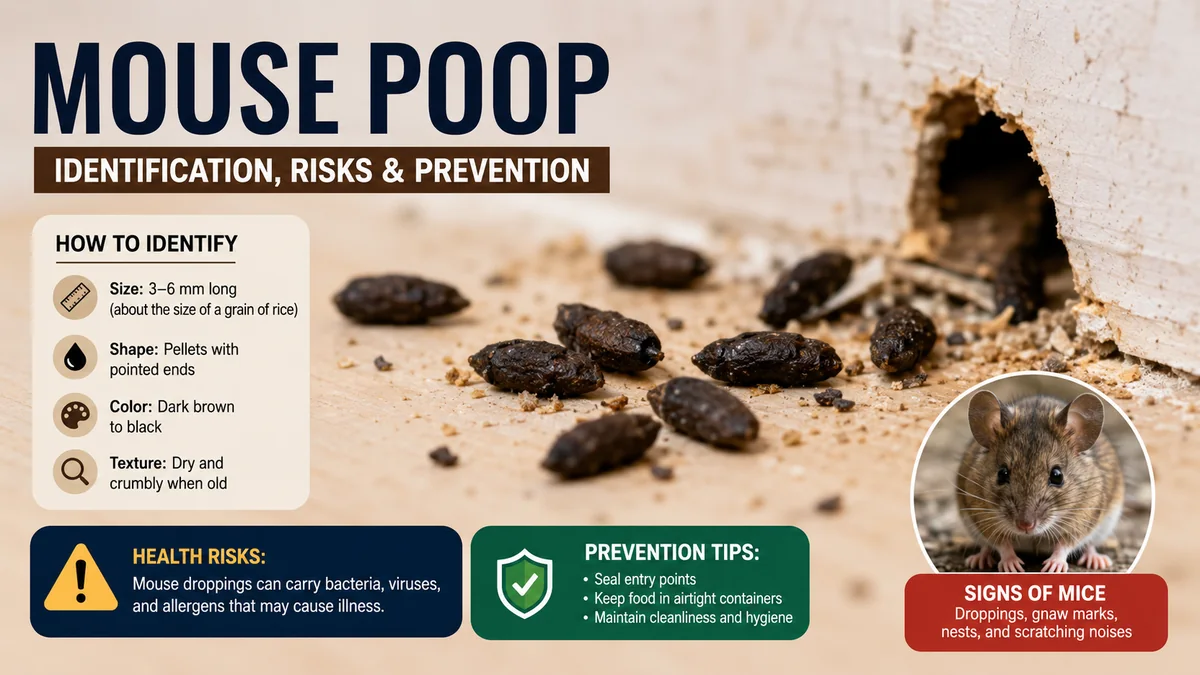

Finding a few tiny black pellets in a kitchen cabinet can be easy to dismiss as crumbs or seeds. But if those pellets are mouse poop, they are evidence that a rodent has been moving through the area—and potentially contaminating surfaces or food.
Mouse poop typically looks like small, dark grains of rice measuring about 1/8 to 1/4 inch (3–6 mm) long, often with tapered or pointed ends. Droppings may appear in cabinets, drawers, pantries, behind appliances, along walls, and near food. Never sweep or vacuum dry rodent droppings; wet them thoroughly with disinfectant before removal.
Identifying the droppings is only the first step. You also need to determine whether mice are still active, clean contaminated areas correctly, protect food, and close the openings that allowed rodents inside.
What Does Mouse Poop Look Like?
House mouse droppings are distinctive once you know the main characteristics. They are usually small, elongated pellets resembling dark grains of rice.
Typical mouse poop has these features:
| Feature | Typical mouse poop |
|---|---|
| Length | About 1/8–1/4 inch (3–6 mm) |
| Shape | Thin, elongated or rice-like |
| Ends | Usually tapered or pointed |
| Fresh color | Dark brown to nearly black |
| Older color | May become lighter, grayish or dull |
| Distribution | Frequently scattered along travel routes |
| Common locations | Cabinets, drawers, pantries, baseboards and behind appliances |
Size is one of the easiest clues. Mouse droppings are considerably smaller than most rat droppings, while their tapered shape helps distinguish them from some insect waste. Multiple pest-identification sources consistently describe house mouse droppings as roughly 3–6 mm long and rice-like.
Still, appearance alone is not perfect evidence. Moisture, age, diet and physical damage can change what a dropping looks like. When identification is uncertain, consider its location and look for other signs of rodent activity.
Where Mouse Droppings Are Usually Found
Mice tend to leave feces while moving through their environment rather than using one dedicated bathroom area. Consequently, pellets may appear scattered along their regular routes.
Check areas such as:
- Inside kitchen cabinets and drawers
- Around stored food
- Under sinks
- Behind refrigerators and ovens
- Along walls and baseboards
- Inside pantries
- Around garbage containers
- In garages and storage areas
- Around nesting materials
- Inside seldom-used cupboards
- Near holes, cracks or utility penetrations
The CDC notes that rodent droppings can occur anywhere rodents have gained access, with cabinets and drawers among common concealed locations. Gnaw marks found nearby provide another useful clue.
Quick Takeaway: Small dark pellets don’t automatically prove that you have mice, but rice-sized droppings combined with gnaw marks, nesting material, food damage or recurring new pellets make mouse activity considerably more likely.
Fresh vs. Old Mouse Poop: Can You Tell the Difference?
People often try to determine whether an infestation is active by deciding whether the droppings look fresh.
Fresh mouse poop generally appears darker and may look somewhat glossy. Older feces tend to become dry, dull and lighter as they age. Very old material can become brittle.
However, appearance isn’t a reliable clock.
Humidity, temperature, food, moisture and the surface underneath the dropping can affect its condition. A pellet that appears old doesn’t prove that mice have disappeared.
A safer and more useful approach is to clean the droppings correctly and monitor the area afterward.
The CDC specifically recommends this approach for determining whether rodents remain active: after safely cleaning an area, the appearance of additional droppings provides evidence of current rodent presence.
Signs the Mouse Problem May Still Be Active
Look beyond the feces themselves. Current activity may also produce:
- New droppings after previous ones were removed
- Fresh gnaw marks
- Torn food packaging
- Scratching sounds, especially at night
- Shredded paper, insulation or other nesting material
- Greasy marks along frequently traveled surfaces
- Unexplained food damage
- A persistent rodent odor
- Actual mouse sightings
Finding new mouse poop after cleaning is particularly useful because it gives you a clear indication that rodents are still accessing the space.
Mouse Poop vs. Rat Poop
One of the most common identification problems is distinguishing mouse feces from rat feces.
The easiest difference is usually size.
Mouse droppings generally measure about 3–6 mm and resemble grains of rice. Rat droppings are substantially larger. The exact appearance of rat feces also varies by species; for example, Norway rat and roof rat droppings can differ in shape.
| Characteristic | Mouse droppings | Rat droppings |
|---|---|---|
| Typical size | About 3–6 mm | Commonly around 12–20 mm depending on species |
| General appearance | Small and rice-like | Larger and thicker |
| Ends | Often tapered/pointed | Can be blunt or tapered depending on rat species |
| Distribution | Frequently scattered | May be more concentrated |
| Useful comparison | Small grain of rice | Larger pellet or olive-like shape |
Don’t identify a rodent solely by whether the pellet has a pointed end. Roof rats, for example, can produce relatively tapered droppings.
Location also provides clues. Small pellets inside a kitchen drawer alongside finely gnawed food packaging strongly suggest mouse activity, while substantially larger feces point toward rats.
Mouse Poop vs. Cockroach Droppings
Cockroach waste can also be confused with rodent feces, particularly when you’re dealing with larger cockroach species.
Small cockroach droppings may resemble black pepper, coffee grounds or dark specks rather than individual rice-shaped pellets. Larger roaches can produce cylindrical feces, making identification less obvious.
Look at the complete evidence rather than one dropping.
Cockroach activity may also produce egg cases, shed skins and a concentrated pepper-like residue in harborages. Mouse activity more commonly comes with gnawed packaging, nesting material and distinct small pellets scattered along travel routes.
Mouse Poop vs. Bat Droppings
Bat guano can sometimes resemble rodent feces, especially in attics.
Location is an immediate clue. Droppings accumulated underneath a roof roost or entry point deserve closer investigation rather than automatic identification as mice.
Avoid crushing unidentified feces with bare fingers as an identification test. If an attic contains substantial quantities of unknown animal waste, professional identification and cleanup may be the safer option.
Is Mouse Poop Dangerous?
Mouse feces should be treated as potentially contaminated material rather than ordinary household dirt.
Rodents can expose people to disease through direct contact and through food, water or dust contaminated by rodent waste. The EPA identifies breathing contaminated dust and consuming contaminated food or water among possible routes of exposure to rodent-associated disease.
The risk does not mean that finding one mouse dropping will automatically make someone sick. The practical response is to minimize contact and clean the material correctly.
Hantavirus and Rodent Droppings
Hantaviruses are among the better-known health concerns associated with rodents.
The CDC explains that people can become infected through contact with infected rodents, particularly their urine, saliva and droppings. In the United States, the deer mouse is the principal carrier associated with the most common hantavirus causing hantavirus pulmonary syndrome (HPS).
This distinction matters because finding ordinary house mouse feces does not establish that hantavirus is present.
The reason cleanup precautions are still recommended is simple: you generally cannot determine whether potentially harmful microorganisms are present merely by looking at rodent waste.
How Contaminated Dust Creates a Problem
Dry rodent waste can break into small particles.
Sweeping or vacuuming contaminated material before disinfecting it can disturb particles and introduce them into the air. That is why CDC guidance explicitly says not to sweep or vacuum dry rodent urine, droppings or nesting material.
This is one of the most important things to remember after discovering mouse feces.
Do not grab the vacuum cleaner first. Wet and disinfect the contamination before removing it.
What If You Touched Mouse Poop?
Don’t panic after accidental skin contact.
Wash your hands thoroughly with soap and warm water and avoid touching your mouth, nose or eyes before washing. Clean contaminated surfaces using appropriate disinfecting procedures.
If you develop an illness after meaningful rodent exposure, tell your healthcare provider about that exposure. CDC specifically recommends mentioning potential rodent contact when seeking medical care for a suspected rodent-borne illness.
Hantavirus pulmonary syndrome symptoms can initially include fever, fatigue and muscle aches, with coughing and shortness of breath developing later in the illness. Symptoms typically begin one to eight weeks after exposure to an infected rodent.
Seek prompt medical attention for significant breathing difficulty or other serious symptoms rather than attempting to diagnose the cause yourself.
How to Clean Mouse Poop Safely
Cleaning mouse poop safely is less complicated than many people expect. The key principle is to disinfect first and remove second.
CDC guidance provides a straightforward procedure for rodent urine and droppings.
1. Ventilate an Enclosed Space
If you’re cleaning a cabin, shed, barn or other enclosed building where rodents have been present, open doors and windows and allow the space to ventilate for 30 minutes before cleaning. Leave the area while it airs out.
Ventilation is particularly relevant when an enclosed structure has been sitting unused.
2. Put On Gloves
Wear rubber or plastic gloves before touching contaminated surfaces or cleaning materials.
Don’t handle feces directly with bare hands.
3. Do Not Sweep or Vacuum
This deserves repeating because it’s an easy mistake to make.
Do not dry sweep or vacuum rodent droppings, urine or nesting materials before disinfection.
Vacuuming feels like the obvious solution for small pellets, but it can disturb contaminated material and put tiny particles into the air.
4. Thoroughly Wet the Droppings
Spray the droppings and contaminated area with a general-purpose household product labeled as a disinfectant or use an appropriate bleach solution.
CDC guidance gives a bleach mixture of 1.5 cups household bleach per gallon of water, equivalent to approximately one part bleach to nine parts water, prepared fresh before use.
Never mix bleach with ammonia or other household cleaning chemicals.
5. Let the Disinfectant Sit
The surface needs adequate contact time.
CDC guidance says to allow the wet disinfectant or bleach solution to soak for five minutes, or follow the contact time specified on the disinfectant’s product label.
Don’t immediately spray and wipe.
6. Wipe Up the Droppings
Use paper towels to pick up the wet material.
Place the used towels and waste into the garbage rather than shaking or brushing them off.
7. Disinfect the Surrounding Area
Droppings are only the visible evidence.
Mouse urine and microscopic contamination may extend beyond individual pellets, so clean surrounding hard surfaces such as:
- Floors
- Countertops
- Shelves
- Cabinets
- Drawers
- Other nearby nonporous surfaces
Mop or sponge these surfaces using disinfectant after the visible waste has been removed.
8. Remove Your Gloves Carefully
Before taking your gloves off, wash the gloved hands with soap and water or disinfect them.
Then remove the gloves and thoroughly wash your bare hands with soap and warm water.
Quick Takeaway: The safest sequence is simple: ventilate when appropriate → gloves → soak with disinfectant → wait for the required contact time → wipe up → disinfect the surrounding surface → wash hands.
How to Clean Mouse Droppings From Different Surfaces
The basic wet-disinfection method works well for hard surfaces, but not every contaminated item can be treated the same way.
Kitchen Counters, Cabinets and Drawers
Remove the visible droppings using the wet-cleaning procedure, then disinfect the complete surrounding surface.
If rodent waste was discovered close to food, inspect packages carefully. Food that may have been contaminated by rodents should not be eaten.
Pay special attention to corners, hinges, drawer tracks and gaps around pipes because these locations may also reveal where mice are traveling.
Clothing and Bedding
Potentially contaminated washable fabrics should be laundered using hot water and detergent.
CDC guidance recommends machine drying on a high setting or allowing items to air-dry in sunlight.
Carpets and Upholstered Furniture
After visible rodent waste has been properly disinfected and removed, CDC recommends shampooing rugs and upholstered furniture with a commercial disinfectant or using an appropriate commercial-grade steam cleaner or shampooing system.
Avoid immediately running a standard vacuum over dry droppings.
Cardboard Boxes
Cardboard presents a bigger problem because it is porous.
CDC recommends discarding cardboard boxes contaminated with rodent urine or feces. Plastic, glass and metal containers can generally be disinfected instead.
This is worth remembering when cleaning garages, sheds and storage rooms where mice frequently nest among old boxes.
Books and Papers
Some items cannot tolerate liquid disinfectant.
CDC guidance says books, papers and similar non-washable items can be placed outdoors in sunlight for several hours or kept in a rodent-free indoor location for an extended period.
Cars and Other Vehicles
Mice sometimes nest in vehicles that sit unused for long periods.
The CDC recommends airing out a vehicle before inspection and checking areas including the passenger compartment, air intakes, filters and engine compartment for rodent activity. Visible waste should be wetted with disinfectant before removal rather than immediately vacuumed.
Nesting material in an air intake deserves particular attention because the affected air filter may also need replacement.
When Mouse Poop Suggests an Active Infestation
Finding a single old pellet doesn’t tell you how many rodents are present.
Finding fresh feces repeatedly is more significant.
The most practical test is to safely clean the affected area and monitor it. If new droppings appear, rodents are still accessing the space.
Don’t Estimate Mouse Numbers From Droppings Alone
You may see claims that a specific number of droppings equals a particular number of mice.
Real infestations aren’t that predictable.
Droppings can accumulate over multiple days, several rodents may use the same route, and old feces may remain hidden for months. A large collection could represent repeated activity rather than a precise population size.
Use droppings as evidence of location and activity, not as an exact mouse census.
Follow the Trail
Where the pellets appear can tell you more than how many you find.
For example, repeated droppings:
- Behind a refrigerator may indicate access to food or warmth.
- Inside a pantry suggest direct food-area activity.
- Under a sink may point toward plumbing penetrations.
- Along one wall may identify a regular travel route.
- Inside an attic may indicate nesting or an entry point near the roofline.
Map these locations before cleaning them. Patterns can help identify where exclusion and trapping efforts should be concentrated.
Why Mouse Poop Keeps Appearing After Cleaning
Cleaning solves the contamination problem, but it doesn’t remove the mouse.
If new pellets appear the following night, you have learned something useful: the infestation is active.
The mouse still has access to at least one of three essentials—food, water or shelter.
The EPA and CDC emphasize removing these resources and preventing rodent access as central parts of long-term rodent control.
Food Sources
Mice are opportunistic feeders.
Potential food sources include:
- Open cereal and grain packages
- Pet food
- Crumbs under appliances
- Garbage
- Bird seed
- Pantry goods
- Food left on counters
Store vulnerable foods in durable containers and clean spilled food promptly.
Water Sources
Even small amounts of available moisture can make an indoor environment more attractive to pests.
Repair leaks and avoid leaving unnecessary standing water around sinks, utility spaces or other mouse-accessible areas.
Shelter and Nesting Material
Clutter provides hiding and nesting opportunities.
Paper, cardboard, fabric and insulation can all become nesting material. Reducing clutter—especially in garages, basements, storage rooms and utility spaces—makes the environment less hospitable and easier to inspect.
How to Prevent Mouse Poop From Coming Back
The real goal isn’t repeatedly cleaning droppings. It’s preventing the rodents from producing new ones.
That requires combining sanitation, exclusion and rodent control.
Seal Mouse Entry Points
Inspect the building carefully for openings around:
- Pipes
- Utility cables
- Doors
- Windows
- Foundations
- Vents
- Cabinets
- Rooflines
- Garage doors
- Wall penetrations
Mice can exploit surprisingly small openings, so don’t focus only on obvious holes.
The CDC recommends sealing holes and gaps as a fundamental way to prevent rodents from entering homes and garages.
Remove Food and Water
Keep food in secure containers, clean crumbs and spills, manage garbage properly and avoid leaving pet food accessible overnight.
The EPA identifies keeping living spaces clean, preventing access and eliminating potential nesting areas as key components of rodent prevention.
Monitor Previously Contaminated Areas
Once an area has been safely cleaned, inspect it regularly.
Fresh droppings provide a clear signal that your exclusion or control efforts haven’t completely solved the problem.
This clean-and-monitor strategy is considerably more reliable than trying to judge activity from the color of old feces.
When Mouse Droppings Need Professional Attention
A few pellets in an easily accessible cabinet can usually be handled using proper precautions.
A completely different situation is a heavily contaminated attic, abandoned building or enclosed room containing extensive feces, urine staining, nesting material and dead rodents.
CDC guidance calls for special precautions during cleanup of heavy rodent infestations, including more extensive personal protective equipment and appropriate respiratory protection.
Professional assistance makes particular sense when:
- Droppings cover large areas
- Contamination is inside HVAC ductwork
- An attic or crawlspace is heavily contaminated
- Rodents repeatedly return despite control efforts
- Contaminated insulation needs removal
- Numerous nests or dead rodents are present
- You cannot identify the animal responsible
- Safe access to the contaminated space is difficult
The CDC specifically recommends professional rodent removal when evidence indicates rodents have accessed heating and cooling ventilation systems.
Common Mouse Poop Cleanup Mistakes
The mistakes people make after finding droppings often matter more than the droppings themselves.
Vacuuming Immediately
This is probably the most common error.
A vacuum seems convenient, particularly when dozens of tiny pellets are scattered across a shelf or floor. But dry vacuuming can disturb contaminated particles.
Disinfect first.
Dry Sweeping
A broom creates the same basic problem by disturbing dry waste and dust.
Wet the material thoroughly before removing it.
Picking Droppings Up Bare-Handed
Mouse feces shouldn’t be handled like ordinary crumbs.
Wear rubber or plastic gloves and wash your hands thoroughly afterward.
Cleaning Only the Visible Pellets
Rodents don’t contaminate only the exact spot where feces are visible.
Disinfect the surrounding hard surface after removing the droppings.
Assuming Old-Looking Droppings Mean the Mice Are Gone
Dry, faded feces indicate that the material itself isn’t fresh; they don’t prove the building is currently rodent-free.
Clean the area and watch for new activity.
Ignoring Contaminated Food
If mice have accessed a pantry or food-storage space, cleanup should include checking the food itself—not simply wiping the shelf.
Damaged or potentially contaminated food should be discarded rather than consumed.
What Mouse Poop Is Really Telling You
Mouse poop is more than an unpleasant mess. It is evidence.
Its size and shape can help identify the pest. Its location can reveal travel routes and feeding areas. New droppings appearing after cleanup can confirm ongoing activity.
The safest response is equally straightforward: don’t disturb dry rodent waste with a broom or vacuum. Wear gloves, thoroughly wet the material with an appropriate disinfectant, allow the required contact time, remove it carefully and disinfect the surrounding surface.
Then address the reason the droppings appeared in the first place. Remove accessible food and water, eliminate nesting opportunities, seal entry points and monitor cleaned areas for new evidence.
Cleaning yesterday’s mouse poop deals with contamination. Preventing tomorrow’s droppings means dealing with the mice themselves.
