
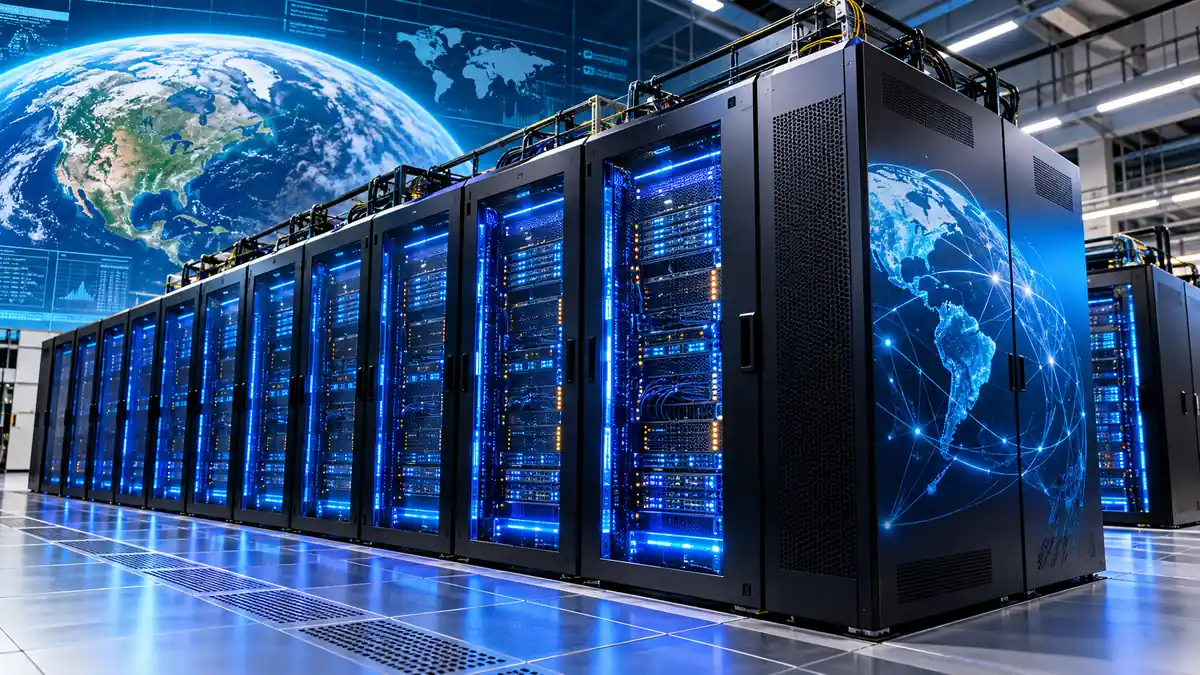

A super computer is built for problems that would overwhelm an ordinary desktop, laptop, or server. Instead of relying on one processor to complete calculations sequentially, modern supercomputers coordinate enormous numbers of processor cores, accelerators, memory systems, storage devices, and high-speed network connections.
A super computer is an extremely powerful computing system designed to process huge amounts of data and perform complex calculations at very high speeds. It typically uses parallel processing across thousands or millions of CPU and GPU cores and is used for scientific simulations, weather forecasting, artificial intelligence, engineering, medicine, and other computationally demanding work.
Modern supercomputing has entered the exascale era, where leading machines can perform more than one quintillion floating-point calculations per second. That scale of computing is changing what researchers can simulate, analyze, and predict.
What Is a super computer?
A super computer is a computer designed to deliver extremely high computational performance compared with general-purpose computers available at the same time.
The term is relative. A machine considered extraordinary several decades ago would be dramatically slower than a modern smartphone or laptop in some respects. Today’s leading systems therefore represent the cutting edge of current high-performance computing rather than a permanently defined level of speed.
Supercomputers are particularly useful when a problem involves:
- Huge volumes of data
- Billions or trillions of mathematical calculations
- Complex physical simulations
- Large artificial intelligence models
- Many calculations that can run simultaneously
- Problems requiring very large memory or storage capacity
A modern supercomputer is rarely one giant processor. It is usually a highly integrated collection of compute nodes, processors, accelerators, memory, storage, software, and networking infrastructure.
According to IBM, these systems use interconnected compute nodes that collaborate on problems, with high-speed interconnects connecting processing, storage, and I/O resources.
What Does “Supercomputer” Actually Mean?
There is no permanent hardware specification that automatically makes a machine a supercomputer.
Instead, the name generally describes computing systems operating near the highest performance levels available in their era.
This is why comparing a 1960s supercomputer directly with a 2026 system can be misleading. Both represented exceptional computing technology in their respective periods, even though their absolute performance differs enormously.
How Does a super computer Work?
The central idea behind a super computer is parallel processing.
Imagine having to complete 10,000 independent calculations. A conventional approach might process them one after another. A parallel system divides the workload so many processors can work on different pieces simultaneously.
The results are then combined to produce the final answer.
Modern supercomputers can contain thousands of nodes and millions of processing cores. These components must communicate extremely quickly; otherwise, processors spend too much time waiting for data instead of performing calculations.
Compute Nodes
A compute node is one of the fundamental building blocks of a supercomputing system.
A node commonly contains:
- CPUs
- GPUs or other accelerators
- Local memory
- Network interfaces
Thousands of nodes may be connected to form one large HPC system.
The U.S. Geological Survey describes a supercomputer as a large system composed of many smaller computers and processors, with nodes communicating through a high-speed network such as InfiniBand.
CPUs and GPUs
The central processing unit (CPU) remains essential for controlling programs and handling many general-purpose operations.
Modern supercomputers increasingly combine CPUs with graphics processing units (GPUs) or other specialized accelerators.
GPUs are especially effective when the same type of mathematical operation needs to be performed across huge datasets. This makes them valuable for:
- Artificial intelligence
- Machine learning
- Scientific simulation
- Molecular modeling
- Computational fluid dynamics
- Matrix calculations
Systems such as Frontier, Aurora, and El Capitan illustrate how CPU-GPU architectures have become central to modern exascale computing.
High-Speed Interconnects
Processing power alone is not enough.
Nodes constantly exchange data. A slow connection between them would create a bottleneck, so supercomputers use specialized high-bandwidth, low-latency interconnect technologies.
Examples include InfiniBand and HPE’s Slingshot architecture.
The network effectively allows enormous numbers of computing components to cooperate on one workload.
Memory and Storage
Scientific workloads may involve petabytes of information, so memory bandwidth and storage performance matter almost as much as processor speed.
A large simulation might repeatedly move enormous datasets between:
- Storage systems
- Main memory
- CPUs
- GPUs
- Other compute nodes
Efficient data movement is therefore a major part of supercomputer architecture.
How Is Supercomputer Speed Measured?
Supercomputer performance is commonly expressed in FLOPS, meaning floating-point operations per second.
Floating-point calculations are fundamental to scientific and engineering workloads involving very large, very small, or fractional numbers.
Common performance units include:
| Unit | Operations per Second |
|---|---|
| MFLOPS | 1 million |
| GFLOPS | 1 billion |
| TFLOPS | 1 trillion |
| PFLOPS | 1 quadrillion |
| EFLOPS | 1 quintillion |
A machine capable of one exaflop can theoretically perform 10¹⁸ floating-point operations per second.
The U.S. Department of Energy describes exascale systems as machines capable of more than 1,000,000,000,000,000,000 floating-point operations each second.
Rmax vs. Rpeak
Supercomputer specifications often show two numbers that can confuse beginners.
Rpeak represents theoretical peak performance based on the hardware’s maximum computational capability.
Rmax represents measured performance achieved on the High Performance LINPACK (HPL) benchmark.
Real applications rarely achieve theoretical peak performance continuously because processors must also deal with memory access, communication, synchronization, storage, and other bottlenecks.
TOP500 and HPCG
The TOP500 project ranks high-performance computer systems primarily using HPL performance.
HPL is useful, but it does not represent every real-world workload.
The High Performance Conjugate Gradient (HPCG) benchmark provides another perspective by stressing computational and data-access patterns that can better reflect certain scientific applications.
For example, the June 2026 HPCG ranking placed LineShine first, followed by El Capitan and Fugaku.
Quick Takeaway: A higher FLOPS figure indicates enormous mathematical capability, but benchmark leadership does not mean one machine will automatically be fastest for every application.
What Is a super computer Used For?
Supercomputers are valuable when researchers need to model something too large, too small, too expensive, too dangerous, or too time-consuming to study directly.
Weather Forecasting and Climate Modeling
Weather prediction requires continuous processing of information about:
- Temperature
- Humidity
- Wind
- Atmospheric pressure
- Ocean conditions
- Clouds
- Precipitation
- Land and ice
Meteorological models divide the atmosphere into grids and repeatedly calculate how conditions change.
More computing power can support higher-resolution models, larger ensembles, and more sophisticated physical calculations.
Supercomputers are also used for long-term climate simulations that explore interactions among the atmosphere, oceans, land, and ice.
Artificial Intelligence and Machine Learning
AI workloads increasingly overlap with high-performance computing.
Training large models involves huge numbers of matrix operations, which makes GPUs and other accelerators particularly useful.
Supercomputing infrastructure can support:
- Large-scale model training
- Scientific machine learning
- Computer vision
- Natural language processing
- Generative AI
- Data analytics
- AI-assisted simulation
The Department of Energy notes that exascale systems are being used to combine artificial intelligence, machine learning, big-data processing, modeling, and simulation.
Medicine and Drug Discovery
Researchers can use supercomputers to model biological and chemical processes that would be difficult to investigate experimentally at the same scale.
Applications include:
- Molecular dynamics
- Protein research
- Genomics
- Drug candidate screening
- Cancer research
- Disease modeling
- Medical imaging analysis
Computational models do not replace laboratory or clinical testing, but they can help researchers narrow enormous numbers of possibilities before conducting expensive physical experiments.
Space and Astrophysics
Many astronomical events cannot be recreated in laboratories.
Scientists instead build mathematical models and run simulations of phenomena such as:
- Galaxy formation
- Supernovas
- Black holes
- Stellar evolution
- Planet formation
- Cosmological structures
The calculations can involve gravity, radiation, fluid dynamics, nuclear reactions, and massive datasets from telescopes and other scientific instruments.
Engineering and Manufacturing
Building and destroying hundreds of physical prototypes would be slow and expensive.
Supercomputing enables engineers to create detailed virtual models first.
Computational fluid dynamics (CFD) can simulate airflow, heat transfer, pressure, turbulence, and fluid movement.
That capability supports fields including:
- Aerospace engineering
- Automotive design
- Turbine development
- Energy systems
- Manufacturing
- Aerodynamics
AWS, for example, identifies CFD, genomic research, molecular modeling, and materials research among important supercomputing workloads.
Materials Science
Researchers can simulate how atoms and molecules behave before attempting to manufacture a material physically.
This can support the development of:
- Batteries
- Semiconductors
- Alloys
- Catalysts
- Energy technologies
- Advanced industrial materials
The goal is often to reduce the number of physical experiments needed to find promising candidates.
National Security and Nuclear Research
Supercomputing has long been associated with defense, cryptanalysis, nuclear physics, and national-security research.
El Capitan at Lawrence Livermore National Laboratory, for example, was built for the U.S. National Nuclear Security Administration and supports modeling and simulation related to the country’s nuclear stockpile.
Types of Supercomputers
Supercomputers can be classified by their architecture and how they process workloads.
Vector Supercomputers
Vector processors perform operations on entire sets or arrays of data.
This architecture became strongly associated with early supercomputing, particularly machines developed by Cray Research.
Vector processing remains historically important, although modern high-end systems generally rely heavily on massively parallel architectures.
Massively Parallel Processing Systems
A massively parallel processing (MPP) system uses large numbers of processors or compute nodes simultaneously.
A large problem is divided into smaller tasks, distributed among processors, and then combined into a final result.
This approach dominates modern supercomputing.
Cluster Supercomputers
Clusters connect many individual computers or servers so they can operate together.
This approach became especially influential because organizations could build powerful systems using increasingly standardized hardware rather than designing every component from scratch.
The Beowulf cluster concept demonstrated how commodity computer hardware could be combined for high-performance scientific computing.
GPU-Accelerated Supercomputers
GPU-accelerated machines combine traditional CPUs with GPUs designed to handle highly parallel calculations efficiently.
Many modern HPC and AI systems use this model.
Frontier uses AMD EPYC CPUs and AMD Instinct MI250X accelerators, while El Capitan uses AMD EPYC processors with AMD Instinct MI300A accelerated processing units.
super computer vs. Mainframe vs. Ordinary Computer
Supercomputers and mainframes are both powerful, but they are optimized for different goals.
| Feature | Supercomputer | Mainframe | Personal Computer |
|---|---|---|---|
| Main purpose | Complex calculations and simulation | High-volume reliable transaction processing | Everyday computing |
| Processing approach | Massive parallelism | High throughput and reliability | Small-scale general processing |
| Typical users | Scientists, engineers, AI researchers | Banks, governments, large enterprises | Individuals and businesses |
| Workloads | Simulation, modeling, AI, research | Transactions, databases, enterprise applications | Browsing, office work, gaming |
| Scale | Thousands to millions of cores | Large enterprise system | Usually one CPU with limited processors/cores |
| Cost | Extremely high | Very high | Relatively affordable |
A bank may prefer a mainframe for processing enormous numbers of transactions reliably.
A climate research center may need a supercomputer because it must solve extremely complex mathematical models simultaneously.
Supercomputer vs. HPC
High-performance computing (HPC) is the broader field of using powerful computing resources to solve demanding computational problems.
A supercomputer is one implementation of HPC.
HPC environments can range from relatively small computing clusters to some of the world’s largest supercomputers.
Supercomputer vs. Cloud Computing
Cloud computing can also provide large amounts of computational capacity.
Cloud HPC lets organizations temporarily combine many processors without building a dedicated physical supercomputer.
Dedicated supercomputers, however, can be engineered as tightly integrated systems with specialized networking, storage, memory, cooling, and accelerators.
The right approach depends on workload size, frequency, data movement, security requirements, cost, and software architecture.
Supercomputer vs. Quantum Computer
A quantum computer is not simply a faster supercomputer.
Traditional supercomputers use classical bits and processors. Quantum computers use qubits and quantum-mechanical effects to perform certain types of computation differently.
Supercomputers remain better suited to a vast range of practical scientific and engineering workloads. Quantum computing is being investigated for specific classes of problems where quantum algorithms may eventually provide an advantage.
The technologies may ultimately complement each other rather than one replacing the other.
What Is the Fastest super computer in the World?
As of the June 2026 TOP500 list, the world’s No. 1 ranked system is LineShine, installed at the National Supercomputing Centre in Shenzhen, China.
LineShine recorded 2.198 exaflops on the HPL benchmark using 13,789,440 cores. It is based on the LingKun platform, LX2 processors, LingQi interconnect, and Kylin operating system.
The top five in the June 2026 TOP500 ranking are:
| Rank | Supercomputer | Location | HPL Rmax |
|---|---|---|---|
| 1 | LineShine | Shenzhen, China | 2.198 EFLOPS |
| 2 | El Capitan | California, USA | 1.809 EFLOPS |
| 3 | Frontier | Tennessee, USA | 1.353 EFLOPS |
| 4 | Aurora | Illinois, USA | 1.012 EFLOPS |
| 5 | JUPITER Booster | Jülich, Germany | 1.000 EFLOPS |
These results represent a significant milestone: five systems on the June 2026 list had demonstrated exascale-class HPL performance.
Rankings change as new machines are deployed and existing systems submit updated benchmark results, so the TOP500 list is the appropriate reference for the latest position.
A Brief History of Supercomputers
The development of supercomputing stretches back to the earliest decades of electronic computing.
CDC 6600
The CDC 6600, introduced in 1964 and designed under Seymour Cray at Control Data Corporation, is widely regarded as the first commercially successful supercomputer.
It achieved performance measured in millions of floating-point operations per second.
That sounds tiny today, but it represented extraordinary computational power at the time.
Cray-1
Seymour Cray later founded Cray Research.
The Cray-1, released in 1976, became one of history’s most recognizable supercomputers. Its vector-processing architecture and distinctive C-shaped design helped establish Cray as a major name in high-performance computing.
Gigaflop Era
The Cray-2, introduced in 1985, pushed performance beyond one gigaflop.
Supercomputing architecture then increasingly shifted toward large-scale parallel processing.
Teraflop Era
In 1996, ASCI Red became the first supercomputer to achieve teraflop-scale performance.
Petaflop Era
IBM Roadrunner crossed another major threshold in 2008 by becoming the first supercomputer to achieve sustained petaflop performance on LINPACK.
Exaflop Era
The next leap came with Frontier at Oak Ridge National Laboratory.
In 2022, Frontier became the first system officially ranked by TOP500 to exceed one exaflop on the HPL benchmark.
Aurora and El Capitan subsequently crossed the exascale threshold, followed by JUPITER Booster and LineShine. By June 2026, LineShine had moved into the No. 1 TOP500 position.
Quick Takeaway: Supercomputing has progressed from megaFLOPS to gigaFLOPS, teraFLOPS, petaFLOPS, and now exaFLOPS—a billion-billion floating-point operations per second.
What Operating Systems Do Supercomputers Use?
Modern supercomputers generally use Linux-based operating environments or customized Linux-derived system software.
Linux became well suited to HPC because it is highly configurable, scalable, widely supported by scientific software, and can be adapted to specialized hardware.
The operating system is only one layer.
A working supercomputer also depends on a substantial software ecosystem involving:
- Compilers
- Scientific libraries
- Message Passing Interface (MPI)
- Job schedulers
- Resource managers
- Parallel file systems
- Monitoring tools
- GPU programming frameworks
- Visualization software
Researchers usually submit jobs to a scheduling system rather than sitting at the machine and using it like an oversized desktop computer.
Advantages of Supercomputers
The most obvious advantage is speed, but computational scale provides several broader benefits.
Solving Previously Impractical Problems
Some simulations would require years or even centuries on smaller computers.
Parallel processing can reduce suitable workloads to manageable timescales.
Safer Virtual Experiments
Researchers can simulate hurricanes, aircraft crashes, nuclear processes, chemical reactions, and other dangerous phenomena without physically recreating every scenario.
Faster Scientific Research
Large computational resources let scientists test more hypotheses and process larger datasets.
Higher-Resolution Models
More computing capacity can support finer detail in climate, weather, engineering, biological, and physical simulations.
AI at Large Scale
Accelerated supercomputers can train and run computationally demanding AI models while also integrating machine learning with conventional scientific simulation.
Limitations and Disadvantages of Supercomputers
Their extraordinary performance comes with serious trade-offs.
High Cost
Building a leading supercomputer can require investments of hundreds of millions of dollars when hardware, facilities, networking, storage, power, cooling, maintenance, and staffing are considered.
Huge Power Requirements
Power consumption is one of supercomputing’s biggest engineering challenges.
The June 2026 TOP500 data, for example, reports LineShine at about 42.2 MW of power for its listed benchmark configuration, while El Capitan is listed at about 29.7 MW.
Cooling Requirements
Processors and accelerators produce substantial heat.
Modern facilities therefore use sophisticated cooling technologies, increasingly including direct liquid cooling, to move heat away from densely packed computing equipment.
Specialized Programming
A normal program does not automatically become thousands of times faster simply because it runs on a supercomputer.
Software must be designed to distribute work efficiently across processors and minimize communication and memory bottlenecks.
Parallel programming expertise is therefore crucial.
Not Every Problem Can Be Parallelized
Some algorithms contain steps that depend directly on previous results.
Those dependencies limit how much work can happen simultaneously. Adding more processors eventually produces diminishing returns if too much of the application must execute sequentially.
Why Supercomputers Matter
The value of a super computer is not simply that it can produce a huge benchmark number.
Its real value comes from turning computation into a scientific instrument.
Researchers can build a digital representation of a physical system, apply mathematical rules, and watch how that system changes. Engineers can evaluate designs before manufacturing them. Scientists can examine phenomena that are impossible to reproduce experimentally.
Supercomputers can also connect with scientific instruments and process enormous datasets as they are generated. The U.S. Department of Energy has highlighted research environments in which advanced computers receive and analyze information from instruments such as X-ray light sources.
That integration of HPC, AI, simulation, experimental data, and high-speed networking is becoming an increasingly important part of computational science.
What Comes After Exascale Computing?
Reaching exascale does not mean supercomputing development has finished.
Researchers continue to work on faster and more energy-efficient processors, accelerators, memory architectures, interconnects, storage systems, algorithms, and cooling technologies.
One of the biggest challenges is energy efficiency. Simply multiplying today’s hardware to obtain dramatically higher performance would demand impractical amounts of electricity.
Future systems therefore need to produce more useful computation per watt.
Another shift is the convergence of AI and traditional scientific computing. Rather than treating machine learning and simulation as completely separate workloads, researchers increasingly combine them. AI can help identify patterns or approximate expensive calculations, while physics-based simulations provide structured scientific information.
Cloud HPC is also expanding access to large-scale computational resources for organizations that cannot build their own dedicated facilities.
Quantum computing may eventually become another component of this environment, with classical supercomputers handling most of a workflow and quantum processors tackling specialized calculations where they offer an advantage.
Final Thoughts on super computer Technology
A super computer is far more than an unusually fast PC. It is a highly coordinated computing environment that combines massive parallel processing, CPUs, GPUs, high-speed interconnects, large memory systems, advanced storage, specialized software, and industrial-scale cooling.
From the CDC 6600 and Cray-1 to Frontier, Aurora, El Capitan, JUPITER Booster, and today’s LineShine, supercomputing has advanced from millions to quintillions of floating-point operations per second.
Yet speed is only useful when it solves meaningful problems. Weather forecasting, climate research, medicine, genomics, materials science, aerospace engineering, astrophysics, artificial intelligence, and national research all depend on the ability to process complex information at enormous scale.
For anyone learning about modern computing, the key concept is parallelism: a supercomputer gains much of its power by breaking enormous problems into smaller pieces and coordinating vast numbers of processors to work on them simultaneously. That principle explains both the extraordinary capability of today’s exascale machines and the direction in which high-performance computing continues to develop.
