
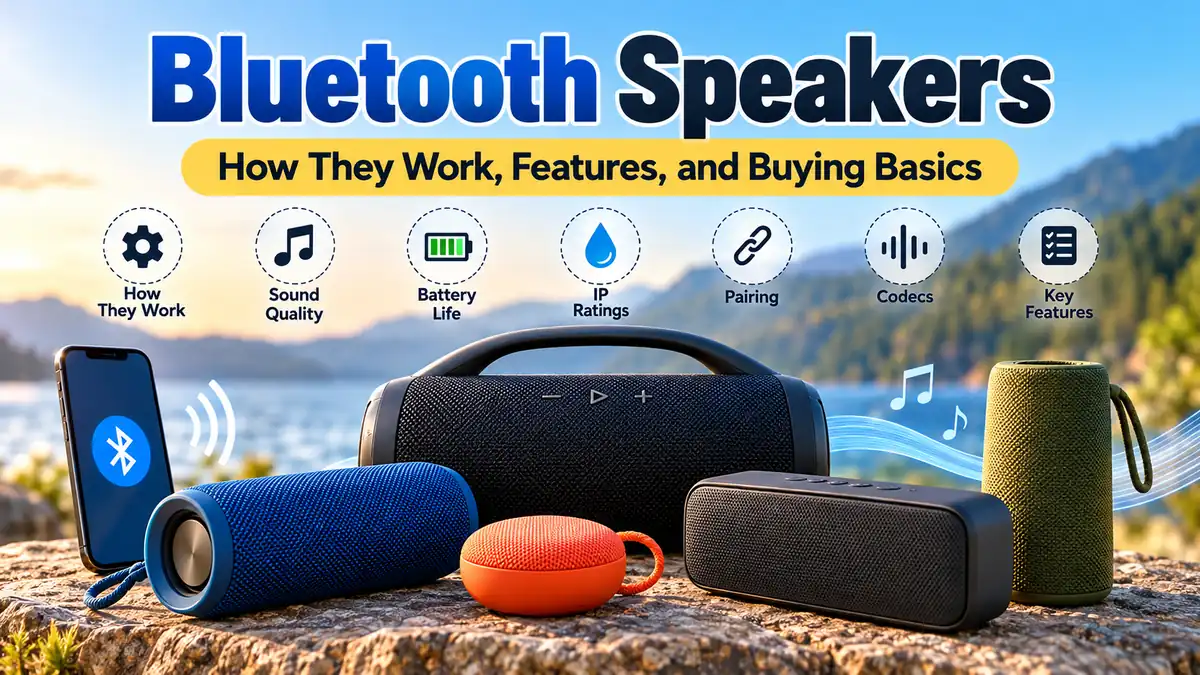

Bluetooth speakers have changed where and how people listen to audio. A phone can stay in your pocket while a compact speaker plays music across a bedroom, patio, campsite, or beach—with no audio cable and, in most cases, no internet connection required.
The category is broad, though. Some models are tiny enough to clip onto a backpack, while others are large party speakers designed to fill a room or outdoor gathering. Understanding the technology and the specifications that actually matter makes those differences much easier to navigate.
Bluetooth speakers are powered speakers that receive digital audio wirelessly from compatible devices using Bluetooth radio technology. Most connect directly to phones, tablets, or computers, decode the transmitted audio, amplify it, and drive built-in speaker units. Portable versions typically add rechargeable batteries, while features such as water resistance, stereo pairing, EQ controls, and microphones vary by model. Bluetooth® Technology Website
What Are Bluetooth Speakers?
Bluetooth speakers are wireless audio devices that use Bluetooth to receive an audio signal from another compatible device.
A typical setup consists of two parts:
- A source device, such as a smartphone, tablet, laptop, or compatible television.
- A Bluetooth speaker, which receives and reproduces the audio.
Unlike traditional passive speakers, most Bluetooth models contain their own amplifier and electronics. Portable versions also contain rechargeable batteries, making them largely self-contained.
Bluetooth is especially useful because the source and speaker establish a direct wireless connection. A Wi-Fi network or mobile-data connection isn’t inherently required for the Bluetooth link itself. Of course, internet access may still be necessary if the music is coming from an online streaming service. RTINGS.com
That distinction explains why portable Bluetooth speakers are so useful for camping, travel, picnics, workshops, beaches, and other places where reliable Wi-Fi may not exist.
How Do Bluetooth Speakers Work?
The process sounds complicated, but from the listener’s perspective it happens almost instantly.
Bluetooth uses radio waves in the 2.4 GHz frequency band to establish short-range communication between compatible devices. Bluetooth Classic, which has traditionally handled wireless audio, operates across 79 channels in that band. Bluetooth® Technology Website
When you play a song, the basic path looks like this:
Phone → Bluetooth encoding → wireless transmission → speaker decoding → amplification → speaker drivers → sound
1. Your device processes the audio
Your phone or computer starts with digital audio from a stored file, podcast, video, streaming application, or another source.
2. Bluetooth prepares it for transmission
The audio is encoded using a supported Bluetooth audio codec.
The codec helps determine how audio information is packaged and transmitted over the wireless connection.
3. The signal travels wirelessly
Your device sends the encoded information to the paired speaker over the Bluetooth radio connection.
Bluetooth uses techniques such as frequency hopping to help maintain reliable communication in the crowded 2.4 GHz spectrum. RTINGS.com
4. The speaker processes the signal
Electronics inside the speaker decode the incoming audio information.
5. The amplifier powers the drivers
An internal amplifier increases the signal to a level capable of driving the speaker’s physical components.
6. The drivers create sound
The drivers move air, converting the electrical signal into the sound you hear.
All of this normally occurs quickly enough that listening to music feels immediate.
How to Connect Bluetooth Speakers
Pairing is the process that creates a Bluetooth connection between two devices. During pairing, the devices establish the information needed for a secure wireless link, and previously paired devices can often reconnect automatically later. RTINGS.com
The exact controls vary by manufacturer, but the basic procedure is usually:
- Turn on the Bluetooth speaker.
- Activate its pairing mode.
- Open Bluetooth settings on your phone, tablet, or computer.
- Allow the device to search for nearby Bluetooth products.
- Select the speaker’s name.
- Wait for confirmation that the connection is complete.
- Start playing audio.
If a previously paired speaker fails to connect, check whether it has automatically connected to another nearby device. Turning Bluetooth off on the old source—or disconnecting it manually—often resolves the problem.
Some speakers also support multipoint, allowing connections with more than one source device, although implementation differs between products.
What Determines Bluetooth Speaker Sound Quality?
A newer Bluetooth version or impressive-looking specification doesn’t automatically mean better sound.
The physical speaker design remains extremely important.
Drivers and enclosure design
Drivers physically produce sound. Their dimensions, number, arrangement, and tuning influence frequency response and maximum output.
The enclosure matters too. Manufacturers carefully design the internal volume, ports, passive radiators, and driver positioning to achieve particular acoustic characteristics.
Small speakers face an unavoidable physical limitation: producing powerful low-frequency sound requires moving significant amounts of air.
That’s one reason larger speakers generally have more potential for deep bass and high output than tiny portable models.
Frequency response and tuning
Frequency response describes the range of frequencies a speaker can reproduce and, more importantly, how it reproduces them.
A well-tuned portable speaker should ideally avoid making vocals muddy, treble painfully sharp, or bass so exaggerated that it overwhelms everything else.
Numbers alone don’t tell the entire story. Independent measurements and careful listening can reveal more about tonal balance than marketing claims.
Loudness
Consider where you’ll actually listen.
A small personal speaker may be perfectly adequate beside a bed or desk but struggle during an outdoor gathering. A large party speaker may have the opposite problem: excellent output but poor portability.
Directivity
Directivity describes how a speaker’s sound changes depending on where the listener is positioned.
Some cylindrical designs attempt to distribute sound across a wider area. Forward-facing models can sound noticeably different when you move away from their main listening axis. RTINGS notes that speakers with good directivity can provide more consistent sound from different listening positions. RTINGS.com
Bluetooth Codecs: SBC, AAC, aptX, and LDAC
Codecs frequently appear on specification sheets, but they’re easy to misunderstand.
A Bluetooth codec encodes and decodes audio for wireless transmission.
Common names include:
| Codec | What to know |
|---|---|
| SBC | Standard baseline Bluetooth audio codec |
| AAC | Commonly associated with Apple-device Bluetooth audio |
| aptX family | Available on certain compatible devices and speakers |
| LDAC | Higher-data-rate codec supported by some compatible hardware |
| LC3 | Codec associated with Bluetooth LE Audio |
SBC remains extremely common in portable speakers. AAC and codecs such as aptX may also be supported depending on the model and source device. SoundGuys
However, codec support should not overshadow basic acoustics.
A well-designed speaker using SBC can sound better than a poorly tuned speaker advertising a more sophisticated codec. Driver quality, enclosure design, DSP, placement, listening environment, and tuning can all have a substantial effect on what reaches your ears.
Compatibility matters as well: both ends of the connection need appropriate support for a particular codec to be useful.
Quick Takeaway: Don’t choose bluetooth speakers solely because one codec looks better on paper. Start with overall sound performance and your intended use, then consider codec compatibility.
Bluetooth Versions and What They Mean
You’ll encounter specifications such as Bluetooth 5.1, 5.2, 5.3, or 5.4 when comparing current products.
A newer version can introduce improvements to the broader Bluetooth platform, but the version number by itself doesn’t guarantee better speaker sound.
Two speakers using the same Bluetooth version may perform very differently because of their antennas, firmware, codecs, acoustic design, and implementation.
Bluetooth technology also includes two major radio approaches: Bluetooth Classic and Bluetooth Low Energy (LE). Bluetooth Classic has long been widely used for wireless audio, while Bluetooth LE supports newer capabilities including LE Audio. Bluetooth® Technology Website
For everyday buyers, connection reliability and actual supported features are usually more meaningful than simply choosing the highest version number available.
How Far Can Bluetooth Speakers Work?
There is no single real-world range that applies to every speaker.
Distance depends on the transmitter, receiver, radio implementation, physical obstacles, interference, and surrounding environment.
An open area generally provides a more reliable connection than several rooms separated by thick walls.
Common sources of interference include other equipment operating around 2.4 GHz. The human body and physical obstacles can also weaken radio signals.
If audio begins cutting out, try reducing the distance between devices and removing major obstructions before assuming the speaker is defective.
Portable Bluetooth Speakers vs. Home and Party Models
Not all bluetooth speakers are designed for the same purpose.
Ultra-portable speakers
These prioritize low weight and compact dimensions.
They’re useful for:
- Backpacking
- Personal listening
- Cycling stops
- Travel
- Small rooms
- Showers, when suitably water-resistant
The trade-off is normally reduced bass extension and maximum volume.
Standard portable speakers
This middle category balances portability with stronger sound.
Many include rechargeable batteries, USB-C charging, rugged construction, water resistance, companion apps, and multi-speaker pairing.
They’re suitable for everyday home listening as well as occasional outdoor use.
Large portable and party speakers
These prioritize output and bass over portability.
Some include handles or wheels and may offer microphone or instrument inputs, lighting effects, karaoke-oriented features, and multi-speaker synchronization. RTINGS notes that party-oriented models may provide extra microphone and guitar connections. RTINGS.com
Bluetooth home speakers
Some home-focused wireless speakers combine Bluetooth with Wi-Fi.
That approach can provide convenient Bluetooth playback while allowing network-based streaming at home. Hybrid Bluetooth/Wi-Fi products therefore occupy a different role from purely portable battery-powered designs. SoundGuys
Bluetooth Speakers vs. Wi-Fi Speakers
Bluetooth and Wi-Fi speakers are both wireless, but they operate differently.
| Feature | Bluetooth | Wi-Fi |
|---|---|---|
| Internet/network required for direct connection | No | Usually requires local network |
| Portability | Often excellent | Usually home-focused |
| Setup | Usually simple | Can require network setup |
| Range | Generally shorter | Can cover a home network |
| Multi-room audio | Limited/model dependent | Common in compatible ecosystems |
| Battery-powered options | Very common | Less central to category |
| High-bandwidth audio | More constrained | Greater potential |
Bluetooth excels when portability and direct device-to-speaker communication matter.
Wi-Fi makes more sense for permanent home installations, synchronized multi-room systems, and certain higher-bandwidth streaming applications.
Some speakers support both, providing Bluetooth away from home and Wi-Fi functionality when connected to a network.
Battery Life: Don’t Trust the Headline Number Alone
Battery runtime is one of the most important specifications for portable bluetooth speakers, but advertised figures should be treated as estimates rather than guarantees.
Real-world runtime can change substantially with:
- Listening volume
- Bass intensity
- LED lighting
- Ambient temperature
- Battery age
- EQ settings
- Additional wireless features
- Charging another device from the speaker
Testing cited by SoundGuys illustrates the difference: a speaker advertised for up to 24 hours delivered about 13.5 hours when tested at a louder, more party-like level. SoundGuys
That doesn’t necessarily make the advertised specification wrong. It means testing conditions and actual usage differ.
If you need a speaker for long outdoor trips, prioritize independently tested battery performance rather than relying entirely on the maximum number printed on the box.
Can a Bluetooth speaker charge your phone?
Some larger portable models include power-bank functionality.
This can be useful during travel, but the energy comes from the speaker’s battery. Charging your phone therefore reduces the amount of power available for music playback. SoundGuys
Understanding IP Ratings
For outdoor use, the Ingress Protection (IP) rating is one of the most useful specifications.
An IP rating can indicate resistance to solid particles such as dust and to water.
For example:
IP67
The first digit relates to protection against solids and dust.
The second digit relates to protection against water.
An X, as in IPX7, means that particular protection category hasn’t been assigned a numerical rating—it should not automatically be interpreted as equivalent dust protection.
An IP67 product is dust-tight and is tested for temporary water immersion under specified conditions. RTINGS describes IP67 as protection against dust and immersion in up to one meter of water for 30 minutes. RTINGS.com
Still, an IP rating isn’t permission to treat electronics carelessly. Protection has specific testing conditions and limits.
For beaches and dusty environments, dust protection deserves particular attention. A product marked IPX7 may provide substantial water resistance while lacking a tested dust rating. SoundGuys
Mono, Stereo, and Multi-Speaker Pairing
A surprising number of portable speakers are effectively mono devices.
Even a small unit containing multiple drivers may not create a convincing stereo image because those drivers sit very close together. Stereo perception depends partly on meaningful spatial separation between left and right channels. SoundGuys
Manufacturers address this by allowing compatible speakers to connect together.
Stereo pairing
Two compatible speakers can sometimes be assigned as left and right channels.
Placing them apart produces much clearer stereo separation than trying to generate stereo from drivers packed into one compact enclosure.
Party or multi-speaker modes
Some ecosystems can synchronize several compatible speakers to play the same audio across a larger area.
Compatibility is crucial.
Multi-speaker systems frequently require particular models from the same manufacturer or product family, so don’t assume speakers from different brands—or even every model from one brand—will link together. RTINGS.com
Useful Features Beyond Basic Playback
Modern bluetooth speakers can do considerably more than simply receive music.
Companion apps and EQ
Manufacturer apps may provide:
- Equalizer controls
- Preset sound modes
- Firmware updates
- Battery information
- Speaker grouping
- Lighting controls
- Device management
EQ is especially useful because placement and personal preferences can dramatically change how much bass or treble sounds appropriate.
Firmware support also matters over the long term because updates can fix problems or introduce new functionality. SoundGuys
Built-in microphones
Some models contain microphones for speakerphone calls or voice-related functions.
Others don’t.
Don’t assume a wireless speaker can handle calls simply because your phone can route audio to it. If speakerphone capability matters, check the specification explicitly. SoundGuys
USB-C
USB-C charging has become common across modern portable electronics and makes it easier to travel with fewer cable types.
However, a USB-C connector doesn’t automatically mean the port accepts audio or supports fast charging. Those capabilities need to be verified separately.
Auxiliary input
A 3.5 mm AUX input can still be valuable.
A wired connection may work with older equipment and can help avoid Bluetooth-related latency when audio synchronization matters. SoundGuys
Power-bank output
Some larger speakers can provide USB power to another device.
It’s useful during travel but consumes the speaker’s battery.
Lighting
RGB and other lighting systems are common on party-oriented products. They’re largely an aesthetic feature, although running elaborate lighting can affect battery runtime.
How to Choose Bluetooth Speakers for Your Needs
The easiest mistake is shopping by specifications before deciding how the speaker will actually be used.
Instead, start with the listening environment.
For home listening
Prioritize:
- Sound balance
- Appropriate room-filling output
- Convenient charging or mains power
- EQ/app functionality
- Stereo or multi-speaker options
Portability and weather protection may be secondary.
For travel
Prioritize:
- Size
- Weight
- Battery life
- USB-C charging
- Durable construction
- Carrying loop or strap
A slightly smaller speaker that you’ll actually carry can be more useful than a powerful model that stays at home.
For beaches, pools, and camping
Pay close attention to:
- IP rating
- Dust protection
- Water resistance
- Rugged construction
- Battery runtime
- Carrying method
- Controls that are easy to operate outdoors
IP67 and IP68 are common examples among rugged portable models, while IPX ratings need to be interpreted carefully because the X doesn’t represent a tested dust-protection level. SoundGuys
For parties
Output becomes more important.
Consider maximum usable loudness, bass performance, battery runtime at higher volumes, speaker linking, microphone inputs, lighting, and physical size.
Remember that a larger speaker may produce substantially stronger low-frequency output but will also be harder to transport.
Common Bluetooth Speaker Mistakes
Choosing by wattage alone
Power figures don’t provide a complete measurement of perceived loudness or sound quality.
Driver efficiency, DSP, enclosure design, distortion, frequency response, and measurement methods all influence the final result.
Assuming more bass always means better sound
Heavy bass can initially sound impressive.
But excessive low-frequency emphasis may obscure vocals and instruments. Balanced tuning often remains enjoyable across a wider variety of music.
Ignoring size
Physics matters.
Compact speakers can achieve impressive performance through clever engineering and digital signal processing, but they cannot completely escape the limitations imposed by small drivers and enclosures.
Treating advertised battery life as guaranteed
Maximum battery figures are usually measured under particular conditions.
Higher playback levels and power-intensive features can substantially shorten runtime. SoundGuys
Assuming “waterproof” means indestructible
Always read the actual IP rating and manufacturer instructions.
Water resistance has limits involving depth, exposure time, pressure, and sometimes the type of liquid.
Focusing too heavily on codecs
Codecs matter, but they are only one part of the audio chain.
For casual portable listening, speaker tuning and acoustic design can make a larger practical difference. SoundGuys similarly notes that codec advantages can become less significant once speaker tuning and listening conditions are considered. SoundGuys
How to Get Better Sound From Bluetooth Speakers
You don’t necessarily need a different speaker to improve your listening experience.
Placement can make a noticeable difference.
Avoid burying the speaker inside a bag or placing it behind furniture. Keep its main drivers unobstructed and experiment with distance from walls and corners.
If the speaker has an EQ, make small adjustments rather than immediately maximizing the bass.
For a model that supports stereo pairing, adding a second compatible unit and separating the two can produce a wider, more convincing soundstage.
Keep firmware updated through the manufacturer’s official app when available, since updates can address connectivity and functionality issues. SoundGuys
And when wireless latency becomes distracting—particularly with video—use a wired input where both devices support one. SoundGuys
Are Bluetooth Speakers Worth Using?
For portable and convenient everyday audio, bluetooth speakers solve a simple problem extremely well: they let you move sound away from your phone or computer without running an audio cable between the two.
Their strengths are portability, simple pairing, direct wireless operation, rechargeable power, and the enormous variety of available sizes.
Their compromises depend on the design. Small models sacrifice deep bass and maximum output. Large models sacrifice portability. Wireless audio introduces codec and latency considerations, while battery-powered models eventually need recharging.
That’s why there is no universally ideal specification.
Choose according to where you’ll listen first. For outdoor use, prioritize durability, IP protection, and realistic battery life. For home listening, place more weight on sound quality and connectivity. For travel, size and weight become critical. For parties, output and battery performance at high volume matter more.
Once those priorities are clear, Bluetooth versions, codecs, stereo pairing, apps, microphones, and other extras become much easier to evaluate—and you’re far less likely to pay for features you won’t actually use.
