

Computers have evolved from enormous machines that occupied entire rooms into powerful devices that fit inside our pockets. This transformation happened through major advances in electronic components, programming, memory, and processing technology.
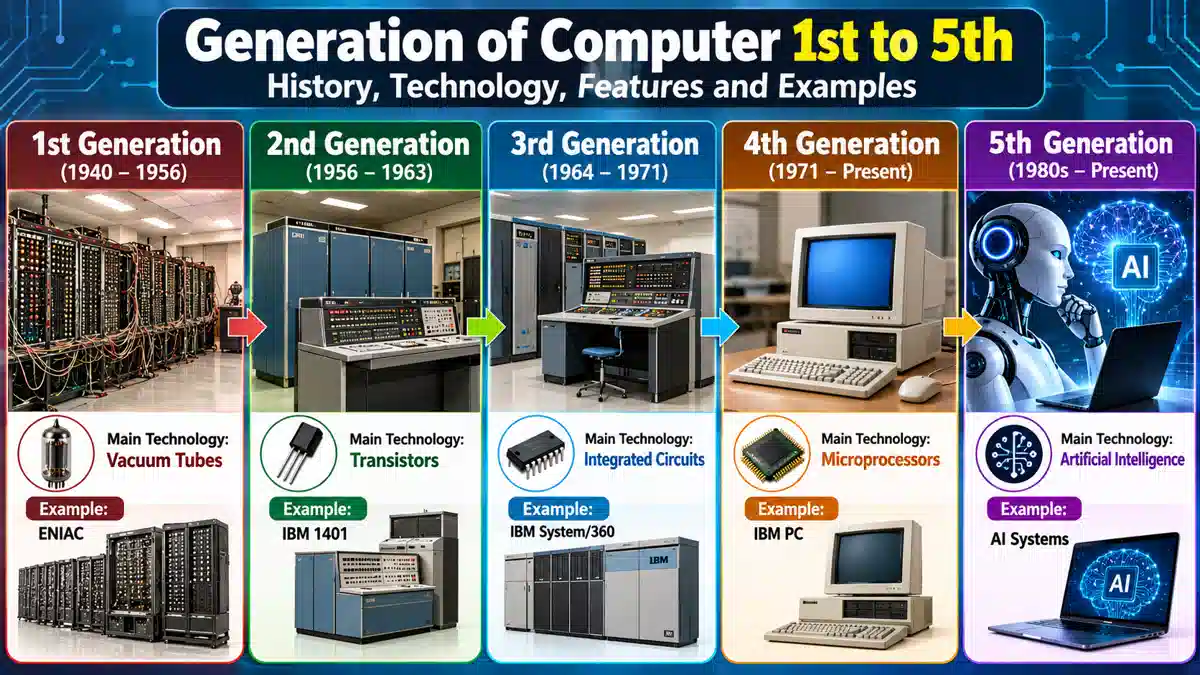
The generation of computer 1st to 5th describes five stages of computer development: vacuum tubes, transistors, integrated circuits, microprocessors, and artificial intelligence-oriented computing. Each generation introduced technologies that made computers smaller, faster, more reliable, and easier to use. These generations provide a useful framework for understanding the history of modern computing.
What Are the Five Generations of Computers?
A computer generation is a period in the evolution of computers identified by its dominant hardware technology and major advances in computing capabilities.
The five-generation classification is commonly taught in computer science and information technology courses. However, the dates are approximate, and the generations overlap because new technologies do not replace older ones simultaneously.
| Generation | Approximate period | Main technology | Examples |
|---|---|---|---|
| First | 1940–1956 | Vacuum tubes | ENIAC, UNIVAC I |
| Second | 1956–1963 | Transistors | IBM 1401, IBM 7090 |
| Third | 1964–1971 | Integrated circuits | IBM System/360, PDP-8 |
| Fourth | 1971–Present | Microprocessors and VLSI | IBM PC, Apple Macintosh |
| Fifth | 1980s–Present | AI, parallel processing, advanced computing | AI research systems, modern AI-enabled computers |
The fourth and fifth generations overlap. The fifth generation is better understood as an AI-focused classification rather than a complete replacement for microprocessor-based computers.
First Generation of Computers (1940–1956)
The first generation marked the beginning of electronic digital computing. Early computers used vacuum tubes to perform electronic switching and calculations.
Technology Used in First-Generation Computers
A vacuum tube is an electronic device that controls the flow of electrons. Before transistors became widely available, vacuum tubes were essential components in electronic computing systems.
First-generation computers also used technologies such as magnetic drums, punched cards, paper tape, and early electronic memory systems.
Main Features
- Extremely large physical size
- High electricity consumption
- Significant heat generation
- Frequent maintenance requirements
- Limited memory capacity
- Programming primarily through machine instructions
- Expensive installation and operation
Many early computers were built for scientific calculations, military research, and government data processing.
Examples of First-Generation Computers
ENIAC (Electronic Numerical Integrator and Computer)
ENIAC was publicly unveiled in 1946. Developed by J. Presper Eckert and John Mauchly at the University of Pennsylvania, it was among the earliest general-purpose electronic digital computers.
It contained approximately 17,468 vacuum tubes and weighed around 30 tons.
UNIVAC I (Universal Automatic Computer I)
Delivered in 1951, UNIVAC I became one of the earliest commercially produced computers in the United States.
It demonstrated that electronic computers could handle business and government data processing.
EDSAC (Electronic Delay Storage Automatic Calculator)
EDSAC began operating at the University of Cambridge in 1949 and was an important early practical stored-program computer.
Advantages and Disadvantages
| Advantages | Disadvantages |
|---|---|
| Enabled high-speed electronic calculations compared with manual methods | Extremely expensive |
| Supported complex scientific research | Occupied large rooms |
| Established the foundations of electronic computing | Produced substantial heat |
| Automated repetitive calculations | Required frequent maintenance |
The greatest achievement of the first generation was proving that electronic machines could perform complex calculations automatically.
Second Generation of Computers (1956–1963)
The second generation introduced transistors as replacements for vacuum tubes.
The transistor was invented at Bell Laboratories in 1947 by John Bardeen, Walter Brattain, and William Shockley. Its adoption in computer systems during the 1950s helped transform computer engineering.
What Made Second-Generation Computers Different?
Transistors were smaller, more energy-efficient, and generally more reliable than vacuum tubes.
Their use allowed computer manufacturers to develop machines with lower power requirements and improved operational stability.
Second-generation systems also increasingly used magnetic-core memory and magnetic tape or disk storage.
Main Features
- Transistor-based circuitry
- Smaller size than many first-generation computers
- Reduced electricity consumption
- Greater reliability
- Faster processing
- Support for assembly language
- Growing use of high-level programming languages
Languages such as FORTRAN and COBOL became important during this period.
FORTRAN was introduced by IBM in 1957 for scientific and engineering calculations. COBOL emerged in 1959 for business-oriented data processing.
Examples of Second-Generation Computers
IBM 1401: Introduced in 1959, the IBM 1401 became a widely used business data-processing computer.
IBM 7090: Announced in 1958, this transistorized scientific computer supported demanding mathematical and engineering calculations.
IBM 1620: Introduced in 1959, the IBM 1620 was used in scientific, educational, and engineering environments.
Advantages and Disadvantages
Second-generation computers offered better reliability, lower operating costs, and improved programming capabilities.
However, they remained expensive, required specialized facilities, and were mainly accessible to governments, universities, and large organizations.
The move from vacuum tubes to transistors was one of the most important hardware breakthroughs in computing history.
Third Generation of Computers (1964–1971)
The third generation introduced integrated circuits, commonly abbreviated as ICs.
An integrated circuit combines multiple electronic components on a semiconductor chip. This innovation reduced the need to assemble large numbers of separate transistors and other components.
Jack Kilby demonstrated an early integrated circuit in 1958, while Robert Noyce developed an influential silicon integrated-circuit design in 1959.
Main Features of Third-Generation Computers
Third-generation computers introduced improvements in both hardware and software.
These included:
- Integrated circuit technology
- Smaller and more reliable hardware
- Lower power consumption per computing function
- Improved processing performance
- More sophisticated operating systems
- Multiprogramming capabilities
- Greater use of keyboards and terminals
- Wider commercial adoption
Multiprogramming allowed operating systems to manage multiple programs more efficiently by sharing processor resources.
Time-sharing systems also developed, enabling several users to interact with a computer through separate terminals.
Examples of Third-Generation Computers
IBM System/360
Announced in 1964, IBM System/360 was a landmark family of compatible computers.
Its architecture allowed organizations to use different models while maintaining substantial software compatibility.
PDP-8
Introduced by Digital Equipment Corporation in 1965, the PDP-8 became an influential minicomputer.
It helped make computing more accessible to laboratories, educational institutions, and smaller organizations.
Honeywell 6000 Series
The Honeywell 6000 family included mainframe computers used for business and scientific applications.
Why Was the Third Generation Important?
The third generation helped move computers beyond specialized research facilities.
Businesses increasingly used computers for payroll, inventory management, accounting, and information processing.
Universities also expanded computer science education as access to computing resources improved.
Integrated circuits laid the foundation for the development of modern microprocessors.
Fourth Generation of Computers (1971–Present)
The fourth generation is generally associated with the development of microprocessors and large-scale semiconductor integration.
A microprocessor integrates the central processing unit’s core functions onto a chip or a small number of chips.
Intel introduced the 4004 microprocessor in 1971, an important milestone in the development of microprocessor-based computing.
Technologies Behind Fourth-Generation Computers
Fourth-generation systems benefited from rapid progress in semiconductor manufacturing.
Important technologies include:
- Large-Scale Integration (LSI)
- Very-Large-Scale Integration (VLSI)
- Microprocessors
- Semiconductor memory
- Personal computer architectures
- Graphical user interfaces
- Networking technologies
- Advanced operating systems
VLSI technology enables very large numbers of transistors to be integrated onto semiconductor chips.
Modern processors may contain billions of transistors, illustrating how far chip technology has advanced.
Main Features
Fourth-generation computers became substantially smaller and more affordable than earlier systems.
Their main characteristics include high processing speed, increased memory capacity, improved energy efficiency, and widespread personal and commercial use.
Personal computers also brought computing directly into homes, classrooms, and small businesses.
Examples of Fourth-Generation Computers
Altair 8800
Released in 1975, the Altair 8800 became an influential early microcomputer based on the Intel 8080 processor.
Apple II
Introduced in 1977, the Apple II helped popularize personal computing among households, schools, and businesses.
IBM Personal Computer
Introduced in 1981, the IBM PC influenced the development of the personal computer industry and compatible computer systems.
Apple Macintosh
Released in 1984, the original Macintosh helped bring graphical user interfaces and mouse-based interaction to a wider audience.
How Fourth-Generation Computers Changed Everyday Life
The fourth generation helped make computing a routine part of modern society.
Computers became essential for writing documents, managing business records, creating software, processing financial transactions, and accessing digital information.
Later advances in networking and the internet expanded their importance further.
Although many educational timelines begin the fifth generation in the 1980s, contemporary laptops, desktops, and smartphones still depend on technologies associated with fourth-generation microprocessor computing.
Fifth Generation of Computers (1980s–Present and Beyond)
The fifth generation is associated with artificial intelligence, knowledge-based systems, natural language processing, and parallel computing.
Unlike the first four generations, which are classified primarily by electronic hardware, the fifth generation emphasizes intelligent information processing.
Origins of Fifth-Generation Computing
In 1982, Japan launched the Fifth Generation Computer Systems (FGCS) project through its Ministry of International Trade and Industry.
The project focused on knowledge-based computing, logic programming, and parallel processing. Researchers developed experimental parallel inference machines designed to process logical information efficiently.
The project ended in 1992. Although it did not establish a new mainstream computer architecture, it remains an important milestone in artificial intelligence research.
Computer Museum
+1
Main Features of Fifth-Generation Computers
The technologies commonly associated with fifth-generation computing include:
- Artificial intelligence (AI)
- Machine learning and deep learning
- Natural language processing (NLP)
- Parallel and distributed processing
- Expert systems and knowledge representation
- Advanced robotics
- Speech recognition and computer vision
- Specialized AI acceleration hardware
These capabilities allow computers to perform tasks involving language, pattern recognition, prediction, and automated decision support.
Examples of Fifth-Generation Computing
Expert systems: Early AI programs designed to apply stored rules and specialist knowledge to particular problems.
Parallel inference machines: Experimental computers developed through Japan’s FGCS initiative to investigate knowledge processing.
Modern AI systems: Applications using machine learning and neural networks for translation, image analysis, speech recognition, and text generation.
AI-enabled robotics: Machines that combine sensors, computational models, and control systems to interact with their environments.
AI accelerators: Specialized processors, including GPUs and neural processing units (NPUs), that speed up machine learning calculations.
Not every modern AI-enabled device is formally a fifth-generation computer. Many use fourth-generation microprocessor technology alongside specialized AI hardware.
Advantages of Fifth-Generation Computing
AI-oriented computing can improve productivity by analyzing large datasets, recognizing patterns, automating repetitive tasks, and supporting complex research.
It also enables more natural interactions between humans and computers through speech, text, and visual interfaces.
Limitations and Challenges
Advanced AI systems still face important limitations.
They may produce inaccurate outputs, require substantial computational resources, inherit biases from training data, and raise privacy or security concerns.
Developing and operating large AI models can also consume significant electricity and specialized hardware resources.
Therefore, the fifth generation should not be interpreted as a stage in which computers have achieved human-level intelligence.
generation of computer 1st to 5th: Key Differences
The easiest way to understand the development of computer generations is to compare their technologies, programming methods, size, and applications.
| Feature | First | Second | Third | Fourth | Fifth |
|---|---|---|---|---|---|
| Core technology | Vacuum tubes | Transistors | Integrated circuits | Microprocessors | AI-oriented systems |
| Physical size | Very large | Smaller | More compact | Desktop to handheld | Varies |
| Processing | Electronic circuits | Transistor logic | IC-based processors | Highly integrated CPUs | Parallel and AI-accelerated processing |
| Programming | Machine code | Assembly, FORTRAN, COBOL | High-level languages and operating systems | Modern programming languages | AI frameworks and specialized languages |
| Reliability | Relatively low | Improved | Higher | Generally high | Depends on system |
| Typical users | Researchers, governments | Large organizations | Businesses, universities | General public | Researchers, businesses, consumers |
| Examples | ENIAC | IBM 1401 | IBM System/360 | IBM PC | Parallel inference and AI systems |
Which Computer Generation Was the Fastest?
There is no single fastest generation in an absolute sense because computing performance depends on the processor, architecture, workload, memory, and software.
However, modern processors and AI accelerators can perform vastly more calculations per second than early vacuum-tube computers.
The transition from first-generation machines to modern computing represents enormous improvements in computational capacity.
Which Generation Introduced Integrated Circuits?
The third generation introduced integrated circuits as a defining technology.
Instead of relying entirely on individually assembled transistors, manufacturers increasingly used circuits containing multiple electronic components on semiconductor chips.
This made computers more compact and helped improve manufacturing efficiency.
What Is the Difference Between Fourth and Fifth Generations?
The fourth generation is mainly defined by microprocessors and semiconductor integration.
The fifth generation focuses on intelligent computing capabilities such as knowledge processing, natural language interaction, and parallel computation.
The distinction is not absolute. Modern AI systems typically run on advanced semiconductor hardware developed from fourth-generation technologies.
CloudsPress
+1
How Computer Technology Evolved Across Five Generations
The history of computers becomes easier to understand when viewed as a sequence of technological improvements.
From Vacuum Tubes to Transistors
Vacuum tubes made electronic digital computing possible, but their size, energy requirements, and maintenance needs limited widespread adoption.
Transistors replaced many of these components with smaller semiconductor devices.
This improved reliability and allowed computer systems to become more practical.
From Transistors to Integrated Circuits
Integrated circuits combined electronic components into compact semiconductor packages.
As manufacturing techniques improved, engineers could place increasing numbers of transistors on individual chips.
This reduced the size and complexity of computer circuitry.
From Integrated Circuits to Microprocessors
Microprocessors brought central processing functions onto highly integrated chips.
This development supported the growth of affordable microcomputers and eventually the personal computer industry.
Semiconductor advances also helped expand embedded computing into vehicles, appliances, industrial equipment, and communication devices.
From Microprocessors to AI-Oriented Computing
The fifth-generation concept introduced the ambition of developing systems capable of more advanced information processing.
Today, AI software and specialized processors can support speech recognition, computer vision, language generation, and complex data analysis.
These systems extend the capabilities of conventional computers rather than completely replacing their underlying architecture.
Important Technologies Behind Computer Generations
Several foundational technologies explain why computing capabilities improved so dramatically.
Central Processing Unit (CPU)
The CPU executes instructions and coordinates many of a computer’s operations.
Early computers implemented processing functions using large collections of electronic components.
Modern CPUs contain highly integrated circuitry with multiple processing cores and sophisticated memory management features.
Random Access Memory (RAM)
RAM temporarily stores data and instructions required by active programs.
Early computer memory technologies included mercury delay lines, Williams tubes, magnetic drums, and magnetic-core memory.
Modern systems generally use semiconductor-based memory technologies such as dynamic RAM.
Semiconductor Technology
Semiconductors are materials whose electrical properties can be controlled to create electronic components.
Silicon became central to transistor and integrated-circuit manufacturing.
Advances in semiconductor fabrication enabled the development of smaller and more capable processors.
Moore’s Law
In 1965, Intel co-founder Gordon Moore observed a trend in the increasing number of components that could be economically integrated onto semiconductor chips.
Moore’s Law later became widely associated with the approximate doubling of transistor counts over a period of about two years.
It is an industry observation and forecasting principle, not a physical law guaranteeing continuous improvements.
Modern chip development increasingly relies on architectural improvements, specialized processors, advanced packaging, and other innovations alongside transistor scaling.
Operating Systems and Programming Languages
Hardware improvements alone did not make computers accessible.
Operating systems, compilers, programming languages, and user interfaces were equally important.
Early programmers worked close to machine instructions. Later generations benefited from languages such as FORTRAN, COBOL, BASIC, C, Java, and Python.
Graphical interfaces and modern operating systems further reduced the technical knowledge required for everyday computer use.
Applications of Different Computer Generations
The uses of computers expanded as hardware became more powerful and affordable.
| Generation | Major applications |
|---|---|
| First | Military calculations, scientific research, census and government processing |
| Second | Business accounting, scientific modeling, engineering |
| Third | Banking, payroll, manufacturing, university computing |
| Fourth | Personal computing, education, office productivity, internet applications |
| Fifth | AI research, language processing, robotics, predictive analytics |
Computers in Education
Early computer systems were too expensive for most schools.
The arrival of minicomputers and personal computers expanded access to programming, digital learning materials, and educational software.
Modern computing supports online classrooms, simulations, accessibility tools, and AI-assisted learning.
Computers in Healthcare
Computer systems help healthcare professionals manage patient records, analyze medical images, coordinate hospital operations, and support scientific research.
Machine learning can assist with pattern recognition in medical data, although clinical applications require appropriate testing, oversight, and validation.
Computers in Business
Businesses moved from large centralized data-processing systems toward personal computers, networks, cloud infrastructure, and automated workflows.
Modern computing supports financial reporting, supply chain management, communication, customer service, and business analytics.
Are There Six Generations of Computers?
Some educational sources describe a proposed sixth generation associated with quantum computing, neuromorphic computing, or other advanced technologies.
However, there is no universally accepted sixth-generation classification.
Quantum computers use quantum-mechanical properties such as superposition and entanglement for particular kinds of computation.
Neuromorphic computing investigates hardware architectures inspired by biological neural systems.
Both are important research areas, but neither automatically establishes a new generation of general-purpose computers.
The conventional five-generation model remains useful for introductory computer education, provided its limitations are understood.
Which Generation of Computers Is Used Today?
Modern desktops, laptops, servers, and smartphones primarily rely on highly integrated semiconductor processors.
Under the traditional hardware-based classification, they are descendants of fourth-generation computing.
Systems using advanced artificial intelligence can also be described as incorporating fifth-generation capabilities.
This is why both terms may appear in descriptions of contemporary computing.
For example, a laptop may contain a multicore CPU, a graphics processor, and an NPU for machine learning workloads. Its hardware reflects decades of microprocessor development, while its software may support AI-based functions.
The generations are therefore not mutually exclusive categories for modern devices.
Why Is Learning the Five Generations of Computers Important?
Understanding the history of computer generations helps explain why modern technology has its current form.
It shows the relationship between advances in electronic components and improvements in computing performance.
For students, the topic also provides essential background for understanding computer architecture, operating systems, programming languages, and information technology.
A simple way to remember the sequence is:
Vacuum Tubes → Transistors → Integrated Circuits → Microprocessors → Artificial Intelligence
Each stage represents an important change in how computers were designed or what they were expected to accomplish.
Conclusion
The generation of computer 1st to 5th explains the transformation of computing from room-sized electronic machines into compact, powerful, and increasingly intelligent systems.
The first generation used vacuum tubes, the second introduced transistors, the third adopted integrated circuits, and the fourth popularized microprocessors. The fifth generation introduced an ambitious vision of AI-oriented and parallel computing that continues to influence modern technology.
The key lesson is that computer development has been a continuous process rather than a series of completely separate eras. Understanding the five generations provides a strong foundation for studying computer science, digital technology, and the future of computing.
