
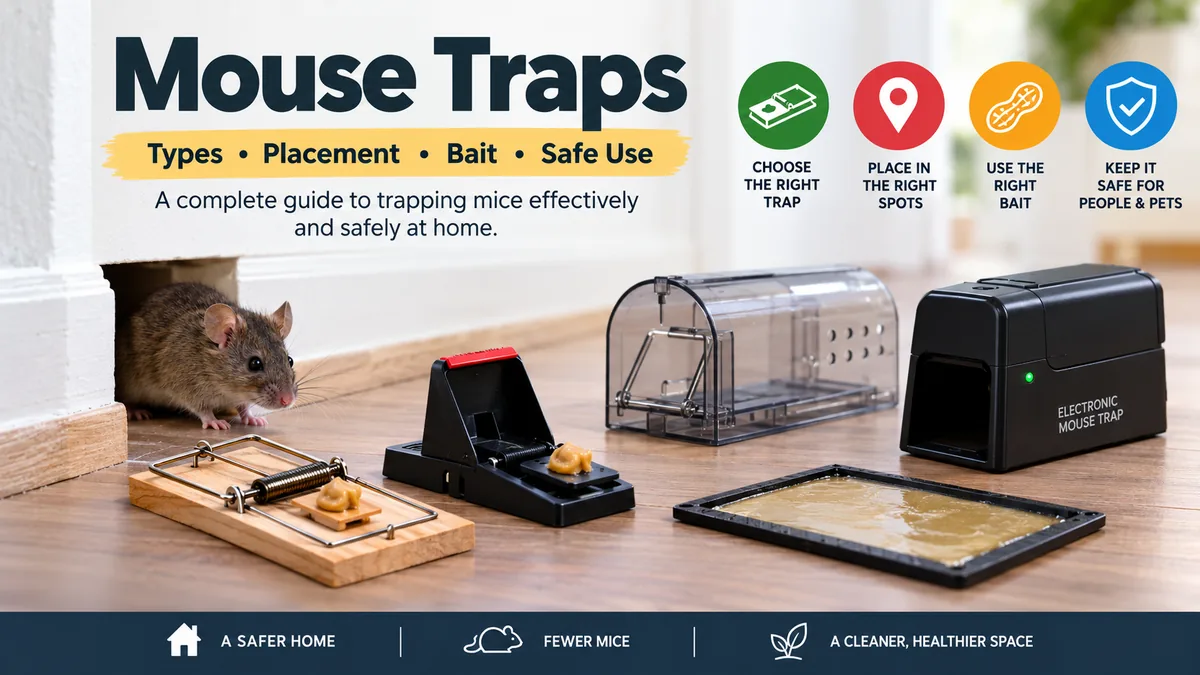

Hearing scratching behind a wall or finding small droppings in a kitchen cabinet usually means a mouse has already found food, shelter, or an entry point. Putting down a trap can help, but simply placing one in the middle of a room rarely solves the problem.
Mouse traps are devices used to capture or kill mice as part of rodent control. For most household infestations, properly placed mouse-sized snap traps are the recommended first-line trapping method. Success depends on identifying active mouse routes, using enough traps, positioning them correctly, checking them regularly, and sealing the openings that allowed mice indoors.
The trap itself is only one part of the solution. Mice follow predictable travel routes, reproduce quickly, and can continue entering a building when gaps remain open. Effective control combines trapping with sanitation, exclusion, careful cleanup, and ongoing monitoring.
How Mouse Traps Work
Mouse traps exploit normal mouse behavior rather than requiring a mouse to wander randomly into them.
House mice typically move close to walls, cabinets, appliances, boxes, and other protected edges. Evidence such as droppings, gnaw marks, nesting material, damaged food packaging, and rub marks can help reveal these routes. The CDC recommends concentrating traps in locations where those signs occur, including behind refrigerators and stoves and toward the backs of cabinets and drawers.
Depending on the design, a trap may:
- trigger a spring-loaded bar or jaw;
- enclose and kill the mouse;
- deliver an electrical shock;
- hold the animal on an adhesive surface;
- capture a mouse alive inside a chamber; or
- capture several mice in a multi-catch mechanism.
The basic principle is the same: position the device where a mouse is already likely to travel.
That explains one of the most common trapping failures. A perfectly baited trap in an inactive part of a room may catch nothing, while a modest trap placed directly across an established runway can work quickly.
Mouse traps versus rat traps
Trap size matters.
A device designed for a house mouse should not automatically be used for a rat. Rats are substantially larger and require appropriately sized traps. The CDC specifically advises choosing the correct snap trap for the rodent present.
Before trapping, confirm what you are dealing with rather than assuming every rodent sign comes from mice.
Types of Mouse Traps and Their Differences
Several designs are widely available, but they differ considerably in operation, cost, maintenance, welfare considerations, and potential exposure to children or pets.
| Trap type | How it works | Main advantage | Main drawback |
|---|---|---|---|
| Snap trap | Spring mechanism strikes the mouse | Effective, inexpensive, reusable | Mechanism can injure fingers, children, or pets |
| Enclosed snap trap | Trigger operates inside housing | Less contact with the captured mouse | Usually costs more |
| Electronic trap | Enclosed chamber delivers electrical shock | Discreet capture and easier disposal | Requires batteries or power |
| Live-catch trap | Door closes after mouse enters | Does not intentionally kill immediately | Requires frequent checking and handling |
| Multi-catch trap | Captures multiple mice in one unit | Useful where several mice are active | Requires frequent inspection |
| Glue board | Adhesive immobilizes a mouse | Simple construction | Welfare, disease-exposure, and non-target concerns |
Traditional snap traps
The familiar spring-loaded snap trap remains one of the simplest methods of mouse control. A bait pan or trigger releases a spring mechanism when disturbed.
For household trapping, the CDC recommends traditional snap traps for reducing rodent populations.
Wooden versions are inexpensive and can be reused if properly cleaned. Modern plastic or clam-style snap traps operate on the same basic principle but can be easier to set and empty.
Their biggest weakness is accessibility. An exposed trigger or striking mechanism should never be positioned where a child or pet can reach it.
Enclosed snap traps
An enclosed design puts much or all of the killing mechanism inside a housing.
This can make handling and disposal less unpleasant and may reduce accidental contact with the mechanism. However, “enclosed” should not automatically be interpreted as child- or pet-proof. The manufacturer’s instructions and placement requirements still matter.
Electronic mouse traps
Electronic traps generally lure a mouse into an enclosed chamber and deliver a lethal electrical shock once the animal contacts internal plates.
They offer a relatively discreet way to trap indoors and often have an indicator showing that the unit has activated. They cost more than ordinary snap traps and depend on batteries or another power source.
They also require regular checking. An electronic device should not become an excuse to leave a captured rodent inside for days.
Live-catch and multi-catch traps
Live traps close a door or entrance after a mouse enters. Some models hold one animal; others can capture several.
At first glance, catch-and-release can appear to be the obvious nonlethal solution. In practice, it creates additional responsibilities. A captured animal needs prompt attention, and release may be restricted by local wildlife or pest-control rules. Entry points must also be sealed or rodents may return.
There is also a health consideration. Current CDC household rodent-control guidance advises against live traps because frightened rodents may urinate, potentially increasing exposure to pathogens.
If someone nevertheless uses a live-capture device, it needs frequent inspection. Extension guidance warns that mice left inside without adequate food or water can die in the trap.
Glue traps and glue boards
Glue boards use a strong adhesive to immobilize rodents crossing their surface.
They are inexpensive and sometimes used for pest monitoring, but they have substantial disadvantages. Captured mice may remain alive and distressed for a prolonged period, while pets, birds, reptiles, insects, or other non-target animals can also become stuck.
The CDC currently recommends not using glue traps for household rodent control, citing the same concern that frightened trapped rodents can urinate and increase potential disease exposure.
UC Integrated Pest Management also notes welfare concerns, non-target captures, reduced effectiveness in dusty conditions, and problems caused by temperature extremes.
Quick takeaway: For a typical indoor mouse problem, mouse-sized snap traps are the strongest starting point in current CDC guidance. Other designs may offer convenience, but placement, accessibility, monitoring, and safety matter as much as trap style.
Where to Place Mouse Traps for Better Results
A mouse trap should intercept the animal’s normal route.
Start by inspecting the room rather than immediately setting traps. Look for fresh droppings, gnawed food containers, shredded nesting materials, holes, greasy marks, or concentrated activity behind appliances and cabinets.
Put traps against walls
For a traditional snap trap, CDC guidance recommends putting it on the floor against a wall with the baited end next to the wall, creating a T-shaped arrangement.
Why?
Mice tend to use protected edges as travel corridors. With the trigger end toward the baseboard, a mouse traveling in either direction encounters the active part of the trap.
Good locations often include:
- behind refrigerators and stoves;
- inside appropriate inaccessible cabinets;
- beside baseboards;
- behind furniture;
- near pantry activity;
- close to suspected entry holes;
- near droppings or nesting material;
- along basement, attic, garage, or utility-room walls.
Keep every trap inaccessible to children and pets.
Use more than one trap
One trap can be insufficient even when only one mouse has been seen.
Using several traps gives you better coverage of possible runways and makes it easier to determine where activity is concentrated. The number needed depends on the size of the affected space and the amount of activity rather than on an arbitrary “one trap per room” rule.
Concentrate them where signs are strongest instead of distributing them evenly through areas with no evidence of mice.
Don’t immediately blame the bait
When bait disappears but a snap trap does not fire, the problem may involve too much bait, incorrect trigger sensitivity, poor trap positioning, or a trap that is unsuitable for the animal.
When neither the trap nor bait is touched, placement is often the first thing worth reconsidering.
Best Bait for Mouse Traps and How Much to Use
The cartoon image of a mouse trap carrying a large wedge of cheese is memorable, but it isn’t a particularly useful trapping strategy.
The CDC recommends placing a small amount of bait on the bait pan and specifically identifies chunky peanut butter as an option.
Sticky bait has a practical advantage: a mouse usually has to interact with the trigger rather than simply picking up a loose piece and leaving.
Why a small amount works better
More bait is not necessarily better.
A large blob may allow feeding without sufficient interaction with the trigger, interfere with some trap mechanisms, or attract insects. A small dab positioned precisely on the bait area forces closer contact.
Other foods may work if mice are already feeding on them, but bait choice should not distract from the bigger issue: location normally matters more than having an exotic bait.
What if mice avoid a new trap?
Prebaiting can sometimes help with trap-shy rodents.
The basic technique is to place bait on an unset trap and allow the mouse to feed without consequence. After feeding activity is established, the trap is armed in the same location.
CDC guidance describes this approach for rodents that appear wary of traps, recommending that traps be set after bait is being eaten.
Avoid repeatedly moving a trap that is already positioned on an active runway. Consistency can be more useful than constantly changing bait.
How to Use Mouse Traps Safely
Trapping involves more than protecting your fingers from a spring mechanism. Rodents and their waste can present health risks, while poorly positioned traps may harm children, pets, or wildlife.
Keep traps inaccessible to children and pets
This rule applies regardless of trap type.
The CDC and EPA both advise keeping traps and rodent-control products where children and pets cannot reach them.
Never assume a curious dog, cat, or young child will ignore a trap simply because it is placed behind an object.
Read the manufacturer’s instructions before setting any mechanical or electronic trap. Designs differ, and the correct setting procedure for one model may be unsafe for another.
Check traps regularly
Regular inspection lets you:
remove captured rodents promptly, reset triggered traps, replace spoiled bait, identify productive locations, and determine whether activity is declining.
Live-capture devices require especially frequent inspection because a trapped mouse has limited access to food and water.
Be cautious about rodenticides
Mouse traps and rodenticides are different control methods.
Poison can sometimes have a role in persistent rodent infestations, but it adds risks that mechanical trapping does not. EPA warns that rodenticides can harm people, children, pets, and wildlife when misused. Consumer products should be used exactly according to their pesticide labels and in the supplied protective bait-station systems where required.
Secondary poisoning is another concern: predators or scavengers can potentially consume poisoned rodents.
For that reason, adding poison simply because a few traps have not worked is not automatically the right next step. First reconsider identification, trap quantity, placement, food sources, and entry points.
What to Do After a Mouse Is Caught
Catching the mouse does not end the job. Disposal and cleanup should be handled carefully.
Avoid unnecessary direct contact with rodents, urine, feces, or nesting material.
CDC cleanup guidance recommends using rubber or plastic gloves when dealing with dead rodents. The rodent should be disinfected according to the agency’s cleanup procedure, double-bagged for disposal, and followed by proper hand hygiene.
If a reusable snap trap is being kept, the CDC provides a disinfection procedure that includes soaking the trap and rodent in disinfectant for five minutes while wearing gloves, disposing of the rodent into a bag, rinsing the trap, allowing it to dry, and washing gloved and bare hands appropriately.
Don’t sweep dry droppings immediately
Rodent cleanup requires more care than ordinary household dust.
Follow CDC guidance for disinfecting contaminated areas rather than casually sweeping or disturbing dry urine, droppings, or nesting material. This is especially relevant after discovering a heavily contaminated cabinet, attic, shed, basement, or other enclosed space.
Cleaning visible evidence also gives you a useful monitoring baseline. Once old droppings are removed safely, the appearance of fresh droppings tells you that mice are still active.
Why Mouse Traps Sometimes Don’t Work
A trap sitting untouched for several nights does not necessarily mean the mouse has disappeared.
Several recurring mistakes explain many unsuccessful trapping attempts.
The trap is in the wrong place
This is probably the first variable to check.
A trap several feet away from an active wall route may never be encountered. Move trapping effort toward confirmed droppings, gnawing, nesting sites, and travel paths.
Too few traps are being used
A single trap has to intercept one particular animal on one particular route. Multiple traps increase coverage and reduce dependence on guessing the perfect location.
The wrong trap size is being used
A mouse trap is not necessarily suitable for a rat. Proper species identification and correct trap sizing are fundamental.
Food is still readily available
Open cereal, crumbs, pet food, bird seed, garbage, and poorly sealed dry goods compete with trap bait.
A tiny dab of peanut butter becomes far less interesting when an animal can reach an entire bag of food nearby.
Entry points remain open
Trapping removes animals already inside. It does not prevent replacement mice from entering.
This is why a household can seem to catch “mouse after mouse” without resolving the underlying problem.
Traps are removed too quickly
Continue monitoring after the last capture. A short period without activity is more meaningful when there are also no new droppings, gnaw marks, noises, or disturbed food.
Quick takeaway: When mouse traps fail, improve the system before assuming the device is defective. Verify the pest, follow its travel routes, increase coverage where necessary, remove competing food, and close entry points.
Mouse Traps Work Best With Rodent-Proofing
Long-term mouse control depends on making the building difficult to enter and unattractive to inhabit.
The CDC identifies three fundamental resources to remove: food, water, and shelter. It also recommends finding and sealing openings that rodents use to enter structures.
Store human and pet foods in durable containers with tight-fitting lids. Clean spilled food promptly, manage garbage, reduce clutter, and investigate leaks or other accessible water sources.
Then inspect the structure.
Pay particular attention around utility penetrations, pipes, vents, doors, foundations, cabinets, garages, and other places where exterior gaps connect to protected indoor spaces.
Simply filling every gap with any convenient material is not enough. Mice gnaw, so exclusion materials need to be appropriate for the location and resistant to rodent damage.
Trapping and exclusion also need sensible timing. You do not want to seal an active animal into an inaccessible wall void. Address indoor activity systematically while closing routes that would permit continued entry.
When a Mouse Problem Needs Professional Help
A small, clearly identified household mouse problem can often be handled with sanitation, exclusion, and correctly placed mouse traps.
Professional pest management becomes more appropriate when activity remains high despite sustained trapping, rodents are repeatedly appearing after entry points have been addressed, the infestation extends into inaccessible structural voids, contamination is extensive, or safe trap placement is difficult because of children, pets, or the building layout.
It is also worth seeking expert identification when you are unsure whether you have house mice, rats, or another animal. Treating the wrong pest wastes time and can introduce unnecessary risks.
A pest professional should be thinking beyond killing individual rodents. Effective integrated pest management looks at the whole system: identification, food and water availability, harborage, structural entry points, population reduction, sanitation, and follow-up monitoring.
Making Mouse Traps Part of a Complete Solution
Mouse traps are most effective when they are treated as one part of rodent control rather than the entire strategy. For typical household mouse activity, current CDC guidance favors appropriately sized snap traps placed along active wall routes while keeping them inaccessible to children and pets.
Use a small amount of bait, concentrate multiple traps where evidence is strongest, inspect them regularly, and handle captured rodents using proper cleanup precautions. Be particularly cautious with glue boards, live traps, and rodenticides because each introduces additional welfare, exposure, or safety considerations.
Most importantly, find out why the mice are there. Remove accessible food and shelter, clean contaminated areas safely, monitor for fresh signs, and seal entry points. Catching one mouse solves one capture; removing the conditions that support an infestation is what solves the larger problem.
