
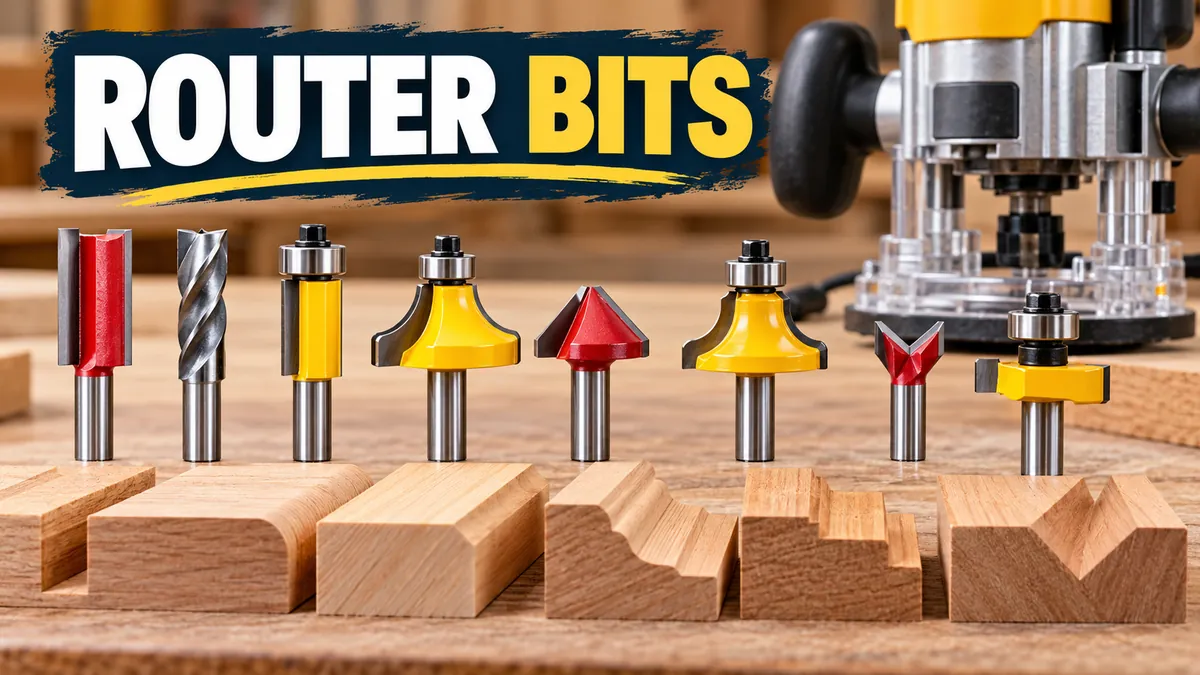

A woodworking router can cut grooves, duplicate templates, shape decorative edges, trim laminate, and create precise joints—but the router itself is only half of the system. The actual cut is determined by the router bits installed in its collet.
Router bits are rotating cutting tools designed to remove material and produce a particular shape, profile, groove, joint, or finished edge. Common options include straight, spiral, flush-trim, roundover, chamfer, rabbeting, dovetail, cove, and ogee bits. Choosing the right one depends on the cut, material, router, shank size, and desired finish.
Understanding those differences is far more useful than simply buying the largest bit set you can find. Many woodworking projects can be completed with a relatively small collection of carefully chosen cutters.
What Are Router Bits?
Router bits are replaceable cutting tools that fit into the collet of a handheld router, plunge router, trim router, or router table. As the router motor spins the bit at high speed, its cutting edges remove material from wood or another compatible workpiece.
Depending on the profile, router bits can be used to:
- Cut grooves, dados, and slots
- Create mortises and recesses
- Round or bevel sharp edges
- Duplicate templates and patterns
- Trim one surface flush with another
- Cut rabbets and dovetails
- Form decorative molding profiles
- Create cabinet-door components
- Engrave lettering and details
A typical router bit consists of a shank, body, and cutting edges. Some designs also include a pilot bearing that follows the workpiece edge or a template. The shank fits into the router’s collet, while the cutter geometry determines the shape left behind.
This distinction matters because router bits are not interchangeable simply because they fit the same machine. A straight bit and roundover bit may have identical shank diameters, but their jobs and resulting profiles are completely different.
Types of Router Bits and What They Do
There are hundreds of individual profiles, but most woodworking router bits fit into a few practical categories: straight and groove-cutting bits, spiral cutters, trimming and pattern bits, edge-forming bits, and joinery bits.
Straight Router Bits
The straight bit is one of the most basic and useful router bits.
Its cutting edges run parallel to the shank, producing a straight-sided, flat-bottomed cut. Straight bits are commonly used for:
- Grooves
- Dados
- Mortises
- Recesses
- Inlays
- General material removal
Straight bits are available in numerous diameters and cutting lengths. They can be guided by a router fence, edge guide, jig, template, or CNC toolpath depending on the application.
For someone building a small collection rather than buying dozens of specialized profiles, a good straight cutter is usually one of the most practical starting points. Straight or spiral cutters are consistently included among the core bits recommended for general woodworking.
Spiral Router Bits
A spiral bit performs many of the jobs associated with a straight cutter, but its cutting edges spiral around the body.
This geometry produces a shearing cutting action and can improve chip evacuation and cut quality.
Three terms appear frequently when shopping for spiral router bits:
Upcut spiral bits pull chips upward and out of a groove. They are useful when efficient chip evacuation is important, particularly in deeper cuts. The tradeoff is that the upward cutting action can lift fibers at the top surface.
Downcut spiral bits push the cutting action downward. They can help maintain a clean upper surface, although chips are pushed farther into the cut rather than being lifted out.
Compression bits combine upcut and downcut geometries. When the workpiece and cutting depth are appropriate, the opposing cutting directions can help reduce tear-out on both faces. These are especially useful when machining sheet goods.
Solid-carbide spiral cutters are also common in CNC routing applications because precise cutting geometry and chip evacuation are particularly valuable during computer-controlled machining.
Flush-Trim Bits
A flush-trim bit is designed to make one surface match another reference surface.
The bit normally combines straight cutting edges with a guide bearing. The bearing follows an existing edge or template while the cutters remove excess material.
Typical applications include:
- Trimming laminate
- Matching duplicated wooden parts
- Cleaning an edge after assembly
- Template routing
- Pattern work
For example, suppose a plywood panel has been rough-cut slightly oversize. A straight reference template can be attached to the panel, and a flush-trim bit can remove the excess until the panel exactly follows that template.
That makes flush trimming especially useful when several identical components need to be produced.
Pattern Bits
Pattern and flush-trim bits perform closely related jobs, but bearing position is an important distinction.
On a typical flush-trim cutter, the bearing is positioned toward the tip of the bit. On a pattern bit, the bearing is generally located near the shank. This changes where the template can be positioned relative to the workpiece.
Having access to both configurations gives a woodworker more flexibility when creating repeated shapes, furniture components, curves, recesses, and other template-routed parts.
Edge-Forming Router Bits
Edge-forming bits create a specific profile along the edge of a board. Many include bearings, making it possible for the cutter to follow the existing edge without requiring a separate fence.
Some of the most useful profiles are roundover, chamfer, cove, beading, and ogee.
Roundover Bits
A roundover bit replaces a sharp square corner with a smooth radius.
It is commonly used on:
- Shelves
- Tabletops
- Benches
- Cabinet components
- Chair parts
- Toys
- Trim
The radius determines how pronounced the curve becomes.
A small-radius roundover can simply soften a sharp corner, while a larger radius creates a much more visible curved profile. Because it improves both appearance and the feel of an exposed edge, the roundover is one of the most broadly useful edge-forming bits.
Chamfer Bits
A chamfer bit produces a flat angled edge rather than a rounded one.
A 45-degree chamfer is particularly common. Chamfers can provide a clean visual transition, remove a sharp corner, or become part of a decorative design.
They are frequently used for furniture, boxes, cabinetry, tabletops, and exposed wooden components.
The amount of material removed can usually be adjusted by changing router depth, allowing the same bit to produce anything from a subtle bevel to a much more prominent chamfer.
Cove Bits
A cove bit cuts a concave curved profile.
Think of the profile as approximately the opposite of a roundover: rather than rounding the material outward, the cutter creates an inward-curving recess.
Cove profiles appear frequently in:
- Decorative trim
- Furniture
- Molding
- Cabinet details
- Edge treatments
Roundovers and coves can also be combined with other profiles when building more complex molding.
Ogee and Roman Ogee Bits
An ogee bit produces a decorative profile based on flowing convex and concave curves.
Roman ogee profiles are commonly associated with traditional furniture, cabinetry, molding, and decorative trim. They create a more elaborate edge than a simple roundover or chamfer.
These cutters are useful when the edge itself is intended to become a visual feature of the finished piece.
Beading Bits
Beading bits form rounded decorative details along an edge.
Depending on the bit and setup, a bead can be used as a standalone decorative feature or incorporated into a more complicated molding profile.
They are commonly found in traditional furniture and architectural woodworking.
Joinery Router Bits
Routers are not limited to decoration. Many router bits are designed specifically for creating woodworking joints.
Rabbeting Bits
A rabbet is a rectangular recess cut along the edge of a workpiece.
Rabbeting bits make these stepped cuts and are useful for:
- Cabinet backs
- Frames
- Shelving
- Glass panels
- Boxes
- Casework
Many rabbeting cutters use guide bearings. Sets may include several bearing sizes so the width of the rabbet can be changed without replacing the main cutter.
The depth of the cut is normally controlled by the router’s bit-height adjustment.
Dovetail Bits
A dovetail bit has angled sides designed to produce the characteristic shape used in dovetail joinery.
Applications include:
- Drawers
- Boxes
- Furniture
- Sliding dovetails
- Dovetail jig systems
Dovetail joints are valued because their interlocking geometry provides mechanical strength as well as a distinctive appearance.
Bit angle, diameter, and cutting depth matter, particularly when using a dovetail jig. The cutter must match the requirements of the jig or joint design rather than simply being approximately the right size.
Mortising Bits
Mortising bits are intended to produce clean recesses or mortises.
They may be used when fitting:
- Hinges
- Hardware
- Loose tenons
- Furniture joints
- Door components
Although a standard straight cutter can perform many mortising operations, purpose-designed mortising bits can be useful when the job requires a particular cutting geometry or plunge performance.
Tongue-and-Groove Bits
Tongue-and-groove joints consist of a projecting tongue on one workpiece that fits into a corresponding groove in another.
Specialized router-bit sets can create these matching profiles accurately.
They are useful for:
- Panels
- Cabinetry
- Flooring-style assemblies
- Furniture components
- Frame construction
Successful tongue-and-groove routing depends heavily on consistent stock thickness and accurate setup.
Rail-and-Stile Bits
Rail-and-stile router bits are used for frame-and-panel cabinet doors.
They machine complementary profiles into the rails and stiles so the frame pieces fit together correctly while also creating the groove that accepts the center panel.
These cutters require careful setup because small height changes can affect how accurately the joint aligns.
Raised Panel Bits
Raised panel bits shape the edge of a panel used inside a frame-and-panel door.
These can be relatively large-diameter cutters. Larger profiles require particular attention to router compatibility, bit speed, workpiece support, and manufacturer instructions. Some large joinery and panel-forming cutters are intended for controlled router-table use rather than freehand routing.
Specialty Router Bits
Beyond common edge and joinery cutters, numerous router bits solve specific woodworking problems.
Keyhole Bits
Keyhole bits create a slot shaped to capture a screw head.
They are frequently used on:
- Picture frames
- Signs
- Small shelves
- Wall-mounted decorations
The wider internal portion accommodates the screw head while the narrower slot retains the mounted object.
V-Groove Bits
A V-groove cutter produces a V-shaped channel.
Common applications include decorative grooves, lettering, sign making, engraving, and CNC carving.
The angle and depth of the cutter determine the width and appearance of the groove.
Core Box Bits
Core box bits create rounded-bottom grooves.
They are useful for decorative channels, carving, trays, fluting, and other applications where a semicircular or curved-bottom recess is required.
Slot-Cutting Bits
Slot cutters produce narrow horizontal grooves, often from the edge of the workpiece.
Applications can include joinery, spline installation, panel construction, and specialized woodworking assemblies.
Router Bit Shank Sizes: 1/4 Inch vs. 1/2 Inch
Two common shank sizes in woodworking are 1/4 inch and 1/2 inch.
The router bit’s shank must match a compatible router collet. A bit should never simply be forced into an incorrect collet.
| Feature | 1/4-Inch Shank | 1/2-Inch Shank |
|---|---|---|
| Typical router | Compact/trim and full-size routers | Primarily full-size routers |
| Size | Smaller | Larger |
| Stability | Suitable for lighter cuts | Generally greater |
| Vibration resistance | Lower | Generally better |
| Large cutters | Limited | Better suited |
| Cost | Often lower | Often higher |
| Best use | Light routing and smaller profiles | Heavier work and larger profiles |
The larger cross-section of a 1/2-inch shank generally provides greater rigidity and stability. Lowe’s notes that 1/2-inch bits tend to be more stable, while compact routers commonly use 1/4-inch cutters. Some larger routers can accept both sizes through compatible collets.
That does not mean a 1/4-inch router bit is inherently unsuitable. Small cutters and compact-router applications are often designed around 1/4-inch shanks.
The practical rule is simple: use a bit size supported by your router and collet, and prefer the more rigid compatible option when the application genuinely benefits from it.
Carbide vs. HSS Router Bits
Cutting-edge material influences durability, edge retention, cost, and suitable applications.
High-Speed Steel
High-speed steel, or HSS, can produce sharp cutting edges and is available on some router bits.
Its primary disadvantage is wear resistance. When used heavily, especially on abrasive materials, HSS generally loses its edge sooner than carbide.
Carbide-Tipped Bits
Carbide-tipped cutters use carbide cutting edges attached to a supporting body.
They are widely used for woodworking because carbide maintains a cutting edge well and can handle materials such as hardwood, plywood, MDF, and laminate more effectively over repeated cuts.
Carbide is hard but also comparatively brittle, so bits should be handled and stored carefully rather than allowed to knock against one another.
Solid-Carbide Bits
Some cutters—particularly many spiral and CNC router bits—are manufactured from solid carbide.
Solid carbide offers excellent rigidity and wear resistance and allows manufacturers to create sophisticated cutting geometries.
The right choice depends on the application rather than material alone. A large decorative profile may logically use carbide cutting edges on a substantial supporting body, while a small precision spiral cutter may be solid carbide.
Bearing-Guided vs. Non-Bearing Router Bits
One of the easiest ways to understand router bits is to determine how they are guided.
A bearing-guided bit has a small bearing that follows an edge or template. Flush-trim, rabbeting, roundover, chamfer, and many decorative bits commonly use this arrangement.
A non-bearing bit must usually be controlled by another reference system, such as:
- Router fence
- Edge guide
- Straightedge
- Jig
- Template guide
- CNC toolpath
Neither design is inherently better.
A bearing-guided roundover is extremely convenient for following an existing edge. A straight bit guided by a fence, however, can cut a groove anywhere across a panel rather than only along its perimeter.
How to Choose the Right Router Bits
The best router bit is determined by the cut you need to make—not by how many pieces are included in a set.
Start with these questions.
1. What Cut Do You Need?
Identify the finished geometry first.
For example:
| Desired Result | Common Bit Choice |
|---|---|
| Straight groove or dado | Straight or spiral bit |
| Rounded edge | Roundover bit |
| Angled edge | Chamfer bit |
| Concave edge | Cove bit |
| Decorative S-profile | Ogee bit |
| Copy a template | Flush-trim or pattern bit |
| Edge recess | Rabbeting bit |
| Dovetail joint | Dovetail bit |
| V-shaped engraving | V-groove bit |
| Cabinet-door panel | Raised panel bit |
Thinking about the finished profile immediately eliminates most unsuitable choices.
2. Check Your Router’s Collet
Determine which shank diameters the router accepts.
A compact trim router may be designed primarily around 1/4-inch shanks, while a larger router may provide both 1/4-inch and 1/2-inch collets.
Never assume compatibility from appearance alone.
3. Consider the Material
Solid softwood, hardwood, plywood, MDF, and laminate behave differently under a cutter.
Abrasive engineered products can accelerate cutting-edge wear. Plywood can also splinter at the veneer surface, making cutter geometry and feed technique especially important.
For frequent work in wood and engineered panels, carbide cutters are widely preferred because of their wear resistance.
4. Consider Cut Depth
Trying to remove too much material in one pass increases the load on the bit, router, and workpiece.
Deep grooves and heavy profiles are often better produced through several progressively deeper passes.
This typically provides better control and reduces unnecessary stress on the cutter.
5. Consider How the Bit Will Be Guided
For an exposed board edge, a bearing-guided bit may make the job straightforward.
For a groove in the middle of a panel, a fence, jig, straightedge, or CNC-controlled path will usually be required.
6. Check Diameter and Speed Requirements
Bit diameter matters because larger cutters generally require lower rotational speeds than small-diameter cutters.
There is no universal RPM that is correct for every router bit. The safe maximum speed specified by the bit manufacturer and the operating instructions for the router should take priority over generic speed charts.
This becomes especially important with large molding and raised-panel cutters.
Router Bit Speed and Feed Rate
Clean routing requires a balance between rotational speed, feed rate, cutting depth, bit condition, and material.
Feed too slowly and excessive friction may create heat and burn marks.
Feed too aggressively and the cutter may chatter, overload, tear fibers, or leave an uneven surface.
A dull bit makes the problem worse because it creates more friction while cutting less efficiently.
For handheld routing, feed direction also matters. During conventional edge routing, the work should be approached so bit rotation tends to pull the router against its guiding edge or fence. Feeding in the opposite direction is known as climb cutting, which can cause the router to pull unexpectedly and become more difficult to control.
Climb cutting does have controlled specialist applications, but it should not be treated as the default feed method, particularly by inexperienced users.
Handheld Router Bits vs. CNC Router Bits
Handheld routers and CNC routers use the same fundamental principle—a rotating cutter removes material—but their operating environments differ.
A handheld router is physically guided by the operator, bearing, fence, or template.
A CNC router follows programmed toolpaths and can control parameters such as:
- Cutting depth
- Toolpath
- Feed rate
- Step-over
- Step-down
- Entry movement
CNC machining makes spiral, compression, engraving, ball-nose, and other specialized cutting geometries particularly useful.
However, a bit that physically fits a CNC collet should not automatically be considered appropriate for CNC operation. Diameter, maximum RPM, cutting geometry, chip evacuation, feed rate, and the manufacturer’s intended application still need to be considered.
Which Router Bits Should a Beginner Get First?
Beginners rarely need a huge router bit set.
A practical starter collection could include:
- Straight or spiral bit for grooves, dados, and general cutting.
- Flush-trim bit for templates and trimming.
- Roundover bit for softening exposed edges.
- 45-degree chamfer bit for beveled edges.
- Rabbeting bit for edge recesses and basic joinery.
Rockler similarly identifies straight or spiral, roundover, cove, chamfer, rabbeting, flush-trim, and pattern cutters among the profiles commonly useful to woodworkers.
Buying bits individually as projects require them also has an advantage: you can spend money on cutters you actually use instead of accumulating specialized profiles that remain untouched.
How to Install Router Bits Correctly
Correct installation affects both cut quality and safety.
First, disconnect the router from power or remove its battery before changing cutters.
Clean the shank and inspect the collet. Dirt, resin, rust, or damage can interfere with proper clamping.
Insert the shank sufficiently into the collet according to the router manufacturer’s instructions. Avoid positioning the bit so the cutting body bottoms out against the collet; follow the tool and bit manufacturer’s specified installation procedure.
Tighten the collet using the correct wrench or locking system.
Before starting work, confirm that the bit can rotate freely without contacting the router base, fence, insert plate, or other hardware.
If you changed to a substantially larger-diameter cutter, check the required speed setting before switching the router on.
Router Bit Safety
Router bits operate at extremely high rotational speeds, so small setup errors can have serious consequences.
Before routing:
- Wear suitable eye and hearing protection.
- Disconnect power when installing or adjusting a bit.
- Secure the workpiece firmly.
- Inspect the cutter for visible damage.
- Confirm that the shank and collet are compatible.
- Keep hands away from the cutter path.
- Use guards and dust collection where appropriate.
- Check the manufacturer’s maximum RPM.
- Reduce cutting depth when a heavy cut would overload the tool.
- Wait for the cutter to stop completely before setting the router down.
Workpiece security is particularly important during handheld routing. Woodcraft recommends firmly restraining the material with appropriate clamps, vises, bench dogs, or similar methods so it cannot shift while the router is cutting.
Large-diameter cutters deserve additional caution. A bit intended for a controlled router-table setup should not be treated like a small edge-forming cutter used freehand.
Common Router Bit Problems
Even a good router bit can leave poor results when setup or technique is wrong.
Burn Marks
Burning often indicates excessive heat.
Possible causes include:
- Feeding too slowly
- Dull cutting edges
- Incorrect speed
- Excessive cutting depth
- Resin buildup on the cutter
A sharp, clean cutter combined with appropriate speed and a steady feed usually improves the result.
Tear-Out
Tear-out occurs when wood fibers break away rather than being cut cleanly.
It commonly appears around difficult grain or vulnerable veneer.
Possible solutions include shallower passes, a sharper cutter, improved workpiece support, different cutting geometry, and adjusting the routing sequence.
Chatter and Vibration
Excessive vibration can indicate:
- Loose collet
- Poor bit installation
- Excessive bit extension
- Inappropriate cutting depth
- Damaged cutter
- Insufficiently rigid setup
A larger 1/2-inch shank can provide greater stability where both the router and cutter are available in that size.
Rough Cut Quality
A rough surface does not necessarily mean the bit profile is wrong.
Check cutter sharpness, feed consistency, cutting depth, grain direction, router stability, and whether resin has accumulated on the cutting edges.
Cleaning and Maintaining Router Bits
Router bits perform best when their cutting surfaces remain clean and sharp.
Wood resin and adhesive residue can accumulate around cutting edges. This buildup increases friction and can make a sharp bit behave like a dull one.
Inspect bits regularly and remove buildup using a cleaning method suitable for the cutter and recommended by its manufacturer.
Bearings also deserve attention. A bearing that feels rough, loose, or damaged should not be ignored because its job is to guide the cutter accurately along the reference surface.
Storage matters as well.
Carbide is extremely hard but relatively brittle. Allowing carbide edges to repeatedly strike other cutters can chip them. Individual slots, holders, trays, or protective storage therefore help preserve cutting edges.
Sharpen or replace bits when cleaning no longer restores cutting performance.
Router Bit Sets vs. Individual Bits
A router bit set can be useful when someone is starting from zero and wants several basic profiles at once.
However, more pieces do not automatically mean better value.
Large inexpensive sets often contain profiles that a particular woodworker may rarely use. A smaller collection of well-chosen straight, spiral, roundover, chamfer, flush-trim, and rabbeting cutters may accomplish far more useful work.
The decision should therefore be based on projects rather than quantity.
If you build cabinets, your collection may gradually expand toward rabbeting, mortising, tongue-and-groove, rail-and-stile, and raised-panel cutters.
If you make signs or CNC projects, V-bits, engraving cutters, spiral end mills, compression bits, and carving cutters may be more relevant.
If you mainly build simple furniture, straight, flush-trim, roundover, chamfer, and pattern bits may cover a large percentage of routine work.
Final Thoughts on Router Bits
Router bits turn a router from a high-speed motor into a remarkably versatile woodworking tool. Straight and spiral cutters handle grooves and general material removal; flush-trim and pattern bits reproduce shapes; roundover, chamfer, cove, and ogee bits form edges; while rabbeting, dovetail, and other specialized cutters make joinery possible.
Rather than trying to own every available profile, start with the cuts your projects actually require. Match the shank to the router’s collet, choose suitable cutter geometry and material, respect manufacturer RPM limits, and use controlled passes with a secure workpiece.
Once you understand what each profile leaves behind in the wood, choosing router bits becomes much simpler: define the cut first, then select the cutter designed to create it.
