
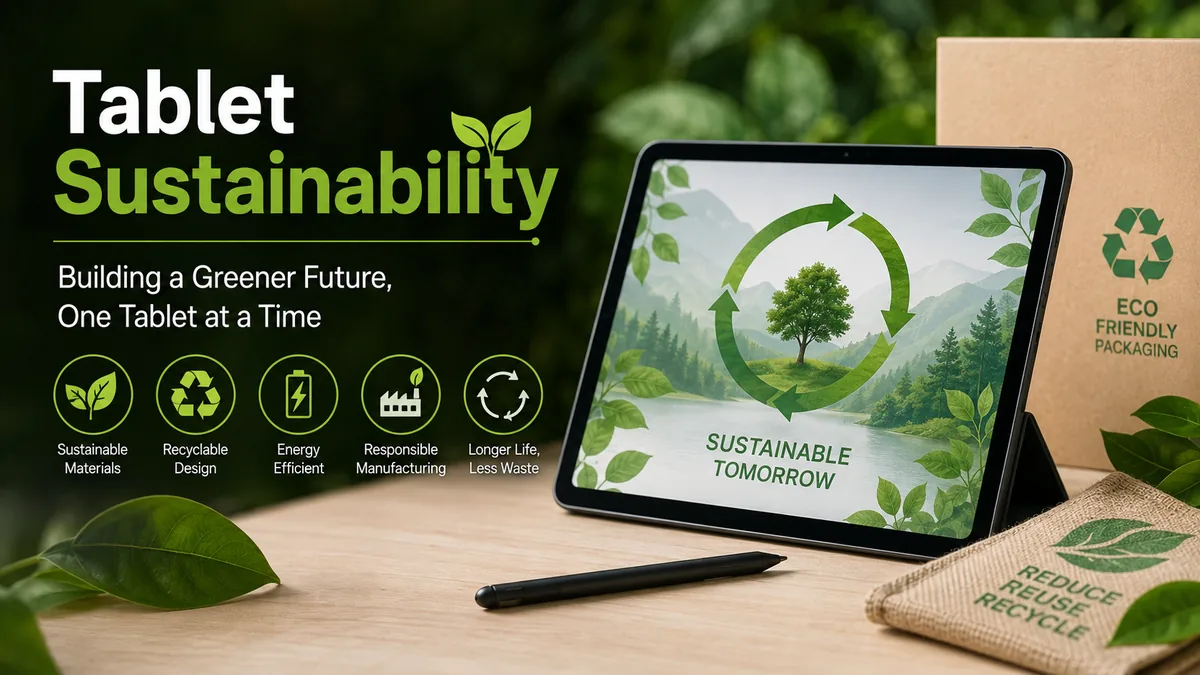

Tablets look clean, compact, and almost weightless compared with desktop computers, but their environmental footprint begins long before they are switched on. Mining metals, producing chips and batteries, assembling displays, transporting devices, charging them, and eventually disposing of them all consume resources.
tablet sustainability means reducing a tablet’s environmental impact throughout its entire life cycle—from raw-material extraction and manufacturing to daily energy use, repair, reuse, refurbishment, and responsible recycling. The most sustainable tablet is generally one that uses lower-impact materials, receives long software support, can be repaired, operates efficiently, and stays useful for as many years as possible.
This lifecycle approach matters because electricity used for charging is only one part of the story. For many tablets, manufacturing creates a much larger environmental burden than everyday operation. Samsung’s lifecycle assessment of the Galaxy Tab S9, for example, estimated that production represented 85.9% of its lifecycle carbon emissions, compared with 7.5% during use.
That changes how we should think about greener technology. Keeping a functional tablet longer can sometimes matter more than replacing it with a slightly more energy-efficient model.
What Is tablet sustainability?
tablet sustainability describes how effectively a tablet conserves materials, energy, and other resources throughout its useful life while limiting greenhouse-gas emissions and electronic waste.
A proper sustainability assessment considers several connected factors:
- Raw-material extraction
- Recycled and responsibly sourced materials
- Semiconductor and display manufacturing
- Battery production
- Assembly energy
- Packaging
- Transportation
- Electricity consumption
- Hardware durability
- Software support
- Battery longevity
- Repairability
- Refurbishment and reuse
- End-of-life recycling
This is essentially a life cycle assessment, or LCA, way of thinking.
Life cycle assessment evaluates environmental effects from resource extraction through manufacturing, transportation, use, and eventual disposal or recycling. Research by NORSUS and the University of Oslo uses exactly this type of lifecycle framework when assessing electronic devices and comparing conventional replacement strategies with repair-based circular strategies.
The practical lesson is simple: judging a tablet solely by how little electricity its charger consumes gives an incomplete picture.
The five stages of a tablet’s environmental lifecycle
| Lifecycle stage | Main environmental concerns |
|---|---|
| Raw materials | Mining, mineral scarcity, energy use, water use |
| Manufacturing | Semiconductor production, displays, batteries, greenhouse-gas emissions |
| Distribution | Packaging, shipping, transportation emissions |
| Use | Charging electricity, battery degradation, accessories |
| End of life | Reuse, refurbishment, material recovery and e-waste |
Sustainability improves when impacts are reduced at several stages rather than simply moving environmental costs from one stage to another.
Why Tablet Manufacturing Has Such a Large Environmental Impact
A tablet may use little electricity once it reaches your desk, but producing it is technically demanding.
Modern tablets contain aluminum, glass, plastics, copper, lithium, cobalt, rare earth elements, gold, tin, integrated circuits and numerous other materials. Turning these resources into processors, memory chips, circuit boards, displays and lithium-ion batteries requires sophisticated industrial processes.
Semiconductor fabrication is especially resource intensive.
Research into circular consumer electronics has found that integrated circuits can become dominant contributors to several environmental impact categories because their manufacture requires substantial material and energy inputs. The research also highlights water and electricity consumption associated with printed circuit board manufacturing.
This explains an apparent contradiction: tablets are relatively energy-efficient devices to operate, yet they can still carry substantial embodied environmental impacts before being used.
Production can outweigh years of charging
An older academic study examining tablets in higher education reported that manufacturing and delivery could represent as much as 80% of a tablet’s carbon footprint in some manufacturer assessments.
More recent product-specific information shows a similar pattern.
Samsung reports an estimated lifecycle carbon footprint of 124.9 kg CO2e for the Galaxy Tab S9 in its assessed UK configuration, with the following distribution:
| Stage | Share of reported lifecycle emissions |
| Production | 85.9% |
| Use | 7.5% |
| Distribution | 4.9% |
| Disposal | 1.7% |
The numbers cannot automatically be applied to every tablet because models, factories, electricity grids, materials, assumptions and usage patterns differ. They do illustrate why extending device life can be so influential.
If manufacturing is the dominant impact, replacing a usable device too early effectively starts much of that manufacturing burden again.
Quick Takeaway: For many tablets, the sustainability question is not simply “How efficiently does it charge?” A better question is “How many useful years can I get from the hardware that has already been manufactured?”
How Materials Affect tablet sustainability
Materials influence sustainability before a tablet even reaches the assembly line.
Producing virgin metals requires mining and processing new resources. Increasing recycled content can reduce dependence on newly extracted materials, although the environmental benefit varies depending on the material, recycling process, energy source and supply chain.
Modern manufacturers are increasingly incorporating recycled aluminum, cobalt, copper, lithium, plastics, tin and rare earth elements.
Recycled aluminum
Aluminum is widely used in premium tablet enclosures because it is light, rigid and durable.
Apple reports that its 2025 iPad with the A16 chip uses 100% recycled aluminum in its enclosure and metal chassis.
Using recycled aluminum does not make the entire device impact-free. The display, processor, battery, printed circuit boards, transportation and manufacturing energy still matter.
However, replacing some virgin material with recycled inputs is an important element of a broader circular-material strategy.
Cobalt and lithium
Lithium-ion batteries require materials that have significant environmental and supply-chain implications.
Apple’s environmental report for the iPad (A16) states that it contains:
- 100% recycled cobalt in the battery
- Recycled lithium in the battery cathode
- 100% recycled rare earth elements in all magnets
- 100% recycled tin in solder on multiple printed circuit boards
- Recycled copper in multiple printed circuit boards
Apple calculates the device at 40% recycled content overall.
Its later M5 iPad Pro environmental report lists 30% recycled content, including 100% recycled cobalt and 95% recycled lithium in the battery.
The percentages differ between products, showing why sustainability should be evaluated model by model rather than assuming everything from one brand has the same material profile.
Recycled plastics
Plastic may represent a smaller environmental headline than the processor or battery, but it still matters across millions of devices.
Samsung reports using recycled plastics in parts of the Galaxy Tab S9, including material derived from discarded fishing nets, water barrels and recycled PBT plastic.
Samsung’s broader circular-economy strategy also includes expanding recycled-material use and recovering resources from discarded electronics.
Responsible sourcing still matters
Recycled material cannot currently meet every material requirement of electronics manufacturing. Virgin resources therefore remain necessary.
Responsible sourcing should consider environmental damage, worker conditions, traceability and mineral-processing practices alongside recycled content.
A tablet marketed as “eco-friendly” because its box uses recycled cardboard may still perform poorly on more meaningful measures such as longevity, repairability or manufacturing emissions.
Packaging is worthwhile—but it is one piece of a much larger lifecycle.
Longevity May Be the Most Important Tablet Sustainability Feature
A tablet that lasts longer spreads its manufacturing impact across more years of productive use.
Consider two hypothetical devices with similar manufacturing footprints.
One becomes obsolete or unusable after three years. The other remains secure and functional for six years.
The six-year device does not magically erase its original manufacturing footprint, but replacing it half as frequently can avoid the environmental cost associated with manufacturing an additional tablet.
This is why durability, software support and repairability work together.
Physical durability
A cracked display, damaged charging port or failed battery can end a tablet’s useful life even while its processor remains perfectly adequate.
Useful durability features can include:
- Strong enclosure construction
- Scratch-resistant display glass
- Water and dust protection
- Quality charging ports
- Replaceable components
- Reliable batteries
- Protective cases
- Long warranties
Durability should not mean simply adding more material. Ideally, a tablet is engineered to survive realistic use without becoming excessively resource intensive.
Software longevity
Hardware can remain physically functional while software makes it effectively obsolete.
When operating-system updates stop, security vulnerabilities may remain unresolved. Applications can eventually lose compatibility as developers target newer operating systems.
Long-term software support therefore has a direct sustainability connection: it helps hardware remain safe and useful instead of forcing replacement for software reasons.
When comparing tablets, check the manufacturer’s specific update commitment for that model, not just the version of Android, iPadOS or Windows installed when you buy it.
Performance headroom
Buying barely adequate hardware can also shorten practical lifespan.
Limited RAM, storage or processor performance may become frustrating as applications become more demanding. That does not mean everyone needs the fastest tablet available.
It means specifications should comfortably match the intended workload for several years.
For someone who mainly reads documents and streams video, moderate hardware may remain useful for a long time. A digital artist or professional video editor may reasonably need more processing power and memory.
Sustainable purchasing means matching capability to long-term need rather than either underbuying or purchasing excessive hardware that will never be used.
Repairability and Battery Replacement Matter More Than They Seem
A tablet can be durable but still unsustainable if one failed component makes the entire device uneconomical to repair.
Batteries are especially important because all rechargeable batteries gradually lose capacity.
When a battery deteriorates but the processor, screen, cameras and storage still work, replacing the battery can extend the device’s useful life considerably.
What makes a tablet repairable?
Look for:
- Available replacement parts
- Published repair documentation
- Reasonable battery accessibility
- Replaceable displays and charging ports
- Screws rather than excessive permanent adhesive
- Manufacturer or third-party repair services
- Diagnostic software
- Repair pricing that makes economic sense
Samsung, for example, provides self-repair resources for supported devices, including tablets, with access to genuine parts, tools and repair documentation.
Availability varies by country and model, so the existence of a manufacturer repair program does not automatically mean every tablet is equally repairable.
The EU repairability score is changing the market
Since June 20, 2025, new European Union requirements have applied to qualifying smartphones and slate tablets placed on the EU market.
The accompanying energy label gives consumers information covering energy efficiency, battery endurance, durability and repairability. Products receive a repairability score from A for the most repairable to E for the least repairable.
That is significant because repairability is becoming a visible product characteristic rather than something consumers must uncover through teardown videos and repair forums.
The rules also reinforce a broader shift toward longer-lasting electronics, energy efficiency and easier repair.
Quick Takeaway: A replaceable £50–$100 component can prevent the premature replacement of a device containing a functioning display, processor, memory, enclosure and numerous resource-intensive electronic components.
Does Energy Efficiency Make Tablets Sustainable?
Yes, but its importance depends on the complete lifecycle.
Tablets generally consume less electricity than large desktop computers because their processors, displays and batteries are designed around mobile power constraints.
Energy-efficient components can reduce electricity demand during charging while improving battery life.
Useful features include:
- Efficient processors
- OLED or efficient LCD display technology where appropriately implemented
- Adaptive brightness
- Automatic screen timeout
- Low-power modes
- Efficient wireless hardware
- Intelligent background-process management
However, buying a new tablet merely because it consumes slightly less electricity than a functional old one may not deliver an immediate environmental benefit.
The manufacturing footprint of the replacement must also be considered.
Your electricity source matters
Charging the same tablet can have different emissions depending on the electricity grid.
A region heavily dependent on fossil fuels will generally produce higher operational emissions per unit of electricity than a grid with substantial renewable or low-carbon generation.
This is one reason lifecycle assessments vary between countries.
Research into consumer electronics notes that regional energy mixes and waste-management systems can materially affect lifecycle results.
Practical ways to reduce tablet energy consumption
You do not need extreme battery-saving behavior.
Simple measures help:
- Lower excessive screen brightness
- Use automatic brightness where practical
- Reduce unnecessary background activity
- Turn off radios you genuinely do not use
- Avoid excessive heat while charging
- Keep software updated
- Use appropriate power-saving modes
Battery health matters too. Heat and repeated extreme conditions can accelerate battery degradation, potentially shortening the useful life of the entire device when the battery is difficult to replace.
E-Waste Is the Other Half of tablet sustainability
A sustainable tablet should not simply disappear from consideration once its owner finishes using it.
Electronic waste is one of the fastest-growing waste streams in the world.
The International Telecommunication Union’s Global E-waste Monitor 2024 reports that the world generated 62 billion kg—62 million tonnes—of e-waste in 2022, while only 22.3% was documented as formally collected and recycled in an environmentally sound way.
That gap matters because electronic devices contain both valuable resources and substances that require controlled treatment.
Discarding electronics also wastes materials that required substantial energy and resources to obtain.
Reuse is often better than immediate recycling
Recycling tends to dominate environmental messaging, but recycling should not automatically be the first destination for a functional tablet.
A more circular hierarchy looks like this:
- Keep using it
- Repair it
- Reuse or repurpose it
- Sell or donate it
- Refurbish it
- Recycle it responsibly
Research into circular electronics emphasizes that reuse can be preferable to material recovery because it preserves more of the value already embedded in manufactured components.
A five-year-old tablet may no longer meet one person’s professional needs while remaining perfectly capable of handling ebooks, video calls, smart-home controls, children’s educational apps or basic browsing.
What should you do with an old tablet?
First, determine whether the device can remain useful.
If another person can use it safely and it still receives essential security support, resale or donation can extend its life.
Before transferring it:
- Back up important files.
- Sign out of accounts.
- Disable device-tracking locks where appropriate.
- Encrypt sensitive data if the platform does not already do so by default.
- Perform a factory reset.
- Remove SIM or memory cards.
- Follow the manufacturer’s transfer instructions.
If the tablet is broken, check whether repair is economically reasonable.
If it genuinely cannot be reused or repaired, use a reputable electronics recycling program, manufacturer take-back scheme or authorized e-waste collection facility rather than putting the device in household waste.
Tablets vs Paper: Which Is More Sustainable?
There is no universally correct answer because the comparison depends heavily on usage.
A tablet has a relatively large upfront manufacturing impact but can display thousands of documents repeatedly.
Paper has a smaller impact per individual sheet, but environmental costs accumulate through forestry, pulp and paper processing, printing, ink, transportation and disposal.
Therefore, replacing occasional paper use with a brand-new tablet is very different from using one tablet for years to replace large quantities of printed materials.
A 2016 study examining tablets in higher education found that some tablet-and-paper scenarios required surprisingly long periods to reach a carbon break-even point because tablet manufacturing created substantial upfront emissions.
The research is now dated and should not be treated as a universal modern benchmark, since manufacturing technologies, devices and electricity systems have changed.
Its underlying lesson remains useful: digital does not automatically mean environmentally free.
The best outcome often comes from using electronics that already exist for longer while reducing unnecessary printing.
How to Choose a More Sustainable Tablet
Sustainability labels and recycled packaging can help, but they should not distract from the characteristics that determine how long the tablet will remain useful.
A practical evaluation can be done in this order.
1. Start with expected lifespan
Ask yourself how many years the tablet realistically needs to serve you.
Choose enough performance, RAM and storage for those needs without buying specifications that provide no practical value.
2. Check software-support commitments
Find out:
- How long OS upgrades are promised
- How long security patches will continue
- Whether the commitment applies to the exact model
- Whether enterprise support differs from consumer support
Long support gives hardware more opportunity to reach its natural physical lifespan.
3. Investigate repairability
Before buying, search for battery and screen replacement options.
If a simple battery failure effectively requires replacing the whole tablet, long-term sustainability suffers.
For tablets sold under applicable EU rules, the repairability score provides another useful comparison point.
4. Examine battery longevity
Look beyond headline battery life measured in hours.
Check whether the manufacturer publishes:
- Battery cycle information
- Battery-health tools
- Replacement pricing
- Repair instructions
- Spare-part availability
Battery longevity directly affects practical device longevity.
5. Look for recycled materials
Product environmental reports can reveal far more than vague environmental marketing.
Useful disclosures include:
- Recycled aluminum percentage
- Recycled cobalt
- Recycled lithium
- Recycled rare earth elements
- Recycled plastic
- Manufacturing electricity sources
- Lifecycle carbon estimates
Apple and Samsung both publish model-specific environmental information for selected tablets, making it possible to examine at least some sustainability indicators rather than relying solely on marketing claims.
6. Consider refurbished tablets
A professionally refurbished tablet can be environmentally attractive because it extends the useful life of hardware already manufactured.
But check:
- Remaining software support
- Battery health
- Warranty
- Screen condition
- Replacement-part availability
- Seller reputation
A refurbished tablet with only a short period of security support remaining may not necessarily be the best long-term choice.
7. Check the manufacturer’s end-of-life program
A credible sustainability strategy should include what happens after the device is no longer usable.
Look for trade-in, reuse, refurbishment and certified recycling programs.
Samsung describes product-life extension and e-waste collection as parts of its circular-economy strategy, while Apple operates trade-in and recycling programs alongside its recycled-material initiatives.
What Matters Most When Comparing Sustainable Tablets?
Not every environmental feature carries equal weight.
A useful comparison hierarchy is:
| Factor | Why it matters |
| Long useful lifespan | Avoids premature replacement |
| Long software support | Keeps otherwise functional hardware usable |
| Repairability | Prevents minor failures from ending device life |
| Battery replacement | Addresses a common aging component |
| Durable construction | Reduces accidental replacement |
| Recycled materials | Lowers dependence on virgin resources |
| Efficient hardware | Reduces use-phase electricity |
| Responsible sourcing | Improves supply-chain performance |
| Refurbishment options | Extends existing hardware life |
| Recycling program | Recovers resources at true end of life |
| Reduced packaging | Cuts material and transport burden |
This does not mean packaging or charger efficiency is irrelevant. It means sustainability claims should be viewed in proportion.
A recyclable box cannot compensate for a tablet that becomes unsupported quickly and cannot have its battery replaced.
Can a Tablet Ever Be Truly Sustainable?
No electronic device is impact-free.
Tablets require minerals, chemicals, sophisticated semiconductor fabrication, electricity, global supply chains and transportation. Even recycled materials require processing.
A better goal is therefore not a mythical “zero-impact tablet” but a lower-impact device within a circular system.
That system would ideally involve:
- Lower-carbon manufacturing
- Renewable electricity
- High recycled-material content
- Responsible mineral sourcing
- Durable construction
- Long software support
- Replaceable components
- Accessible repair documentation
- Refurbishment
- Second-life markets
- High-quality material recovery
European sustainability policy is increasingly pushing electronics in this direction. The EU’s tablet and smartphone rules introduced requirements aimed at durability, energy efficiency and repairability, while giving consumers more visible information through energy labels and repairability scores.
Research is also exploring more recyclable printed circuit boards and better recovery of integrated circuits, areas that could eventually reduce impacts that are difficult to address through consumer behavior alone.
How Owners Can Improve tablet sustainability Without Buying Anything
One of the easiest mistakes in sustainable technology is assuming improvement requires purchasing a newer “green” product.
Often, the device you already own is the better starting point.
To extend its life:
- Use a protective case where drop risk is high.
- Avoid unnecessary exposure to extreme heat.
- Maintain enough free storage for reliable operation.
- Install security and operating-system updates.
- Replace a worn battery where practical.
- Repair damaged ports or screens when economically sensible.
- Remove unused applications that cause performance problems.
- Factory-reset and repurpose older devices rather than abandoning them in drawers.
- Sell or donate functional tablets you no longer need.
- Recycle only when reuse and repair are no longer realistic.
A circular approach focuses on retaining the value already embodied in electronics.
NORSUS describes this contrast directly: instead of a linear strategy where products are purchased and discarded, a circular strategy introduces repair and lifespan-extension measures wherever possible.
That principle applies especially well to tablets.
The Future of tablet sustainability
The next stage of tablet sustainability is likely to involve improvements across both hardware design and regulation.
Repairability is becoming more measurable. Recycled materials are appearing in batteries, enclosures and circuit-board components. Manufacturers are publishing more product-specific environmental data. Researchers are developing electronics that are easier to dismantle and recover.
The European Union’s current framework already requires qualifying slate tablets sold in the EU to carry information about factors such as battery endurance, energy efficiency and repairability.
Meanwhile, electronics research is examining recyclable circuit-board substrates and component recovery because simply recycling outer casings does not address the environmental intensity of semiconductor manufacturing. Research published in Scientific Reports found that recovering integrated circuits could substantially reduce environmental impacts in its consumer-electronics case studies.
The challenge will be turning those advances into mainstream products that remain affordable, performant and genuinely repairable.
Final Thoughts on tablet sustainability
tablet sustainability is ultimately about getting more useful life and value from fewer resources.
Recycled aluminum, lower-carbon manufacturing and efficient processors matter, but they should be viewed alongside longevity, software support, battery replacement, durability, repairability, reuse and responsible recycling.
For most owners, the most effective first action is remarkably ordinary: keep a capable tablet working for as long as it safely meets your needs.
When replacement eventually becomes necessary, evaluate the entire lifecycle rather than one environmental claim. Choose hardware that can remain useful for years, look for transparent environmental reporting, prioritize repairability and long software support, and give the old tablet a second life whenever possible.
That lifecycle mindset turns tablet sustainability from a marketing label into something measurable and practical.
