
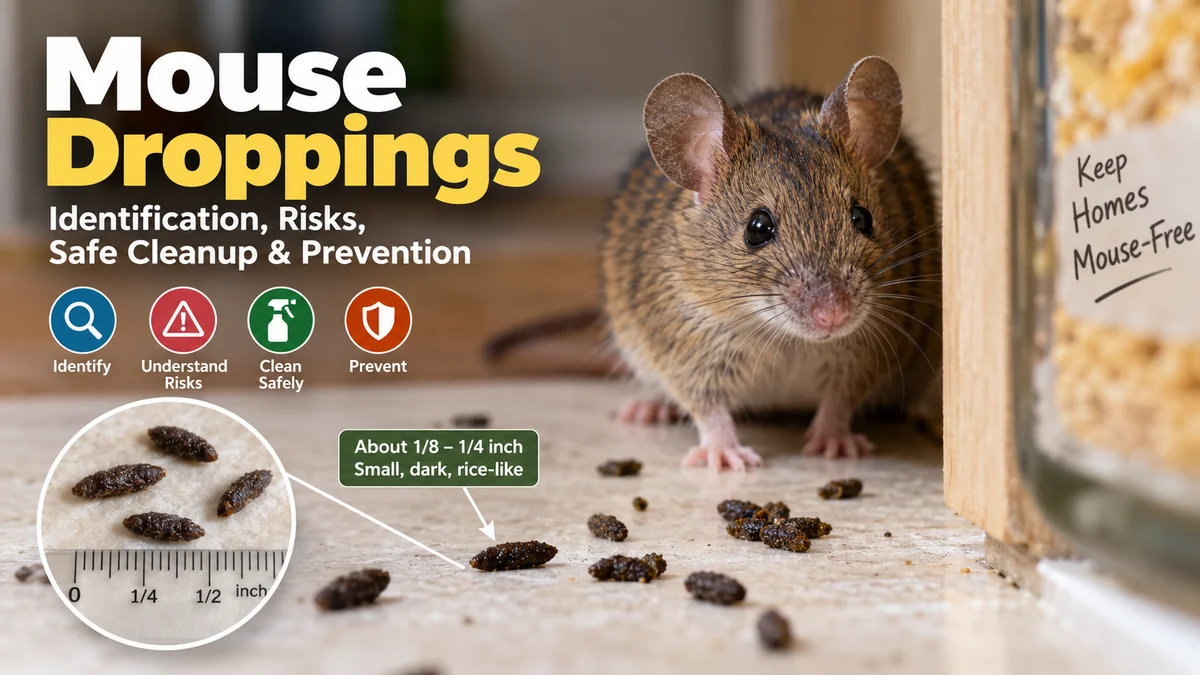

Finding tiny dark pellets in a kitchen cabinet, pantry, garage, or behind an appliance can be unsettling. In many homes, mouse droppings are the first visible evidence that mice have entered the building.
The pellets themselves are useful clues, but they should also be treated as potentially contaminated material. Rodent waste can expose people to disease-causing organisms, particularly when dry droppings, urine, or nesting material are disturbed and particles become airborne.
Mouse droppings are typically small, dark, rice-like pellets, commonly about 1/8 to 1/4 inch long, with at least one pointed end. If you find them, avoid sweeping or vacuuming them while dry. Wet them thoroughly with an appropriate disinfectant, wipe them up while wearing gloves, disinfect the surrounding surface, and wash your hands afterward.
What Do Mouse Droppings Look Like?
House mouse feces are much smaller than many people expect. The National Park Service describes mouse excrement as generally dark, smooth, ovoid, about 1/8 to 1/4 inch long, and similar in appearance to small dark grains of rice. At least one end is characteristically pointed.
The main identification clues are:
| Feature | Typical mouse droppings |
|---|---|
| Size | Roughly 1/8–1/4 inch |
| Shape | Small, elongated or rice-like |
| Ends | Usually pointed or tapered |
| Color | Commonly dark brown to black |
| Surface | Generally smooth |
| Pattern | Often scattered rather than forming one large pile |
| Common locations | Cabinets, drawers, pantries, behind appliances and along travel routes |
Color alone is not a reliable identification method. What a rodent eats can affect the appearance of its waste, and aging changes how a pellet looks.
Shape, approximate size, location, and other evidence around the droppings give you a much better picture.
Are fresh mouse droppings different from old ones?
People commonly try to determine the age of an infestation by examining whether pellets look shiny or dull.
Fresh fecal material can appear darker and may contain more moisture, while older pellets tend to dry. However, environmental conditions such as humidity can affect appearance.
For that reason, don’t handle, squeeze, break, or crush droppings to determine their age.
There is a safer test for ongoing activity: clean the contaminated area correctly and then monitor it. The CDC notes that if droppings reappear after cleaning, that is evidence of current rodent activity.
Quick Takeaway: Treat unknown rodent waste as potentially contaminated regardless of whether it appears fresh or old.
Mouse Droppings vs Rat, Cockroach, and Other Droppings
One of the easiest mistakes is assuming every small black pellet came from a mouse.
The surrounding evidence matters because pest species require different control strategies.
Mouse droppings vs rat droppings
Size is one of the most useful initial clues.
The National Park Service describes mouse feces as approximately 1/8 to 1/4 inch long, while rat droppings are substantially larger—approximately 1/2 to 3/4 inch in its museum-pest identification guidance. Rat feces are also wider and more likely to have blunt ends.
| Clue | Mouse | Rat |
|---|---|---|
| Relative size | Small | Significantly larger |
| General appearance | Small grain of rice | Larger capsule/pellet |
| Ends | Often pointed | Commonly blunter |
| Distribution | Frequently scattered | Larger, heavier pellets |
| Other evidence | Small gnaw marks, nesting material | Larger gnawing and damage |
There can be variation between rodent species, so a single pellet should not be treated as perfect species identification.
Mouse droppings vs cockroach droppings
Cockroach waste is another common source of confusion.
Droppings from smaller cockroaches may resemble black pepper or coffee grounds rather than distinct grains of rice. Larger cockroach species can produce cylindrical fecal pellets, but these may show ridges and blunter ends.
Cockroach evidence is commonly concentrated around cabinet corners, hinges, appliance seams, cracks, sinks, and other hiding places.
Distinct smooth pellets resembling tiny dark grains of rice point more strongly toward mice, especially when accompanied by gnaw marks or shredded nesting material.
What about bat droppings?
Bat guano can sometimes be mistaken for rodent waste, especially in attics.
Location provides an immediate clue: fecal material accumulating directly beneath an overhead roost or entry point may warrant investigation for bats rather than mice. Avoid handling unidentified animal feces simply to test its texture.
Where Are Mouse Droppings Usually Found?
Mice favor areas that provide shelter and convenient access to food and water.
That makes kitchens an obvious location, but droppings can appear almost anywhere mice travel.
The CDC specifically recommends checking areas such as kitchen cabinets, closets, behind appliances, attics, basements, crawl spaces, around pipes, utility penetrations, vents, and the junction between floors and walls when looking for rodent entry points and activity.
Inside a house, pay particular attention to:
- Pantry and kitchen cabinets
- Drawers containing food or utensils
- Under sinks
- Behind refrigerators and stoves
- Around pet-food storage
- Along baseboards
- Garages and storage rooms
- Attics and crawl spaces
- Basements
- Closets
- Around garbage containers
- Near holes surrounding pipes and cables
Finding pellets inside a drawer or cupboard is especially significant because mice can contaminate food, packaging, cookware, and food-contact surfaces as they travel.
Why do I keep finding mouse droppings in the same place?
Mice repeatedly use protected routes between their nesting, feeding, and water areas.
If cleaned surfaces develop new pellets, urine spots, gnawing, or other signs, the underlying rodent problem is still active. Simply removing the visible waste will not stop it.
You need to address both contamination and infestation.
Are Mouse Droppings Dangerous?
Mouse feces should be handled carefully because rodents can carry diseases capable of spreading to humans.
According to the CDC, rodent-associated diseases can spread through contact with urine, feces, or saliva, and exposure can also occur when contaminated material becomes airborne. You cannot determine whether a rodent carries a disease simply by looking at the animal—or its waste.
One widely discussed example is hantavirus.
Hantaviruses are a family of viruses spread primarily by rodents. Depending on the virus and geographic region, infection can cause illnesses including hantavirus pulmonary syndrome (HPS) and hemorrhagic fever with renal syndrome (HFRS).
This does not mean every mouse or every dropping contains hantavirus.
The practical lesson is much simpler: don’t handle rodent waste unnecessarily, and don’t use cleaning methods that throw dry contaminated material into the air.
Can you get sick from breathing near mouse droppings?
The concern is particularly relevant when contaminated material is disturbed.
The CDC explains that when infected rodent urine, feces, or nesting material is stirred up, viral particles can enter the air and potentially be inhaled. Exposure may also occur if contaminated material reaches broken skin or the eyes, nose, or mouth.
That’s why sweeping a dusty attic full of rodent waste is very different from safely wet-disinfecting a few pellets on a kitchen floor.
Heavy infestations require additional precautions beyond ordinary household cleanup.
How to Clean Mouse Droppings Safely
The biggest cleanup mistake is reaching immediately for a broom or vacuum cleaner.
Do not sweep or vacuum dry mouse droppings, urine, or nesting material. The CDC specifically warns against this because these methods can put contaminated particles into the air.
For ordinary rodent urine and dropping cleanup, CDC guidance provides a straightforward wet-cleaning process.
1. Put on gloves
Wear rubber or plastic gloves before touching contaminated materials or surfaces.
Keep children and pets away from the area while you clean.
2. Thoroughly wet the droppings
Spray the urine and feces with an EPA-registered disinfectant or appropriate bleach solution until the material is very wet.
The goal is to disinfect the material rather than disturbing it while dry.
3. Allow the disinfectant to work
CDC guidance says to let the disinfectant soak for five minutes, or follow the contact time specified on the disinfectant product label.
Don’t immediately wipe the product away if its instructions require a contact period.
4. Wipe up the waste
Use paper towels to pick up the wet droppings and cleaning solution.
Avoid actions that crush or scatter the pellets.
5. Dispose of contaminated material
Place the used paper towels and waste in a covered garbage container that is regularly emptied, following applicable local disposal requirements.
6. Disinfect the surrounding area
Cleaning only the visible pellets isn’t enough.
Mice may also leave urine on nearby surfaces, so mop or sponge the surrounding floor, countertops, cabinets, drawers, or other hard surfaces with disinfectant as appropriate.
7. Clean your hands
The CDC advises washing your gloved hands with soap and water or disinfectant before removing the gloves. After removing them, wash your bare hands thoroughly with soap and warm water.
Quick Takeaway: Wet first, wipe second. Never make dry rodent waste airborne by immediately sweeping or vacuuming it.
What If You Already Vacuumed Mouse Droppings?
Don’t continue vacuuming the contaminated area.
The CDC’s current rodent-cleanup guidance explicitly says not to vacuum or sweep rodent urine, feces, or nesting material before disinfection.
Switch to the recommended wet-cleaning method for remaining contamination.
If the exposure involved a large accumulation of rodent waste, an enclosed heavily infested structure, or extensive nesting material, ordinary household cleanup may not be appropriate. CDC guidance calls for additional precautions for heavy infestations.
If you become ill after substantial rodent exposure, tell a healthcare professional about that exposure. CDC clinical guidance advises healthcare providers to consider hantavirus testing when compatible symptoms occur alongside rodent exposure.
What Should You Do With Food Near Mouse Droppings?
Food contamination deserves separate attention.
If rodents have reached a pantry, don’t simply wipe visible feces from packages and put everything back.
The FDA warns that foods and drinks exposed to rodents can make people or animals sick. It recommends discarding food products in paper and plastic containers that have been exposed to filth. Damaged cans and glass containers—including those with broken seals, punctures, cracks, swelling, severe dents, or significant rust—should also be discarded.
That includes pet food and other animal foods.
After removing contaminated products, disinfect the storage area and wash your hands thoroughly.
Do Mouse Droppings Mean You Have an Infestation?
A dropping confirms that a rodent has accessed the area, but the number of pellets does not give you a dependable mouse head count.
One mouse can produce many fecal pellets. The National Park Service notes that a single house mouse can produce approximately 50–75 pellets per day.
So 50 pellets do not necessarily mean 50 mice.
The better question is whether the activity is continuing.
Clean the area safely and inspect it again. Fresh evidence after cleanup strongly suggests active rodent presence.
Look for additional signs
Droppings become more meaningful when combined with:
- Gnaw marks on food packaging or wood
- Shredded paper, fabric, or other nesting material
- Urine staining
- Scratching noises, particularly at night
- Damaged stored food
- Holes around walls, cabinets, pipes, and utilities
- Actual mouse sightings
The CDC identifies both droppings and gnaw marks as common signs of rodent presence.
How to Stop Mouse Droppings From Coming Back
Cleaning removes contamination. It does not remove the reason the contamination appeared.
Long-term control requires three things: remove existing rodents, eliminate food and water sources, and block entry points.
Seal mouse entry points
House mice can squeeze through surprisingly small openings.
The CDC says mice can fit through a hole about the width of a pencil—approximately 1/4 inch (6 mm) in diameter.
Inspect around:
- Plumbing lines
- Electrical cables
- Kitchen cabinets
- Doors and windows
- Dryer and floor vents
- Foundations
- Attic and crawl-space vents
- Rooflines and eaves
- Gaps behind appliances
For small openings, CDC guidance recommends materials such as steel wool secured with caulk. Larger openings may require hardware cloth, metal, cement, lath screen, or metal sheeting.
Remove food and water sources
Keep food in containers made from thick plastic, glass, or metal with tight-fitting lids.
Clean spills promptly, put pet food away after feeding, avoid leaving food and water bowls out overnight, and use tightly covered garbage containers.
Also repair leaking pipes and eliminate accessible water sources where practical.
Trap remaining mice
When evidence of rodents is present, CDC guidance recommends setting traps in areas where rodents have been seen or are likely to travel while keeping traps and bait away from children and pets.
Continue monitoring after cleanup and control measures.
If inaccessible areas remain contaminated, rodents continue appearing, or the infestation is extensive, professional pest-control assistance may be appropriate.
When Mouse Droppings Require Extra Caution
A handful of pellets on a washable kitchen floor is not the same cleanup problem as an attic covered with years of rodent waste.
Use greater caution when you encounter:
- Large accumulations of feces and urine
- Extensive nesting material
- Dead rodents
- Heavy contamination in an attic, shed, cabin, garage, or crawl space
- Contaminated insulation
- Rodent waste inside ventilation systems
- Areas that cannot be safely reached or disinfected
The CDC specifically distinguishes heavy rodent infestations as situations requiring additional precautions.
Likewise, don’t assume that old-looking waste is automatically harmless. Visual inspection cannot tell you whether fecal material contains disease-causing organisms.
Mouse Droppings Are a Warning Sign, Not Just a Cleaning Problem
Finding mouse droppings tells you two things: a rodent has gained access to the area, and the space needs to be cleaned using appropriate precautions.
Start by identifying the pellets using their size, shape, location, and surrounding evidence. Don’t sweep or vacuum them dry. Wet them thoroughly with an appropriate disinfectant, wipe them up while wearing gloves, disinfect nearby surfaces, dispose of contaminated food where necessary, and wash your hands carefully.
Then deal with the source. Check for new droppings, seal openings as small as roughly 1/4 inch, secure food and garbage, remove accessible food and water sources, and address any remaining rodents. That combination of safe cleanup, exclusion, sanitation, trapping, and monitoring is what prevents the same mouse droppings from appearing again.
