
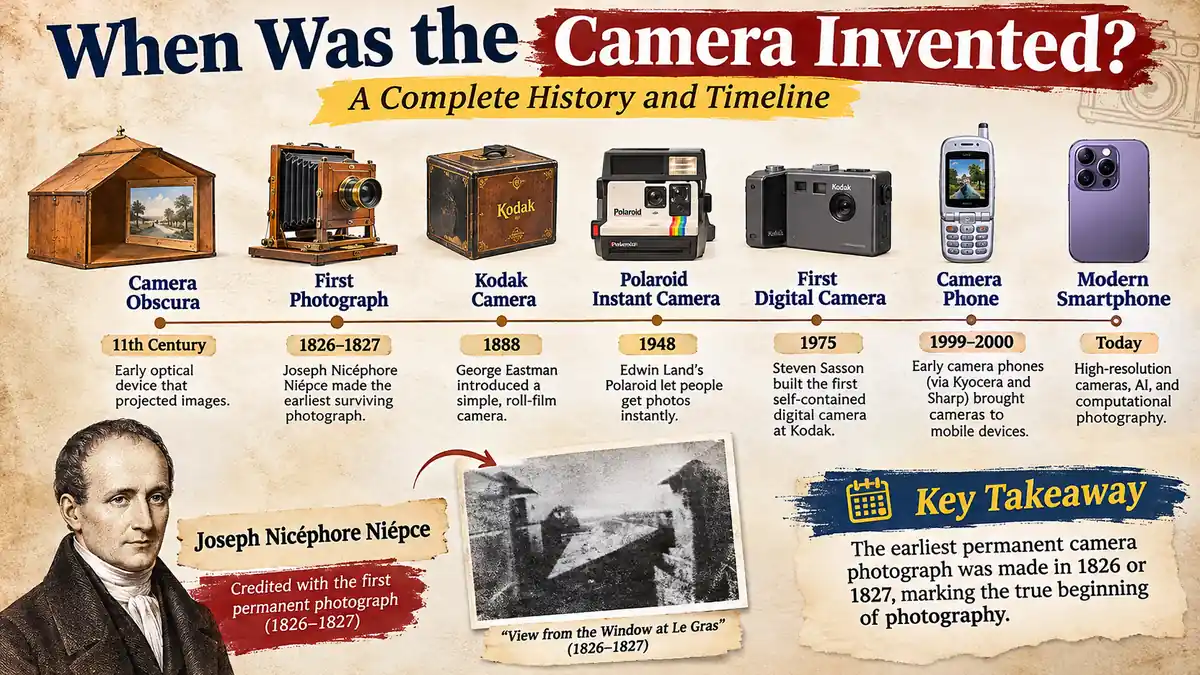

The camera is one of humanity’s most influential inventions, but its history began long before anyone could take a photograph. Early cameras were simple darkened rooms that projected images, while modern cameras can capture detailed photographs and videos in a fraction of a second.
When was the camera invented? The first successful permanent camera photograph was made by Joseph Nicéphore Niépce in 1826 or 1827. However, the camera obscura, an optical device that projected images using light, existed centuries earlier. Practical photography emerged in 1839, followed by film cameras, digital cameras, and smartphone photography.
Understanding the invention of the camera requires distinguishing between three developments: the discovery of optical image projection, the invention of permanent photography, and the creation of cameras ordinary people could use.
When Was the Camera Invented for the First Time?
The answer depends on what counts as a camera.
If a camera means a device that uses light to project an image, its origins stretch back more than 2,000 years. If it means a device that records a permanent photograph, the invention belongs to the early nineteenth century.
The modern photographic camera developed through several important milestones.
| Year | Invention or milestone | Inventor or contributor |
|---|---|---|
| 5th century BCE | Early description of the pinhole image principle | Mozi and the Mohist tradition |
| 4th century BCE | Observations of images formed through small openings | Aristotle |
| 11th century | Detailed investigations of the camera obscura | Ibn al-Haytham |
| 1826–1827 | Earliest surviving permanent camera photograph | Joseph Nicéphore Niépce |
| 1839 | Public introduction of the daguerreotype | Louis Daguerre |
| 1841 | Patented calotype negative-positive process | William Henry Fox Talbot |
| 1888 | Kodak roll-film camera | George Eastman and Kodak |
| 1900 | Kodak Brownie popularizes inexpensive snapshot photography | Eastman Kodak |
| 1975 | Prototype self-contained digital camera | Steven Sasson at Kodak |
| 1990s | Digital consumer cameras become increasingly practical | Multiple manufacturers |
| 2000 | Commercial camera phones appear | Sharp and other manufacturers |
These dates represent different stages of camera technology rather than a single invention.
Was the camera invented in 1816 or 1826?
Both dates appear in histories of photography, but they refer to different achievements.
In 1816, Niépce experimented with capturing images using a camera obscura and light-sensitive materials. His early results were not permanently preserved.
Around 1826 or 1827, he produced the earliest surviving permanent photograph made using a camera.
For this reason, 1826 or 1827 is usually the more useful answer when discussing the invention of photographic cameras.
Who Invented the First Camera?
Joseph Nicéphore Niépce is widely credited with producing the first surviving permanent camera photograph.
Niépce was a French inventor who experimented with light-sensitive chemicals and photographic techniques during the early nineteenth century.
His achievement was not the invention of the optical camera itself. Camera obscura devices already existed. Instead, he developed a method for preserving the images those devices projected.
Joseph Nicéphore Niépce and the first photograph
Niépce created an image known as View from the Window at Le Gras, showing buildings and rooftops visible from an upstairs window at his family’s estate in Saint-Loup-de-Varennes, France.
The photograph was produced using a process he called heliography, meaning roughly “sun writing.”
His method involved coating a pewter plate with bitumen of Judea, a substance that hardened when exposed to light. After a lengthy exposure, he used solvents to remove the unhardened material, leaving an image on the plate.
The exposure likely lasted several hours, although the precise duration remains debated.
The result was revolutionary: a projected optical image could finally be preserved.
Why was Niépce’s invention important?
Before permanent photography, artists could use optical devices to help them draw scenes accurately, but the projected images disappeared when the light or viewing conditions changed.
Niépce demonstrated that light could create a lasting visual record without requiring an artist to manually reproduce the entire scene.
His experiments established a foundation for photographic chemistry and later camera technology.
Did Louis Daguerre invent the camera?
Louis Daguerre played a crucial role in developing photography, but he was not the first person to produce a permanent photographic image.
Daguerre began collaborating with Niépce in 1829. After Niépce died in 1833, Daguerre continued developing photographic methods.
In 1839, the daguerreotype process was publicly introduced in France.
It produced detailed photographs on polished, silver-coated copper plates. Compared with Niépce’s earlier technique, it was more practical and eventually required much shorter exposure times.
The daguerreotype became the first widely adopted photographic process.
The Camera Obscura: How Cameras Existed Before Photography
Camera Obscura – Art – Mammoth Memory Art
12 Oldest Digital Camera in World – Oldest.org
Watching the World in a Dark Room: The Early Modern Camera Obscura — The Public Domain Review
7
The camera obscura is the optical ancestor of the modern camera.
The Latin term camera obscura means “dark chamber.”
A basic camera obscura consists of a darkened space with a small opening on one side. Light from objects outside passes through the opening and projects an inverted image onto an opposite surface.
The image appears upside down because light travels in approximately straight lines.
Who discovered the camera obscura?
The camera obscura was not invented by one identifiable individual.
Ancient Chinese philosopher Mozi, or the Mohist tradition associated with him, described principles of inverted images formed through small openings.
Aristotle also discussed optical observations involving sunlight passing through small apertures.
Centuries later, the scholar Ibn al-Haytham, also known as Alhazen, investigated light and vision through systematic experiments.
His work helped establish the scientific understanding of image formation and optics.
How did early camera obscura devices work?
The process was straightforward:
- Light entered a darkened room or box through a small opening.
- Rays from the upper part of an outdoor scene traveled toward the lower part of the opposite surface.
- Rays from the lower part traveled upward.
- An inverted image appeared on the projection surface.
- An observer could view or trace the projected scene.
Later versions incorporated lenses and mirrors to improve brightness and viewing convenience.
How did artists use the camera obscura?
During the Renaissance and subsequent centuries, artists and scientists used camera obscura devices to study perspective, proportions, and the behavior of light.
Leonardo da Vinci described optical principles associated with the camera obscura in his notebooks.
Portable versions eventually made it easier for artists to observe and trace projected scenes.
The device provided a useful drawing aid, but it could not independently produce a permanent photograph.
That limitation remained until the development of photographic chemistry.
How Photography Developed in the 1800s
The nineteenth century transformed the camera from an optical instrument into a practical tool for recording people, places, and events.
Three major photographic processes helped establish modern photography: the daguerreotype, the calotype, and the wet plate collodion process.
The daguerreotype revolution of 1839
Giroux daguerreotype camera | Objects | George Eastman Museum
The daguerreotype became one of the earliest successful commercial photographic processes.
It used a silver-coated copper plate that was sensitized to light, exposed inside a camera, and chemically developed.
Early daguerreotype portraits required subjects to remain still for extended periods. As photographic techniques improved, exposure times decreased substantially.
Daguerreotypes offered impressive detail, but they had limitations. Each plate produced a unique image, and making additional copies was difficult.
The public announcement of the daguerreotype on August 19, 1839, became a defining moment in photographic history. That date is now commemorated as World Photography Day. World Photography Organisation+1
William Henry Fox Talbot and the calotype
British inventor William Henry Fox Talbot developed an alternative photographic method.
His calotype process, patented in 1841, used paper negatives to create positive photographic prints.
Unlike daguerreotypes, which generally produced one original image, the negative-positive approach allowed photographers to create multiple prints from the same negative.
This concept became central to conventional film photography.
Talbot’s earlier photogenic drawing experiments also contributed to the development of light-sensitive photographic paper.
Frederick Scott Archer and wet plate photography
In 1851, Frederick Scott Archer introduced the wet plate collodion process.
Photographers coated glass plates with chemicals, sensitized them, exposed them while still wet, and developed them shortly afterward.
The technique combined high image detail with the ability to produce negatives suitable for multiple prints.
However, photographers often needed portable darkrooms because plates had to be prepared and processed before drying.
Wet plate photography became widely used for portraits, landscapes, scientific documentation, and historical records.
When did cameras become widely available?
Cameras existed commercially during the nineteenth century, but early photography required specialized equipment and considerable technical knowledge.
Professional photographers typically handled chemical preparation, exposure, and development.
The introduction of dry plates in the late 1870s and improvements in photographic manufacturing made photography more convenient.
The decisive shift toward everyday photography occurred when George Eastman introduced simpler cameras and roll-film systems during the 1880s.
When Was the First Film Camera Invented?
Film photography developed gradually through improvements in photographic materials and camera design.
Early photographers used metal plates, paper negatives, and glass plates rather than the flexible film associated with later cameras.
The introduction of roll film helped make photography portable and accessible.
George Eastman and the Kodak camera
Original Kodak Camera, Serial No. 540 | National Museum of American History
George Eastman founded the business that became Eastman Kodak Company and helped popularize roll-film photography.
In 1888, Kodak introduced a simple camera that allowed customers to take photographs without processing their own photographic materials.
The original Kodak camera was supplied ready to use and could capture 100 circular photographs.
After taking the pictures, customers returned the camera to Kodak for processing, printing, and reloading.
This service model removed much of the chemical work previously associated with photography.
Why was the Kodak camera revolutionary?
Before consumer-friendly cameras, photography often demanded experience with exposure settings, chemicals, and photographic plates.
Kodak simplified the process.
The camera became an everyday recording device rather than equipment reserved primarily for specialists.
People could photograph family gatherings, travel experiences, celebrations, and ordinary life.
The Kodak Brownie camera in 1900
No. 1 Brownie Box Camera | Science Museum Group Collection
collection.sciencemuseumgroup.org.uk
In 1900, Kodak introduced the original Brownie camera.
Its low price and simple operation encouraged photography among children, families, and amateur photographers.
The Brownie helped establish snapshot photography as a widespread activity.
Instead of requiring a professional studio, people could capture informal moments themselves.
This change influenced family photography, journalism, travel documentation, and visual culture.
How Did Cameras Evolve During the 20th Century?
The twentieth century brought major improvements in camera size, exposure control, film technology, and photographic convenience.
Cameras became more portable, faster, and capable of producing increasingly detailed images.
The rise of 35mm cameras
One important development was the use of 35mm film for still photography.
The Leica I, introduced commercially in 1925, helped establish the compact 35mm camera as a practical photographic tool.
Its small size made it easier for photographers to work outside studios.
Photographers could capture street scenes, news events, travel photographs, and spontaneous moments.
The 35mm format later became a dominant standard in consumer and professional film photography.
Single-lens reflex cameras
Single-lens reflex cameras, commonly called SLR cameras, use a mirror mechanism that allows photographers to view a scene through the taking lens.
This arrangement helps the photographer compose and focus an image accurately.
Although SLR designs existed earlier, they became especially popular during the twentieth century.
Manufacturers such as Nikon, Canon, Pentax, and Minolta introduced influential SLR models.
Interchangeable lenses expanded their versatility for portraits, sports, wildlife, and landscape photography.
Instant photography and the Polaroid camera
Edwin Land developed the instant photography system associated with Polaroid.
The Polaroid Land Camera Model 95 became commercially available in 1948.
It allowed users to produce a finished photographic print shortly after exposure without sending film to a laboratory.
Instant photography became popular for personal memories, identification photographs, creative projects, and professional applications.
Later Polaroid systems simplified the process further.
Color photography becomes mainstream
Color photography also developed through several stages.
James Clerk Maxwell demonstrated an early three-color photographic method in 1861 using photographs made by Thomas Sutton.
The Lumière brothers introduced the Autochrome color photographic process commercially in 1907.
Kodachrome color film appeared in 1935, while Kodacolor negative film for consumer prints followed in 1942.
As processing became more accessible, color photography increasingly replaced black-and-white photography for everyday snapshots.
When Was the Digital Camera Invented?
Il a inventé le tout premier appareil photo numérique. . En 1975
Logi Fotoman Pixtura (Kodak DC50) 2024 – Digitalkamera-Museum
7
The first widely recognized self-contained digital camera prototype was developed in 1975 by Steven Sasson, an engineer working at Eastman Kodak.
Unlike traditional cameras, which relied on light-sensitive photographic film, Sasson’s invention used an electronic image sensor to capture visual information.
The image was converted into digital data and stored on magnetic tape.
How did Steven Sasson’s first digital camera work?
Sasson’s prototype combined several technologies, including a charge-coupled device (CCD), electronic circuits, an analog-to-digital converter, and magnetic storage.
Its technical capabilities were modest compared with modern cameras.
| Feature | Kodak digital camera prototype, 1975 |
|---|---|
| Inventor | Steven Sasson |
| Company | Eastman Kodak |
| Image resolution | 100 × 100 pixels |
| Megapixels | 0.01 MP |
| Image type | Black and white |
| Storage | Magnetic cassette tape |
| Recording time | Approximately 23 seconds per image |
| Weight | Approximately 3.6 kg (8 lb) |
The camera demonstrated that photographs could be captured and stored electronically without traditional photographic film.
Sasson’s invention became a foundational milestone in digital photography. National Inventors Hall of Fame®+2
Why did digital cameras take so long to become popular?
Although the first prototype appeared in 1975, digital cameras did not immediately replace film cameras.
Early electronic imaging systems faced significant challenges:
- Image sensors offered relatively low resolution.
- Digital storage was expensive and limited.
- Electronic components were large and power-hungry.
- Display technology was less convenient.
- Film cameras already had established manufacturing and processing systems.
Advances in semiconductor technology, computer processing, and storage gradually made digital photography more practical.
When did digital cameras become available to consumers?
Commercial digital camera development accelerated during the late 1980s and 1990s.
The Fujix DS-1P, demonstrated in 1988, was an important early digital still-camera prototype using semiconductor memory.
The Dycam Model 1, also marketed as the Logitech Fotoman, appeared in 1990 and became one of the earliest commercially available consumer digital cameras.
Apple introduced the QuickTake 100 in 1994.
During the late 1990s and early 2000s, digital cameras became increasingly popular as image quality improved and prices decreased.
By the 2010s, digital photography had largely displaced film photography in the mass consumer market.
When Were Phone Cameras Invented?
Camera phones brought photography into devices people already carried every day.
Early camera phones emerged around the turn of the twenty-first century, although the exact first depends on how a camera phone is defined.
The first camera phones
The Kyocera VP-210, released in Japan in 1999, is often recognized as an early commercially available mobile videophone with a built-in camera.
In 2000, Sharp introduced the J-SH04 in Japan, widely recognized as an early mass-market camera phone designed for capturing and sharing digital still photographs.
These devices had very limited image resolution compared with modern smartphones.
Nevertheless, they introduced a major change: photography could be integrated directly into mobile communication.
How smartphones changed photography
Laut Stiftung Warentest: Das ist das beste Handy 2024
Smartphones transformed the camera industry by combining photography, computing, editing, storage, and internet connectivity.
Apple’s original iPhone, introduced in 2007, included a built-in camera. Subsequent iPhone and Android devices expanded mobile photography capabilities.
Modern smartphones use technologies such as:
- CMOS image sensors
- Multiple camera lenses
- Optical image stabilization
- Computational photography
- High dynamic range imaging
- Portrait-mode depth processing
- Night photography
- High-resolution video recording
Software now plays a major role in producing photographs.
For example, a smartphone may capture several exposures and combine them into a single image with improved shadow and highlight detail.
This approach differs significantly from traditional film photography, where the chemical properties of film determined much of the final image.
Did smartphones replace digital cameras?
Smartphones replaced many compact point-and-shoot cameras for everyday photography.
However, dedicated digital cameras remain important for professional and specialized applications.
Mirrorless cameras and digital single-lens reflex cameras can offer larger sensors, interchangeable lenses, extensive manual controls, and specialized accessories.
Smartphones prioritize portability and computational convenience, while dedicated cameras often provide greater flexibility for demanding photographic situations.
How Does a Camera Work?
Despite major technological changes, cameras still rely on the same basic optical principle used by the camera obscura.
Light enters through an opening, is directed toward an image-forming surface, and creates a representation of the scene.
The main difference between early and modern cameras is how that image is recorded.
The essential components of a camera
Most modern photographic cameras include several important components.
Lens: Focuses incoming light to form an image.
Aperture: Controls the size of the opening through which light passes.
Shutter: Determines how long the recording surface receives light.
Image sensor or film: Records the image.
Viewfinder or screen: Helps the photographer compose the scene.
Image processor: In digital cameras, processes electronic sensor information into usable image data.
Film cameras vs. digital cameras
| Feature | Film camera | Digital camera |
|---|---|---|
| Recording medium | Light-sensitive film | Electronic image sensor |
| Image formation | Chemical reaction | Electronic signal |
| Storage | Physical negatives or transparencies | Digital files |
| Image review | Usually after processing | Usually immediate |
| Repeated use | Requires new film | Reusable storage |
| Editing | Darkroom or scanned image | Digital software |
| Common formats | 35mm, medium format, large format | JPEG, RAW, HEIF |
Film cameras record light through chemical changes in a photosensitive material.
Digital cameras use sensors containing millions of light-sensitive elements called pixels.
Both depend on optics, exposure, and the controlled collection of light.
What is the difference between CCD and CMOS sensors?
Two important image sensor technologies are CCD and CMOS.
CCD stands for charge-coupled device. CCD sensors were important in early digital imaging and remain useful in some scientific applications.
CMOS stands for complementary metal-oxide-semiconductor.
Modern CMOS image sensors are widely used in smartphones, mirrorless cameras, webcams, and many industrial imaging systems.
CMOS technology supports efficient electronic integration, fast image readout, and relatively low power consumption.
The development of these sensors made digital photography increasingly compact and affordable.
Why Was the Invention of the Camera Important?
The invention of the photographic camera changed how people preserve information and understand the world.
Before photography, visual documentation relied heavily on drawings, paintings, engravings, and written descriptions.
Photography introduced a way to record visible scenes directly through light-sensitive materials.
Photography transformed historical documentation
Photographs became important records of people, architecture, transportation, conflicts, scientific discoveries, and social conditions.
Historical photographs provide visual evidence that can complement written records.
However, photographs are not automatically complete or objective representations of events. Framing, timing, editing, and context influence what an image communicates.
Understanding these limitations is essential when interpreting historical photographs.
Cameras transformed science and medicine
Scientific cameras enabled researchers to document phenomena that were difficult to observe directly.
Photography became valuable in astronomy, microscopy, medical imaging, biology, and industrial research.
Specialized cameras can capture ultraviolet light, infrared radiation, high-speed motion, and other information beyond ordinary human vision.
Modern astronomical instruments, including space telescopes, rely on sophisticated imaging sensors.
Photography changed journalism and communication
Portable cameras allowed journalists to document events closer to the moment they occurred.
Photojournalism became a powerful form of visual storytelling.
Later, digital cameras accelerated the transmission of photographs from distant locations.
Smartphones and internet connectivity now allow images to circulate globally within seconds.
This convenience also creates challenges involving privacy, misinformation, manipulation, and image authenticity.
Cameras became part of everyday life
Perhaps the greatest social change was the democratization of photography.
Early photographic portraits were relatively expensive and required professional assistance.
Mass-produced cameras, affordable film, and eventually smartphones made photography accessible to billions of people.
Family photographs, holiday pictures, educational materials, and personal memories became ordinary parts of daily life.
When Was the Camera Invented Compared With Other Technologies?
The camera’s development overlapped with several other inventions that changed communication and entertainment.
| Technology | Important early milestone | Historical significance |
|---|---|---|
| Camera obscura | Ancient period | Optical image projection |
| Photographic camera | 1820s | Permanent photographic images |
| Telegraph | 1830s–1840s | Long-distance electrical communication |
| Telephone | 1876 | Practical voice communication |
| Motion-picture camera | Late 1880s–1890s | Recording moving images |
| Radio communication | 1890s | Wireless transmission |
| Television | 1920s–1930s | Electronic moving-image broadcasting |
| Digital camera | 1975 | Electronic digital image recording |
| Camera phone | 1999–2000 | Mobile image capture and sharing |
These technologies influenced one another.
For example, advances in electronics and image sensors contributed to both digital cameras and modern video equipment.
Computing and wireless communication later made it possible to capture, process, and distribute photographs through a single device.
Common Misconceptions About the Invention of the Camera
The long history of camera technology has created several misunderstandings.
The camera was invented by one person
No single inventor created every part of the modern camera.
Ancient optical discoveries, medieval scientific investigations, nineteenth-century photographic chemistry, and twentieth-century electronics all contributed.
Niépce, Daguerre, Talbot, Eastman, and Sasson made different innovations at different stages.
The first camera was invented in 1839
The year 1839 marks the public introduction of practical photographic processes, especially the daguerreotype.
It does not mark the first use of the camera obscura or the first successful permanent camera image.
Niépce’s surviving heliograph predates the announcement by approximately twelve years.
The first photograph was taken in 1826 with certainty
The date is not universally agreed upon.
Some historical sources give 1826, while the Harry Ransom Center identifies its surviving Niépce heliograph as dating from 1827.
The institution holding the original photograph describes it as the earliest surviving camera-obscura photograph. Harry Ransom Center+2
The first digital camera was available in stores in 1975
Sasson’s 1975 digital camera was an experimental prototype, not a mass-market consumer product.
Commercial digital cameras arrived much later as electronic technology became more practical.
Old cameras always produced black-and-white images
Early photography was predominantly monochromatic, but inventors began experimenting with color photography during the nineteenth century.
Color photographic processes existed long before modern digital cameras.
Their widespread use depended on improvements in photographic materials, manufacturing, and processing.
The Future of Camera Technology
Nearly two centuries after the earliest surviving permanent camera photograph, imaging technology continues to advance.
Modern cameras increasingly combine optical engineering with computational processing.
Artificial intelligence can assist with autofocus, subject detection, noise reduction, and image enhancement.
Computational photography also allows devices to combine multiple exposures, estimate scene depth, and correct certain optical limitations.
Scientific imaging continues to expand through high-speed sensors, specialized wavelengths, and advanced measurement systems.
At the same time, camera manufacturers face growing expectations around image authenticity and the ability to distinguish genuine photographs from digitally altered or artificially generated content.
These developments show that the camera is still evolving, even though its underlying principle remains the controlled recording of light.
Final Thoughts: When Was the Camera Invented?
The question when was the camera invented has several historically valid answers.
The camera obscura existed in ancient times and was developed through centuries of optical research. Joseph Nicéphore Niépce produced the earliest surviving permanent camera photograph around 1826–1827. Louis Daguerre helped introduce practical photography in 1839, while George Eastman made photography more accessible with Kodak cameras beginning in 1888.
The digital camera emerged in 1975 through Steven Sasson’s pioneering work, and camera phones brought photography into everyday mobile devices around 1999–2000.
The most useful date to remember is 1827, the year assigned to the earliest surviving camera photograph by the Harry Ransom Center. From that historic image to modern smartphone photography, cameras have transformed the way people document, communicate, and remember the world.
